Animal Personality and Behavioral Syndromes: From Foundational Concepts to Biomedical Applications
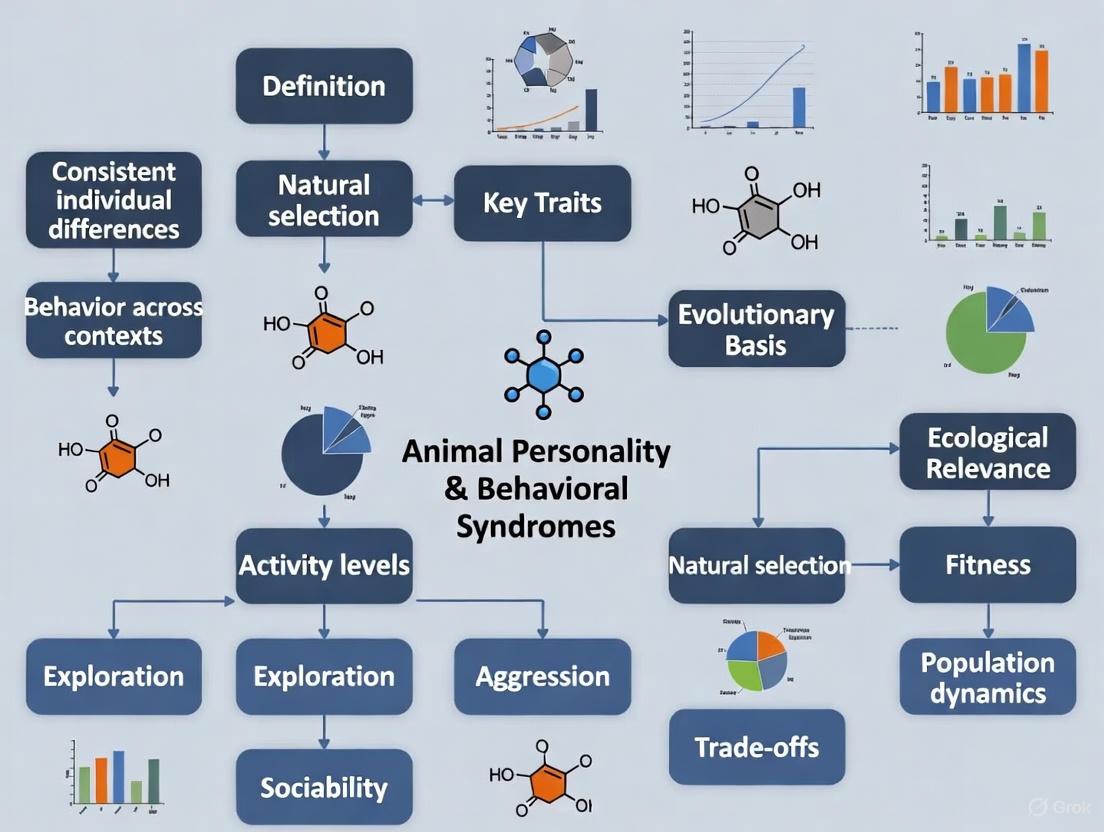
This article provides a comprehensive synthesis of the field of animal personality, defined as consistent individual differences in behavior that are stable over time and across contexts.
Animal Personality and Behavioral Syndromes: From Foundational Concepts to Biomedical Applications
Abstract
This article provides a comprehensive synthesis of the field of animal personality, defined as consistent individual differences in behavior that are stable over time and across contexts. Tailored for researchers, scientists, and drug development professionals, it explores the foundational theories of behavioral syndromes, established and emerging methodologies for personality assessment, and the critical challenges in data interpretation. It further examines the validation of personality traits and their comparative impact in diverse fields, including conservation translocations and biomedical research. By integrating ecological and evolutionary perspectives with biomedical applications, this review aims to establish animal personality as a crucial source of individual variation that can influence experimental outcomes, therapeutic efficacy, and the development of animal models for human conditions like Canine Cognitive Dysfunction Syndrome.
Defining the Consistent Individual: Core Concepts and Evolutionary Frameworks of Animal Personality
The study of animal personality represents a paradigm shift in behavioral ecology, moving beyond anthropomorphic interpretations to establish a rigorous biological construct. Animal personality is scientifically defined as behavioral and physiological differences between individuals of the same species that are stable in time and across different contexts [1]. This conceptual framework provides a foundation for understanding how consistent individual differences influence evolutionary processes, ecological dynamics, and conservation outcomes. The biological basis of personality transcends simple behavioral observations, encompassing correlated suites of traits known as behavioral syndromes—statistically related behaviors that occur across multiple contexts [2] [3]. This construct has revolutionized how researchers approach behavioral variation, shifting focus from population-level averages to meaningful individual differences that persist over time and circumstances.
The ontology of animal personality operates across three distinct levels: specific behaviors (observable actions), personality traits (consistent dispositions), and general personality (the overall behavioral phenotype) [4]. This hierarchical structure allows researchers to systematically investigate how discrete behaviors give rise to stable traits, which in turn form integrated behavioral profiles. The field has matured from initial documentation of individual differences to sophisticated investigations of proximate mechanisms, evolutionary consequences, and ecological implications, establishing animal personality as a legitimate biological phenomenon with far-reaching implications across disciplines from behavioral ecology to conservation science [1] [5].
Defining Criteria: The Operational Framework
The identification and validation of animal personality traits rest upon three formal criteria that must be satisfied simultaneously. These criteria provide the operational framework that distinguishes personality from transient behavioral states.
Individual Differences (Variation Between Individuals)
The foundation of personality research rests on demonstrable behavioral variation between individuals of the same species [4]. This variation must be consistent and measurable, representing true differences in behavioral tendencies rather than random fluctuations. Individuals occupy different positions along behavioral gradients, allowing researchers to classify them as relatively bolder, shyer, more aggressive, or more exploratory compared to conspecifics. These differences are quantified through standardized behavioral assays and statistical comparisons of response patterns across individuals.
Temporal Stability (Consistency Over Time)
For a behavior to qualify as a personality trait, it must demonstrate stability over a biologically relevant timeframe [4]. This temporal consistency distinguishes personality traits from ephemeral behavioral states induced by immediate circumstances. The required duration of stability varies by species and lifespan, but must encompass multiple behavioral observations separated by sufficient time to rule out short-term motivational states. Temporal stability is statistically quantified through measures of repeatability, which partition behavioral variance into within-individual and between-individual components.
Contextual Consistency (Stability Across Situations)
Personality traits must manifest consistently across different environmental contexts and situations [4]. An individual's behavioral tendency should be detectable regardless of specific circumstances, though expression may vary in magnitude. This cross-contextual stability reveals the underlying behavioral architecture that constrains plasticity and generates predictable responses to diverse ecological challenges. Contextual consistency is what distinguishes specialized general tendencies from context-specific adaptations.
Table 1: Formal Criteria for Identifying Animal Personality Traits
| Criterion | Definition | Measurement Approach | Statistical Validation |
|---|---|---|---|
| Individual Differences | Behavioral variation between individuals of the same species | Standardized behavioral assays across multiple individuals | Significant between-individual variance component |
| Temporal Stability | Behavioral consistency within individuals across time | Repeated measurements of same individuals over biologically relevant intervals | High repeatability estimates (intra-class correlation) |
| Contextual Consistency | Behavioral stability across different situations/environments | Testing same individuals in varied ecological contexts | Significant cross-context correlations at individual level |
Methodological Framework: Measurement and Assessment
The study of animal personality employs rigorous methodological approaches designed to quantify the three defining criteria. Two primary data collection methods dominate the field: coding and rating [4].
Behavioral Coding
Behavioral coding involves direct observation and recording of discrete, well-defined behavioral units with minimal inference [4]. Researchers establish operational definitions for specific behaviors (e.g., latency to emerge from shelter, distance maintained from predator, number of conspecifics approached) and record their frequency, duration, or intensity in standardized experimental setups. This objective approach generates quantitative data suitable for statistical analysis of individual differences and their stability. Coding requires careful experimental design to control for confounding variables and ensure behavioral measures accurately reflect the underlying traits of interest.
Behavioral Rating
Rating methods involve qualitative assessments by human observers familiar with the subjects [4]. Observers score individuals on predefined trait dimensions based on integrated knowledge of their behavioral patterns across multiple situations and time points. This approach leverages the pattern-recognition capabilities of experienced observers and can capture broad behavioral tendencies that might be missed in brief, standardized tests. However, it introduces potential observer bias and requires validation against objective behavioral measures.
Experimental Assays for Common Traits
Standardized experimental paradigms have been developed to measure specific personality traits. Boldness is frequently assessed through novel object tests, predator response assays, or emergence tests [1] [6]. Exploration is measured in novel environment tests, activity in open field trials, aggressiveness through conspecific interaction tests, and sociability via choice experiments measuring time near conspecifics versus alone [6]. These assays provide operational definitions that allow cross-species comparisons while recognizing that ecological relevance may vary across taxa.
Table 2: Standardized Methodologies for Assessing Major Personality Dimensions
| Personality Dimension | Experimental Paradigms | Primary Behavioral Measures | Ecological Context |
|---|---|---|---|
| Boldness | Novel object test, Predator simulation, Emergence test | Latency to approach, Distance to threat, Time in shelter | Risk-taking, Predator avoidance |
| Exploration | Novel environment test, Maze exploration | Area covered, Path complexity, Information gathering | Habitat exploitation, Resource finding |
| Aggressiveness | Mirror test, Resident-intruder, Resource defense | Attack latency, Threat displays, Contest duration | Territory defense, Mating competition |
| Activity | Open field test, Home cage observation | Movement rate, Distance traveled, Resting time | Energy budget, Space use |
| Sociability | Choice test, Group observation | Proximity to conspecifics, Social initiation, Contact time | Group living, Cooperation |
Behavioral Syndromes: Integrated Trait Architectures
Behavioral syndromes represent the correlated suites of behaviors that constitute the integrated phenotype, formally defined as "a suite of correlated behaviors expressed either within a given behavioral context or across different contexts" [2]. These syndromes structure individual behavioral variation into predictable patterns that constrain independent evolution of single traits and generate ecological trade-offs.
The conceptual relationship between behaviors, personality traits, and behavioral syndromes follows a hierarchical organization, visualized in the following diagram:
This architecture explains why individuals often show limited behavioral plasticity—the same underlying traits manifest across different ecological contexts, necessarily generating suboptimal behavior in some situations [2] [3]. For example, an individual that is aggressive toward conspecifics may also show boldness toward predators and novelty, creating a behavioral type that is successful in some contexts but maladaptive in others. These evolutionary trade-offs maintain variation within populations through frequency-dependent selection, where the fitness of each behavioral type depends on its prevalence in the population [1] [2].
Experimental Evidence and Conservation Applications
Animal personality research has demonstrated significant practical implications, particularly in conservation biology and translocation programs. The selection of individuals based on personality traits directly influences translocation success, with different personality profiles conferring advantages in specific ecological contexts.
Survival Outcomes by Personality Type
Substantial evidence demonstrates how personality traits influence post-release survival in conservation translocations. Boldness carries context-dependent advantages—bolder Tasmanian devils (Sarcophilus harrisii) survived 3.5 times longer after translocation, while shyer swift foxes (Vulpes velox) had higher survival rates [1]. Similarly, more exploratory Blanding's turtles (Emydoidea blandingii) showed enhanced survival, possibly through better resource location [1]. These findings highlight the importance of matching personality types to specific conservation contexts and release environments.
Table 3: Personality-Dependent Survival Outcomes in Translocation Programs
| Species | Personality Trait | Survival Outcome | Proposed Mechanism |
|---|---|---|---|
| Swift Fox (Vulpes velox) | Boldness | Bolder individuals died sooner | Increased risk-taking, predator encounters |
| Blanding's Turtle (Emydoidea blandingii) | Exploration | More exploratory survived longer | Better resource location (muskrat dens) |
| Tasmanian Devil (Sarcophilus harrisii) | Boldness | Bolder survived 3.5x longer | Context-dependent advantage in release environment |
| European Mink (Mustela lutreola) | Boldness, Exploration | Year-dependent effects | Cautious animals favored initially, then bold |
| Blue-fronted Parrot (Amazona aestiva) | Boldness | Shyer survived 40 days longer | Reduced risk-taking in novel environment |
Experimental Protocols for Personality Assessment
Standardized protocols enable consistent measurement of personality traits across species and studies. The novel environment test assesses exploration and activity by introducing individuals into unfamiliar enclosures and recording movement patterns, area covered, and latency to emerge [6]. The predator response assay measures boldness by exposing subjects to predator models or cues and quantifying approach distance, inspection time, and refuge use [1]. Social interaction tests quantify sociability and aggressiveness through controlled conspecific introductions, measuring contact time, aggressive displays, and proximity maintenance [6].
These protocols require careful standardization of testing conditions, including time of day, hunger status, previous experience, and environmental complexity. Multiple testing sessions are essential to establish temporal stability, while varied contexts are necessary to assess contextual consistency. Appropriate acclimation periods minimize novelty stress, and blind testing procedures prevent observer bias in behavioral scoring.
Research Reagent Solutions: Essential Methodological Tools
The experimental investigation of animal personality requires specialized methodological tools and approaches that serve as "research reagents" for standardizing measurements across studies and species.
Table 4: Essential Methodological Tools for Animal Personality Research
| Research Tool | Function | Application Examples |
|---|---|---|
| Standardized Behavioral Coding Systems | Quantitative measurement of specific behaviors | Operational definitions of boldness, exploration, aggression |
| Experimental Arenas | Controlled environments for behavioral testing | Open-field tests, novel object setups, maze designs |
| Predator Simulation Apparatus | Standardized threat presentation | Predator models, alarm cue delivery systems |
| Automated Tracking Software | Objective movement and interaction quantification | Video analysis, path tracking, proximity measurement |
| Statistical Repeatability Analysis | Quantifying temporal stability | Mixed models partitioning within/between individual variance |
| Cross-context Test Batteries | Assessing behavioral syndromes | Multiple assays measuring different traits in same individuals |
Future Directions: Expanding the Trait Horizon
While much research has focused on the "Big Five" traits (boldness, exploration, activity, aggressiveness, and sociability), there is growing recognition that this limited framework constrains understanding of animal personality [6]. Many species exhibit consistent individual differences in other ecologically relevant behaviors, including maternal care styles, mating tactics, cognitive biases, and communication patterns [6]. Future research should broaden the trait spectrum to include these understudied dimensions, particularly those most consequential for specific species' ecologies.
The integration of psychological and biological approaches represents another promising frontier [5]. After initial cross-disciplinary fertilization, animal personality research developed largely independently from human personality psychology, with parallel methodological and conceptual advances. Strategic reintegration could leverage complementary strengths, with biology contributing evolutionary theory and field methodologies, and psychology offering sophisticated assessment tools and structural models [5]. This collaboration is particularly relevant for pharmaceutical development, where animal models of personality could predict individual differences in drug responses and treatment efficacy.
Advanced statistical approaches, including multilevel structural equation modeling, Bayesian mixed effects models, and dynamic network analysis, offer powerful new tools for unraveling complex personality structures [5]. These methods can simultaneously capture the hierarchical organization of personality, quantify trait associations, and model personality-development pathways across lifetimes. Combined with genomic, physiological, and neurobiological approaches, these integrated frameworks promise a more comprehensive understanding of animal personality as a biological construct with profound evolutionary significance and practical applications.
Behavioral syndromes represent a foundational concept in behavioral ecology, defined as suites of correlated behaviors exhibited across different contexts or over time [7] [2]. This in-depth technical guide examines the evolutionary origins, ecological consequences, and methodological approaches for studying behavioral syndromes. Also termed "animal personality," this phenomenon reflects consistent between-individual differences in behavior, such as where some individuals are consistently more aggressive, bold, or exploratory than others, even when behavioral plasticity occurs in response to specific situations [7] [8]. Understanding these syndromes provides crucial insights into evolutionary tradeoffs, the maintenance of behavioral variation, and the fundamental connections between animal behavior, ecology, and evolution [7] [2].
The study of behavioral syndromes challenges historical assumptions that animal behavior is infinitely flexible and purely situation-dependent [8]. Research has demonstrated that individuals from the same species or population often maintain consistent behavioral differences, meaning some individuals are consistently more aggressive, more explorative, or shyer than others throughout their lives and across different situations [8]. These behavioral correlations generate important evolutionary tradeoffs; for instance, an aggressive genotype might succeed in competitive situations but fail in contexts requiring caution or parental care [7] [2].
Behavioral syndromes are characterized by two key interrelated aspects: limited behavioral plasticity and behavioral correlations across situations [7]. These constraints appear common in nature, suggesting they may reflect genetic constraints, physiological mechanisms, or stable evolutionary strategies rather than imperfections in the adaptive process [7]. The study of behavioral syndromes integrates proximate and ultimate explanations for animal behavior, examining both the developmental mechanisms and evolutionary consequences of consistent individual differences [8].
Conceptual Foundations and Definitions
Core Terminology
The field of behavioral syndrome research employs specific terminology that requires precise definition:
- Behavioral Syndrome: A suite of correlated behaviors expressed either within a given behavioral context (e.g., correlations between foraging behaviors in different habitats) or across different contexts (e.g., correlations among feeding, antipredator, mating, aggressive, and dispersal behaviors) [2].
- Behavioral Correlation Across Situations: Between-individual consistency across situations that can either involve the same context in different situations (e.g., feeding activity with versus without predators) or different contexts in different situations (e.g., aggression toward conspecifics versus feeding activity with predators) [7].
- Animal Personality: Consistent individual differences in behavior that remain stable over time and across various situations [8].
- Proactive-Reactive Continuum: A common behavioral syndrome dimension where proactive individuals are typically more aggressive, active, and bold, while reactive individuals are more passive, less active, and shyer [7].
Classifying Behavioral Syndromes
Behavioral syndromes can be categorized based on their breadth and the specific behaviors they connect:
- Domain-Specific Syndromes: Correlations occur within a single behavioral domain, such as within mating behaviors where aggression toward males and females might be correlated [7].
- Broad Cross-Domain Syndromes: Correlations extend across multiple behavioral contexts, potentially linking feeding, mating, contest, antipredator, parental care, and dispersal behaviors [7].
- Contextual Syndromes: The same behaviors may correlate differently across populations or species depending on ecological factors. For example, activity and boldness might correlate positively in high-predation environments but not in low-predation environments [7].
Table 1: Common Types of Behavioral Syndromes and Their Ecological Significance
| Syndrome Type | Behavioral Correlations | Ecological Context | Evolutionary Tradeoffs |
|---|---|---|---|
| Aggression Syndrome | Aggression in mating, competition, and predator inspection contexts [7] | Social and competitive environments | Benefits in competition versus costs of inappropriate aggression [7] [2] |
| Exploration-Avoidance Syndrome | Correlated exploration of novel environments, objects, and food sources [8] | Novel environments and changing habitats | Finding new resources versus predation risk and energy expenditure [7] |
| Activity Syndrome | Feeding activity correlated across different risk levels [7] | Predator-prey interactions | Higher feeding rates versus increased predation risk [7] |
| Boldness-Shyness Continuum | Boldness toward predators, novel objects, and novel food sources [2] | Environments with varying risk and novelty | Acquisition of risky resources versus survival costs [7] |
Evolutionary Framework and Ecological Implications
Evolutionary Origins and Maintenance
Behavioral syndromes persist in populations despite evolutionary pressures that might theoretically decouple maladaptive correlations. Several evolutionary mechanisms explain this maintenance:
- Genetic Constraints: Pleiotropic effects or linkage disequilibrium can genetically couple behaviors, making independent evolution of behavioral traits difficult [7] [8]. For example, genes influencing aggression in one context might have pleiotropic effects on aggression in other contexts [7].
- Stable State-Dependent Strategies: Consistent individual differences can reflect alternative adaptive strategies where different behavioral types achieve similar fitness payoffs under different conditions or states [7].
- Life History Tradeoffs: Behavioral correlations often align with life history strategies, such as correlations between boldness-aggressiveness and high reproductive effort at the cost of survival, versus shyness-unaggressiveness with lower reproductive effort but higher survival [7].
- Fluctuating Selection: Environmental variation across time or space can maintain different behavioral types, with each having fitness advantages under specific conditions [8].
Table 2: Evolutionary Models Explaining Behavioral Syndromes
| Evolutionary Model | Key Mechanism | Predictions | Empirical Evidence |
|---|---|---|---|
| Genetic Constraint | Pleiotropy and genetic linkage create correlations that are difficult to break evolutionarily [7] | Behavioral correlations remain stable across environments; limited behavioral flexibility [7] | Artificial selection studies; cross-fostering experiments demonstrating heritability [8] |
| Adaptive Specialization | Individuals specialize on specific resources or niches, favoring correlated behaviors [7] | Correlation strength varies with ecological factors; fitness tradeoffs across environments [7] | Population comparisons showing different correlation patterns; fitness measurements [7] |
| State-Dependent Feedback | Internal state (size, condition, metabolism) drives consistent behavior [7] | Behavioral consistency linked to individual state; state changes alter behavior | Manipulation of individual condition affects behavioral type [7] |
Ecological Consequences
Behavioral syndromes have profound ecological implications because they can generate tradeoffs that limit species' abilities to cope with environmental factors and couple ecological processes in unexpected ways [7]:
- Species Distributions and Invasiveness: Species with broader behavioral syndromes or greater behavioral flexibility may be more successful invaders, as they can maintain adaptive behavior across novel environments [7]. Inflexible correlations can limit a population's ability to expand into new habitats.
- Population Dynamics: Activity syndromes that link foraging and risk-taking behaviors can directly influence birth and death rates, potentially creating feedback loops that affect population stability [7].
- Trophic Interactions: In predator-prey systems, behavioral syndromes can affect encounter rates and functional responses. For example, correlated activity levels across contexts can create a tradeoff where higher activity increases feeding rates but also increases predation risk [7].
- Speciation Processes: Behavioral correlations can contribute to reproductive isolation if different populations evolve different behavioral correlations, potentially reducing mating success between populations [7].
Research Methodologies and Experimental Protocols
Measuring and Quantifying Behavioral Syndromes
Research on behavioral syndromes requires standardized protocols for measuring consistent individual differences across contexts and time:
Standardized Behavioral Assays:
- Repeatability Assessment: Measure the same behavioral trait multiple times in the same context to establish baseline consistency (e.g., repeated novel environment tests) [8].
- Cross-Context Testing: Subject individuals to behavioral tests in different contexts (e.g., aggression tests toward conspecifics, predators, and novel objects) [7] [2].
- Temporal Stability Tests: Repeat behavioral assays after significant time intervals (days to weeks) to assess long-term consistency [8].
- Correlational Analysis: Calculate correlation coefficients between different behaviors across individuals to identify behavioral syndromes [2].
Experimental Protocol: Aggression Syndrome Characterization
- Objective: Quantify correlations between aggressive behaviors across mating, territorial, and predator inspection contexts.
- Subjects: 40+ individuals from study population to ensure adequate statistical power.
- Procedure:
- Territorial Aggression Test: Record responses to simulated intruder (mirror or conspecific model).
- Mating Context Aggression: Measure aggression toward potential mates versus competitors.
- Predator Inspection: Record boldness and aggressive displays toward predator models.
- Statistical Analysis: Calculate between-individual correlations using multivariate statistics; assess repeatability via intraclass correlation coefficients [7] [8].
Advanced Tracking and Visualization Technologies
Recent technological advances enable more precise quantification of animal behavior and head orientation, providing insights into how animals perceive and respond to their environments:
Head Orientation-Determining Systems (HODS):
- Technology: Head-mounted sensors containing tri-axial accelerometers and magnetometers record head movement and directionality [9].
- Data Collection: Sensors typically record at frequencies ≥10 Hz, capturing detailed head movement data across three axes (surge, heave, sway) [9].
- Orientation Sphere (O-Sphere) Visualization: A spherical plot representing head heading as longitude and head pitch as latitude, enabling intuitive visualization of head orientation patterns [9].
- Application: This approach helps identify behaviors and clarify which environmental areas animals prioritize ("environmental framing") by tracking head movements [9].
Head Orientation Tracking Workflow
Analytical Approaches for Social Contexts
Understanding how behavioral syndromes operate in social environments requires specialized analytical techniques:
Exponential Random Graph Models (ERGMs):
- Application: ERGMs are generative models of social network structure that treat network topology as a response variable, making them ideal for investigating how individual behaviors shape social interactions and group structure [10].
- Utility: These models help answer questions about why specific social associations occur, enabling researchers to test hypotheses about how behavioral types influence social bond formation and maintenance [10].
- Integration with Behavioral Syndromes: ERGMs can determine whether animals with similar behavioral types associate preferentially (assortative mixing) or whether certain behavioral types occupy specific social positions [10].
Behavior-Social Structure Relationship
The Scientist's Toolkit: Key Research Reagents and Methodologies
Table 3: Essential Research Tools for Behavioral Syndrome Investigations
| Research Tool | Technical Function | Application in Behavioral Syndromes |
|---|---|---|
| Tri-axial Accelerometer/Magnetometer | Measures head/body movement and orientation in 3D space [9] | Quantifies activity patterns, head orientation, and movement signatures associated with different behavioral types [9] |
| Orientation Sphere (O-Sphere) Visualization | Spherical plot representing head heading (longitude) and pitch (latitude) [9] | Visualizes environmental framing patterns and identifies characteristic head movement sequences across contexts [9] |
| Exponential Random Graph Models (ERGMs) | Statistical models for analyzing social network formation and structure [10] | Tests hypotheses about how behavioral types influence social association patterns and network position [10] |
| Standardized Behavioral Assays | Controlled experimental protocols for eliciting specific behaviors [7] [8] | Measures behavioral expression across multiple contexts to identify correlations and consistency [7] |
| Genetic Markers & Quantitative Genetics | Identifies genetic loci associated with behavioral variation [8] | Distinguishes genetic versus environmental contributions to behavioral correlations; identifies pleiotropic effects [7] [8] |
| Hormonal Assay Kits | Measures circulating or excreted hormone levels (corticosterone, testosterone) [8] | Links physiological mechanisms to behavioral type; examines endocrine correlates of syndromes [8] |
| Curcumaromin C | Curcumaromin C, MF:C29H32O4, MW:444.6 g/mol | Chemical Reagent |
| Hemiphroside B | Hemiphroside B, MF:C31H38O17, MW:682.6 g/mol | Chemical Reagent |
The study of consistent individual differences in behavior, often termed animal personality or temperament, has become a central focus in behavioral ecology and comparative psychology. These personality traits represent behavioral tendencies that vary across individuals within a population but remain consistent within individuals across time and contexts [11]. Research conducted over the past two decades has demonstrated that such consistent behavioral differences are not unique to humans but are widespread across the animal kingdom, from invertebrates to mammals [12]. This whitepaper focuses on four core personality dimensions—boldness, exploration, aggression, and sociability—that represent fundamental axes of behavioral variation in animal populations and provide a framework for understanding behavioral syndromes, which are suites of correlated behaviors that occur together across multiple contexts [13] [11].
According to the conceptual framework established by Réale et al. [12] and widely adopted in the field, these dimensions can be defined as follows: boldness represents the propensity to respond to situations that potentially threaten survival; exploration refers to the propensity to be active and collect information in novel situations; aggression describes the propensity to exhibit antagonistic behaviors toward conspecifics; and sociability reflects the propensity to interact with conspecifics [13]. These dimensions are not merely descriptive categories but represent fundamental biological phenomena with physiological underpinnings, evolutionary consequences, and significant implications for understanding individual variation in fitness-related outcomes across species [12] [11].
Table 1: Operational Definitions of Key Personality Dimensions
| Personality Dimension | Operational Definition | Behavioral Measures |
|---|---|---|
| Boldness | Response propensity to situations threatening survival | Latency to emerge from refuge, approach to predator stimuli, risk-taking in open areas |
| Exploration | Propensity to collect information in novel situations | Movement paths in novel environments, investigation of novel objects, information-gathering behaviors |
| Aggression | Propensity for antagonistic behaviors toward conspecifics | Frequency of attacks, threats, chases, or displays toward conspecifics |
| Sociability | Propensity to interact with conspecifics | Time spent near conspecifics, social investigation, affiliative behaviors |
Experimental Paradigms and Assessment Methodologies
Standardized Testing Protocols
Robust assessment of animal personality dimensions requires carefully designed experimental protocols that elicit individual differences while controlling for contextual variables. The behavioral coding approach, which involves measuring the frequency of behaviors from a well-defined ethogram, has emerged as a gold standard in the field [13]. For boldness assessment, novel environment tests combined with predator stimuli presentations have proven highly effective. For instance, in a study of naked mole-rat disperser morphs, researchers employed a Perspex tunnel system with an acclimation pod connected to two other pods (a control pod and a novel object/experimental pod) to quantify boldness responses when exposed to fresh snakeskin as a predator stimulus [13].
Exploration is typically measured through novel environment tests and novel object tests. In the tunnel system used for naked mole-rats, exploration was quantified through behaviors such as scanning (visual inspection while stationary), sniffing (nasal contact with surfaces), and the number of tunnel sections entered during testing periods [13]. Aggression assays often involve resident-intruder paradigms or mirror tests, where subjects are exposed to conspecifics or their own reflection, with aggressive acts (confrontation, biting, shoving) recorded according to standardized ethograms [13]. Sociability measures frequently employ choice tests where subjects can choose to spend time near conspecifics or in isolation, with the proportion of time spent in social proximity serving as the primary metric.
The Behavioral Syndrome Framework
Personality dimensions frequently covary, forming what researchers term behavioral syndromes or coping styles [12]. Individuals with a proactive behavioral syndrome typically exhibit heightened aggressiveness, greater exploration, and increased boldness, along with behavioral inflexibility [13]. By contrast, reactive individuals demonstrate lower aggressiveness, reduced exploration, and diminished boldness, often with greater behavioral flexibility [12]. These syndromes represent integrated suites of behavioral and physiological traits that have important implications for how individuals interact with their environment and conspecifics.
Table 2: Characteristics of Proactive and Reactive Behavioral Syndromes
| Trait Dimension | Proactive Syndrome | Reactive Syndrome |
|---|---|---|
| Boldness | High | Low |
| Exploration | High | Low |
| Aggression | High | Low |
| Sociability | Variable | Variable |
| Behavioral Flexibility | Low | High |
| Physiological Profile | Elevated sympathetic arousal, dampened HPA reactivity | Lower sympathetic arousal, elevated HPA reactivity |
Quantitative Findings and Data Synthesis
Empirical Evidence Across Taxa
Research across diverse taxa has demonstrated significant repeatability (a measure of consistent individual differences) for the four focal personality dimensions. In a comprehensive study of domestic pigs, researchers tested 101 piglets and demonstrated that behavioral tests for reward sensitivity and approach-avoidance conflicts showed high reproducibility and repeatability, with strong links to established personality dimensions [14]. Similarly, in naked mole-rat disperser morphs, behavioral tests revealed consistent individual differences in boldness and exploration across time and contexts, confirming the presence of distinct personalities in this species [13].
The correlation structure between personality dimensions reveals fascinating evolutionary patterns. For example, boldness and aggression frequently covary across species, as documented in funnel-web spiders, crabs, sticklebacks, and song sparrows [12]. However, these behavioral syndromes are not necessarily consistent across species or environments, suggesting context-dependent evolutionary pressures. For instance, exploration and boldness show positive correlations in some species and environments but not in others, demonstrating the importance of ecological context in shaping personality architecture [12].
Physiological Mechanisms and Biomarkers
A physiological profile approach has advanced our understanding of the mechanistic bases of personality dimensions, moving beyond one-to-one relationships between single behavioral traits and physiological systems to consider integrated multi-system regulation [12]. Research indicates that behavioral variance among individuals is systematically associated with neuroendocrine variance, particularly involving the hypothalamic-pituitary-adrenal (HPA) axis, sympathetic nervous system, and immune function [12].
Proactive individuals typically exhibit elevated sympathetic arousal coupled with dampened HPA axis reactivity, whereas reactive individuals show the opposite pattern with lower sympathetic reactivity and enhanced HPA responses [12]. These physiological differences align with their respective behavioral profiles, with proactive animals showing rapid but inflexible responses and reactive animals demonstrating more measured, flexible behavioral strategies. At the neural level, tendencies to approach rewards and avoid threats involve the behavioral activation system (BAS) and behavioral inhibition system (BIS), which show individual differences in sensitivity and responsivity [14].
Table 3: Physiological Correlates of Personality Dimensions
| Personality Dimension | Physiological Systems | Key Biomarkers/Pathways |
|---|---|---|
| Boldness | HPA axis, Sympathetic nervous system | Cortisol/corticosterone levels, heart rate variability, CRH receptor expression |
| Exploration | HPA axis, Mesolimbic dopamine system | Corticotropin-releasing hormone (CRH), dopamine receptor density, novelty-seeking genes |
| Aggression | Sex steroid systems, Serotonin system | Testosterone, estrogen, 5-HIAA levels, androgen receptor expression |
| Sociability | Oxytocin/vasopressin systems, Endogenous opioids | Oxytocin receptor density, vasopressin V1a receptor expression, μ-opioid activation |
The Scientist's Toolkit: Research Reagent Solutions
Essential Research Materials and Methodologies
Table 4: Essential Research Materials and Methodologies for Personality Assessment
| Research Tool Category | Specific Examples | Function/Application |
|---|---|---|
| Behavioral Coding Systems | Ethogram development, Behavioral scoring sheets | Standardized measurement of behavioral frequencies and durations |
| Novel Environment Apparatus | Open-field arenas, Perspex tunnel systems, Plus-mazes | Controlled assessment of exploration and boldness in novel settings |
| Social Interaction Tests | Resident-intruder paradigms, Social choice apparatus, Mirror tests | Quantification of aggression and sociability toward conspecifics |
| Stimulus Materials | Predator odors (e.g., fresh snakeskin), Novel objects, Conspecific stimuli | Elicitation of context-specific behavioral responses |
| Data Collection Technology | Video recording systems, Automated tracking software, RFID systems | Objective behavioral recording and analysis |
| Physiological Assays | Salivary cortisol kits, Heart rate monitors, Immune factor assays | Correlation of behavioral traits with physiological parameters |
| Gelsempervine A | Gelsempervine A, MF:C22H26N2O4, MW:382.5 g/mol | Chemical Reagent |
| Pungiolide A | Pungiolide A, MF:C30H36O7, MW:508.6 g/mol | Chemical Reagent |
Evolutionary Context and Life-History Connections
Personality dimensions have profound implications for evolutionary fitness through their connections to life-history strategies. Research has demonstrated that behavioral traits like boldness, exploration, and aggression directly affect fitness components including survival, reproductive success, and dispersal [12] [11]. These personality traits are linked to life-history productivity, defined as the generation of new biomass through growth or reproduction [11]. Empirical studies across diverse taxa have revealed positive correlations between personality traits and productivity metrics, supporting the hypothesis that consistent individual differences in personality are maintained by life-history tradeoffs [11].
The evolutionary maintenance of personality variation can be understood through tradeoffs between growth and mortality or between fecundity and mortality [11]. For instance, bolder, more aggressive individuals may achieve higher food intake rates and greater reproductive success in the short term but suffer increased predation risk or physiological costs that reduce longevity [11]. This evolutionary framework explains why multiple behavioral types can persist within populations—different strategies prove advantageous under varying environmental conditions or at different points in life-history trajectories.
Future Research Directions and Integrative Approaches
The field of animal personality research is currently experiencing a paradigmatic shift toward increased integration across biological and psychological perspectives [5]. Future research directions include developing more standardized designs and assessment tools to capture defined behavioral dimensions, analyzing the magnitude and dimensionality of behavioral differences within and between individuals and species, and investigating the robustness of specific genetic, environmental, and gene × environment interaction effects [5]. There is also growing recognition of the need to understand the development and stability of personality across the lifespan and the consequences of personality for social, health, and performance domains [5].
A call for papers from Personality Science highlights the urgent need for integrative approaches that bridge personality psychology and animal personality research, leveraging complementary conceptual and methodological strengths across these fields [5]. Such integration will help illuminate the species-generality versus species-specificity of personality dimensions and open new perspectives for defining what, if anything, is uniquely human about personality organization [5]. This interdisciplinary approach will be essential for advancing our understanding of the four key personality dimensions—boldness, exploration, aggression, and sociability—and their role in shaping individual differences in behavior across the animal kingdom.
In classical evolutionary theory, one might expect natural selection to inevitably drive populations toward a single, optimal behavioral phenotype. The persistent and systematic variation in animal behavior—where some individuals are consistently more aggressive, exploratory, or social than others—presents a compelling scientific puzzle. This phenomenon, termed animal personality or behavioral syndromes, refers to consistent individual differences in behavior that are stable across time and contexts [8]. The concept of the Evolutionarily Stable Strategy (ESS) provides the fundamental theoretical resolution to this puzzle, demonstrating how and why such variation can be maintained by natural selection rather than eroded by it. An ESS is a strategy that, once adopted by a population, cannot be invaded by any alternative strategy through natural selection [15] [16] [17]. This framework reveals that behavioral variation is not merely evolutionary "noise" but can represent a stable evolutionary endpoint arising from frequency-dependent selection, where the fitness of a behavioral strategy depends on the strategies employed by others in the population [17] [18].
Theoretical Foundations of the Evolutionarily Stable Strategy
Core Definition and Historical Development
The ESS concept was formally introduced by John Maynard Smith and George R. Price in 1973 to explain the evolution of ritualized animal conflict, specifically why animals often engage in relatively harmless displays rather than deadly combat [19] [18]. Their seminal work demonstrated that game theory, originally developed for human economic behavior, could be powerfully applied to evolutionary biology by treating strategies as phenotypes and payoffs as contributions to fitness [17] [18]. This approach differed fundamentally from earlier applications of game theory to evolution that viewed populations as playing against "nature," instead focusing on strategic interactions between individuals within populations [18].
An ESS must satisfy one of two mathematical conditions against any potential mutant strategy y attempting to invade a resident population employing strategy xâ [16] [17] [20]:
- E(x, x) > E(y, x), or
- If E(x, x) = E(y, x), then E(x, y) > E(y, y)
where E(a, b) represents the payoff (fitness) to strategy a when interacting with strategy b. The first condition ensures that the resident strategy performs better against itself than any mutant does against the resident. The second condition provides additional stability for cases where this initial requirement is met equally, stating that the resident must outperform the mutant in interactions with the mutant itself [17].
The Hawk-Dove Game: A Paradigm for Behavioral Evolution
The Hawk-Dove game stands as the classic illustration of ESS analysis, modeling the evolution of aggression versus pacifism in animal contests [15] [19] [17]. The game involves two strategies competing for a resource of value V with potential injury cost C:
- Hawk: Always escalate fights until injured or until the opponent retreats
- Dove: Display but retreat immediately if the opponent escalates
Table 1: Payoff Matrix for the Hawk-Dove Game
| Focal Player Strategy | Opponent: Hawk | Opponent: Dove |
|---|---|---|
| Hawk | (V-C)/2 | V |
| Dove | 0 | V/2 |
The ESS solution depends critically on the relationship between resource value and conflict cost:
- When V > C, the Hawk strategy is a pure ESS because it provides higher payoffs regardless of opponent strategy [15]
- When V < C (the biologically common scenario), neither pure strategy is stable alone. Instead, a mixed ESS emerges at a frequency of V/C Hawks and 1 - V/C Doves [19] [17]
This mixed ESS represents a stable polymorphism where both behavioral types coexist indefinitely, providing a fundamental explanation for why populations maintain both aggressive and non-aggressive behavioral phenotypes [15] [17]. The diagram below illustrates the logical structure and outcomes of the Hawk-Dove game.
Integrating ESS Theory with Animal Personality Research
From Strategic Polymorphisms to Behavioral Syndromes
ESS theory provides the evolutionary rationale for maintaining behavioral variation, while animal personality research documents the empirical manifestations of this variation [8]. The mixed ESS in the Hawk-Dove game directly corresponds to what behavioral ecologists observe as the "boldness-shyness" continuum in natural populations, where individuals consistently differ in risk-taking propensity across situations and throughout their lifetimes [8]. These consistent behavioral differences often form behavioral syndromes—correlated suites of behaviors across multiple contexts—that represent alternative evolutionary strategies maintained by frequency-dependent selection [8].
Recent research has established strong connections between these behavioral tendencies and underlying neurobiological systems. The Reinforcement Sensitivity Theory proposes three core motivational systems regulating approach-avoidance behaviors [21]:
- Behavioral Activation System (BAS): Reward-driven approach behavior
- Fight-Flight-Freeze System (FFFS): Fear-driven avoidance behavior
- Behavioral Inhibition System (BIS): Mediates approach-avoidance conflicts
In domestic pigs, high BAS responsiveness correlates with exploratory and social behaviors, while high BIS activity correlates with behavioral inhibition in novel situations, demonstrating how fundamental motivational systems underlie personality variation and may be maintained as alternative evolutionary strategies [21].
Empirical Evidence for ESS in Behavioral Variation
Multiple lines of evidence support ESS mechanisms in maintaining animal personalities:
- Fitness consequences: Different behavioral types show equal lifetime reproductive success in stable environments, satisfying the ESS condition of equal fitness at equilibrium [8]
- Frequency-dependent selection: The fitness advantage of particular behavioral strategies changes with their frequency in the population [15] [17]
- Genetic heritability: Behavioral traits show significant heritability, confirming they are subject to evolutionary processes [8]
- Developmental stability: Individual behavioral differences persist throughout an animal's lifetime and across contexts [8]
Table 2: Evolutionary Mechanisms Maintaining Behavioral Variation
| Mechanism | ESS Basis | Empirical Evidence |
|---|---|---|
| Frequency-Dependent Selection | Fitness depends on strategy frequency in population | Hawk-Dove game polymorphisms; rock-paper-scissors dynamics in side-blotched lizards |
| State-Dependent Strategies | Individual condition affects optimal strategy | Size-dependent aggression; resource-holding potential variations |
| Spatial/Temporal Heterogeneity | Environmental variation favors different strategies | Habitat-specific optimal activity levels; seasonal food availability effects |
| Genetic Constraints | Pleiotropic effects maintain correlated behaviors | Behavioral syndromes; genetic correlations between boldness and aggression |
Methodological Framework: Experimental Protocols for ESS Research
Standardized Behavioral Assays for Personality Assessment
Research on animal personality and ESS employs standardized behavioral tests to quantify consistent individual differences. The following protocols represent established methodologies in the field [21] [8]:
Open-Field Test (OFT)
- Purpose: Measures exploration, boldness, and general activity in a novel environment
- Protocol: Place individual in a novel, empty arena for standardized duration (typically 10-15 minutes)
- Measurements: Latency to enter, distance traveled, time spent in center versus periphery, freezing behavior
- Validation: Shows high repeatability and heritability in multiple species
Novel Object Test (NOT)
- Purpose: Assesses neophobia and curiosity toward unfamiliar stimuli
- Protocol: Introduce a novel object into the arena after habituation period
- Measurements: Latency to approach, time spent investigating, number of contacts
- Personality Dimensions: Boldness, exploration, neophobia
Human Approach Test (HAT)
- Purpose: Quantifies reactions to potential predators/humans
- Protocol: Experimenter enters arena or approaches test subject systematically
- Measurements: Minimum approach distance, flight initiation distance, investigative behavior
- Applications: Widely used in conservation and wildlife management
Novel Peer Test (NPT)
- Purpose: Measures sociability and reaction to unfamiliar conspecifics
- Protocol: Introduce unfamiliar individual (or model) into testing arena
- Measurements: Social investigation, aggressive displays, proximity maintenance
- Validation: Correlates with BAS sensitivity in pigs [21]
The BIBAGO Test: Quantifying Approach-Avoidance Conflicts
A recently developed methodology specifically targets the neurobiological systems underlying personality variation. The BIBAGO test (BIS/BAS, Goursot) simultaneously presents positive (treat ball) and negative (moving plastic bag) stimuli to activate BAS, FFFS, and BIS systems separately [21]. This protocol provides:
- BAS Measurement: Interactions with reward, chewing sounds, number of rewards eaten
- FFFS Measurement: Freezing behavior, retreat to safe areas
- BIS Measurement: Interruption of vocalizations, approach-avoidance conflict behaviors
The BIBAGO demonstrates high repeatability and correlates with established personality dimensions, offering a direct experimental bridge between evolutionary game theory and neurobehavioral mechanisms maintaining behavioral variation [21].
Table 3: Key Research Reagent Solutions for ESS and Animal Personality Research
| Research Tool | Function/Application | Specific Examples |
|---|---|---|
| Automated Tracking Systems | Quantify movement patterns, activity budgets, and social interactions | EthoVision, ANY-maze, BioObserver for OFT and NOT |
| Behavioral Coding Software | Systematic analysis of video-recorded behavioral sequences | BORIS, Observer XT for structured ethograms |
| Genetic Analysis Tools | Identify heritability and genetic architecture of behavioral traits | SNP arrays, RAD sequencing, pedigree analysis |
| Hormonal Assay Kits | Measure corticosteroid and androgen levels as physiological correlates | CORT ELISA, testosterone RIA for stress and aggression |
| Neurobiological Markers | Localize neural activity in BAS/FFFS/BIS circuits | c-Fos immunohistochemistry, immediate early gene expression |
| Game Theory Modeling Software | Simulate evolutionary dynamics and ESS conditions | MATLAB, R with games and deSolve packages |
Advanced Concepts: Expanding the ESS Framework
The Iterated Prisoner's Dilemma and Cooperation
Beyond the Hawk-Dove game, the Iterated Prisoner's Dilemma provides crucial insights into how cooperative behaviors can persist as evolutionary stable strategies. While single encounters favor defection, repeated interactions enable reciprocal altruism to evolve [15]. The "tit for tat" strategy—begin with cooperation, then mirror the opponent's previous move—emerges as a robust ESS when the probability of future encounters is sufficiently high [15]. This evolutionary framework explains the persistence of cooperative and altruistic behaviors that initially appear contradictory to "survival of the fittest" [15].
Complex Evolutionary Games and Behavioral Diversity
Natural systems often involve more complex strategic interactions than simple two-strategy games [15] [19]:
- War of Attrition: Models contests where persistence time determines success, leading to mixed ESS with random persistence times
- Bourgeois Strategy: Uses asymmetries (like prior ownership) to resolve conflicts without fighting
- Rock-Paper-Scissors Dynamics: Creates cyclic frequency-dependent selection, as observed in Escherichia coli colicin polymorphisms and side-blotched lizard mating strategies [22]
These complex games demonstrate how multiple behavioral strategies can coexist indefinitely through negative frequency-dependent selection, providing a comprehensive evolutionary explanation for the remarkable behavioral diversity observed in natural populations [15] [22].
The concept of the Evolutionarily Stable Strategy provides a powerful mathematical foundation for understanding why behavioral variation persists in natural populations. By demonstrating how frequency-dependent selection can maintain multiple behavioral phenotypes indefinitely, ESS theory resolves the apparent paradox of consistent individual differences in behavior. The integration of ESS models with empirical research on animal personalities has created a robust framework that connects evolutionary dynamics, neurobiological mechanisms, and ecological consequences.
Future research directions include:
- Linking specific genetic polymorphisms to ESS-maintained behavioral strategies
- Exploring how environmental change shifts ESS equilibria and behavioral distributions
- Integrating ESS theory with complex neurogenetic architectures underlying behavior
- Applying ESS concepts to conservation challenges involving behavioral diversity
This evolutionary perspective reveals that behavioral variation is not transitional but represents stable evolutionary endpoints, with profound implications for understanding individual differences, species interactions, and biodiversity conservation in changing environments.
In evolutionary biology, the fitness landscape is a powerful metaphor for visualizing the relationship between genotypes, phenotypes, and reproductive success [23]. This model, first introduced by Sewall Wright in 1932, conceptualizes fitness as height, with genotypes that are similar being "close" to one another in the landscape [23]. Populations evolving under natural selection typically climb uphill in this landscape through a series of small genetic changes until they reach a local optimum [23].
The concept of animal personality—consistent individual differences in behavior across time and contexts—adds a crucial layer of complexity to this evolutionary framework [8]. When individuals within a species or population consistently differ in their behavior (e.g., some are consistently more aggressive, explorative, or shy than others), this phenomenon, also termed a behavioural syndrome, must be subject to evolutionary processes, as it has been shown to be heritable and to entail fitness consequences [8].
This article explores the intersection of these two concepts, examining how the adaptive value of specific personality traits is not absolute but is profoundly shaped by the multifaceted environmental, social, and temporal context—the fitness landscape itself.
Theoretical Framework: Fitness Landscapes and Seascapes
Types of Fitness Landscapes
Fitness landscapes can be characterized in three primary ways, differentiated by what the dimensions of the landscape represent [23]:
- Genotype to Fitness Landscapes: Wright visualized genotype space as a hypercube, where a network of genotypes are connected via mutational paths without continuous genotype dimensions [23]. Stuart Kauffman's NK model falls into this category [23].
- Allele Frequency to Fitness Landscapes: In Wright's mathematical work, each dimension describes an allele frequency at a different gene, ranging from 0 to 1 [23].
- Phenotype to Fitness Landscapes: Here, each dimension represents a different phenotypic trait, which under the assumptions of quantitative genetics, can be mapped onto genotypes [23].
From Static Landscapes to Dynamic Seascapes
A critical extension of the classic fitness landscape model is the fitness seascape, which allows the adaptive topography to shift through time or across changing environments [23]. Rather than a fixed topography, seascapes describe adaptive surfaces whose peaks and valleys change dynamically, which is necessary to accurately predict adaptation under time-varying selective conditions [23].
Factors that cause time-varying fitness landscapes/seascapes include [23]:
- Environmental change
- Drug exposure and cycling
- Immune surveillance
- Evolving host environments
- Red Queen effects, where interactions between two species dynamically affect each one's fitness landscape
Table: Key Characteristics of Fitness Landscapes vs. Seascapes
| Characteristic | Fitness Landscape | Fitness Seascape |
|---|---|---|
| Temporal Dynamics | Static | Dynamic, time-varying |
| Adaptive Peaks | Stable position | Shifting position |
| Selection Pressures | Constant | Fluctuating |
| Evolutionary Trajectories | Predictable toward stable optima | More complex, may track moving peaks |
| Primary Model Use | Understanding basic evolutionary principles | Modeling real-world, changing environments |
Animal Personality in Evolutionary Context
Defining Animal Personality and Behavioral Syndromes
Behaviors are considered among the most flexible traits in animals, yet individuals within the same species or populations often consistently differ in their behavior—some individuals are consistently more aggressive, more explorative, or shyer than others [8]. This phenomenon of consistent individual behavioral differences has been termed 'animal personality' or a 'behavioural syndrome' [8].
Research has demonstrated that animal personality is heritable and entails fitness consequences, demonstrating that it is subject to evolutionary processes [8]. Furthermore, as consistent individual differences in behavior can result from developmental processes, research on animal personality integrates proximate and functional questions about animal behavior [8].
The Evolutionary Puzzle of Animal Personality
The existence of animal personality presents three fundamental evolutionary questions [8]:
- Why are individuals consistent in their behavior?
- Why do individual differences in behavior exist?
- Why are behavioral traits sometimes correlated with each other?
Several evolutionary concepts have been proposed to explain these phenomena, including life-history trade-offs, frequency-dependent selection, and spatial/temporal variation in selection pressures [8].
Context-Dependent Selection on Personality Traits
Ecological Contexts
The adaptive value of personality traits varies dramatically across different ecological contexts. A trait that enhances fitness in one environmental setting may reduce it in another.
Table: Fitness Outcomes of Personality Traits Across Ecological Contexts
| Personality Trait | High-Fitness Context | Low-Fitness Context | Empirical Example |
|---|---|---|---|
| High Aggression | High resource competition, stable territories | High predation risk, social species | Sticklebacks under predation pressure [8] |
| Boldness/Exploration | Novel environments, low predation | High predation, familiar environments | Great tits in fluctuating environments [8] |
| Sociability | Cooperative breeding, group defense | Solitary species, resource scarcity | Cooperative cichlid fish [8] |
| Neophobia | Stable, familiar environments | Changing environments, new resources | Multiple bird and fish species [8] |
Social and Frequency-Dependent Selection
The fitness landscape for personality traits is also shaped by social context and the distribution of traits within a population. Frequency-dependent selection occurs when the fitness of a behavioral phenotype depends on its frequency relative to other phenotypes in the population.
- In three-spined sticklebacks, Bell and Sih demonstrated that exposure to predation generates personality,
- Research on great tits has shown that pairs of extreme avian personalities have highest reproductive success [8],
- Theoretical models suggest that consistent individual differences can result from strategic niche specialization [8].
Methodological Approaches and Experimental Protocols
Quantifying Animal Personality
Standardized protocols for measuring animal personality typically involve:
- Repeated Behavioral Assays: Individuals are tested multiple times in standardized contexts to measure consistency.
- Multiple Context Testing: The same individuals are observed across different situations (e.g., novel environment, predator exposure, social interaction).
- Statistical Analysis of Repeatability: Calculation of behavioral repeatability using intraclass correlation coefficients.
Measuring Fitness Consequences
Research protocols for linking personality to fitness include:
- Longitudinal Studies: Tracking individuals throughout their lifetimes to measure reproductive success and survival.
- Experimental Manipulations: Altering environmental conditions to measure how fitness landscapes shift.
- Cross-Population Comparisons: Comparing selection gradients across different populations occupying different ecological contexts.
Table: Essential Research Tools for Animal Personality Studies
| Research Tool Category | Specific Examples | Primary Function |
|---|---|---|
| Behavioral Tracking | Automated video tracking systems, RFID technology, GPS loggers | Quantify movement, exploration, and social interactions |
| Physiological Measures | Cortticosterone/cortisol assays, heart rate monitors, metabolic chambers | Measure stress response, energy expenditure |
| Genetic Analysis | SNP genotyping, pedigree analysis, gene expression profiling | Determine heritability, identify genetic correlates |
| Environmental Monitoring | Temperature loggers, food availability measures, predator density counts | Characterize environmental context |
| Statistical Tools | Mixed-effects models, structural equation modeling, multivariate analysis | Analyze behavioral consistency and fitness consequences |
Experimental Evolution Approaches
Advanced methodologies include:
- Artificial Selection Lines: Selectively breeding for specific personality traits to study evolutionary responses.
- Transplant Experiments: Introducing individuals with known personalities into new environments to measure fitness consequences.
- Resource Manipulation: Experimentally altering resource availability to study how this shifts the fitness landscape.
Research Reagent Solutions and Essential Materials
Table: Key Research Reagents and Materials for Animal Personality Research
| Item | Function | Application Example |
|---|---|---|
| Automated Behavioral Arenas | Standardized testing environments with controlled stimuli | Novel environment tests, open field assays |
| Biotelemetry Systems | Remote monitoring of physiology and movement | Heart rate monitoring during stressful events |
| Hormone Assay Kits (CORT, Testosterone) | Quantifying endocrine correlates of personality | Stress response profiling |
| Genetic Sequencing Kits | Genotyping and expression analysis | Identifying genetic bases of behavioral syndromes |
| Predator Stimuli | Standardized predator models or odors | Measuring anti-predator responses and boldness |
| Video Tracking Software (e.g., EthoVision) | Automated behavior quantification | Analysis of movement patterns and social interactions |
Conceptual Diagram: Personality in a Dynamic Fitness Seascape
Diagram 1: Contextual Influences on Personality Fitness. This model illustrates how multiple contextual factors shape the expression and fitness consequences of personality traits within a dynamic fitness seascape, creating feedback loops that drive evolutionary change.
The fitness landscape framework provides powerful conceptual tools for understanding how context shapes the value of personality traits. Rather than being fixed attributes with constant fitness values, personality traits exist within dynamic fitness seascapes where their adaptive significance shifts with ecological, social, and temporal variables. This perspective helps explain the maintenance of individual differences in behavior within populations and highlights the importance of environmental heterogeneity in shaping evolutionary trajectories.
Future research in animal personality should increasingly incorporate the dynamic nature of fitness seascapes, particularly in the context of rapid environmental change caused by human activities. Understanding how fitness landscapes are shifting will be crucial for predicting evolutionary responses and for conservation efforts aimed at preserving behavioral diversity in natural populations.
Measuring the Unseen: Innovative Methods and Translational Applications of Personality Assessment
The study of animal personality and behavioral syndromes requires robust, reproducible, and standardized methodological approaches. Behavioral assays provide the foundational tools for quantifying consistent individual differences in behavior across time and contexts, enabling researchers to explore the neural, genetic, and environmental underpinnings of personality [21]. In both human and non-human animal research, personality describes these consistent individual differences, with traits such as exploration, boldness, and sociability providing a framework for understanding individual variation in coping strategies, stress responses, and vulnerability to psychopathology [21].
The reinforcement sensitivity theory of personality offers a neurobiological framework for understanding these individual differences, proposing three core motivational systems: the behavioral activation system (BAS) governing reward-driven approach; the fight-flight-freeze system (FFFS) mediating fear-driven avoidance; and the behavioral inhibition system (BIS) resolving approach-avoidance conflicts [21]. Standardized behavioral assays, including the open field test and novel object reactions, operationalize these constructs by presenting animals with standardized environmental challenges, allowing researchers to quantify behaviors along these fundamental dimensions. This article provides a comprehensive technical guide to the primary behavioral assays used in animal personality research, with detailed methodologies, data interpretation frameworks, and integration strategies for comprehensive behavioral phenotyping.
Core Behavioral Paradigms: Methodologies and Applications
Open Field Test (OFT)
The Open Field Test is a widely used assessment that evaluates locomotor activity, anxiety-like behavior, and general exploratory tendencies in a novel environment [24] [21].
Basic Protocol [24]:
- Equipment: A square, open arena (size appropriate to species), controlled lighting (typically 50-100 lux in center), video camera with tracking software (e.g., EthoVision XT, Any-maze), sound-attenuating room, cleaning supplies (70% ethanol).
- Procedure: The animal is placed in the center (or near the wall, depending on the specific protocol) of the empty arena and allowed to explore freely for a predetermined session (typically 10-30 minutes). The session is recorded for subsequent automated or manual analysis.
- Key Measurements:
- Activity Level: Total distance traveled, average velocity, rearing frequency.
- Anxiety-like Behavior: Time spent in the center zone vs. periphery, number of entries to the center zone, latency to enter center.
- Exploratory Behavior: Qualitative analysis of specific exploratory acts (e.g., sniffing, rearing against the wall) [25].
- Special Considerations for Lupus Models: Mouse models of neuropsychiatric disease such as NPSLE may exhibit heightened stress sensitivity, motor impairments, or light sensitivity. Proper habituation to handling and test room, consistent timing of tests, and consideration of test order in a battery are crucial to minimize confounding effects [24].
Novel Object Recognition (NOR) and Novel Object Tests
These tests assess learning, memory, and exploratory behavior (neophilia/neophobia) by leveraging the natural tendency of rodents to investigate a novel object over a familiar one [24].
Basic Protocol [24]:
- Equipment: The same open field arena, two identical objects in the familiarization phase, one familiar and one novel object in the test phase. Objects should be of similar size but different shapes, made of non-porous, easy-to-clean materials.
- Procedure:
- Habituation: The animal is allowed to explore the empty arena.
- Familiarization: Two identical objects (A1 and A2) are placed in the arena, and the animal is given a session to explore them.
- Retention Delay: The animal is removed from the arena for a delay period (short-term: minutes-hours; long-term: 24 hours).
- Test Session: One familiar object (A) is replaced with a novel object (B). The animal is returned to the arena, and exploration of both objects is recorded.
- Key Measurements: Discrimination index [(Time with Novel - Time with Familiar) / Total exploration time], total exploration time, and recognition index (Time with Novel / Total exploration time). Automated analysis using machine learning and image processing is increasingly used for high-throughput and objective scoring [26].
- Interpretation: A significant preference for the novel object indicates successful encoding and retention of the familiar object, reflecting intact recognition memory.
Anxiety and Conflict-Based Assays
These tests measure anxiety-related behavior by creating a conflict between the innate exploratory drive and the aversion to potentially dangerous areas.
Elevated Plus Maze (EPM) [24]:
- Equipment: A plus-shaped maze elevated from the floor with two open arms (without walls) and two enclosed arms (with high walls).
- Procedure: The animal is placed in the central square facing an open arm and allowed to explore for 5-10 minutes.
- Key Measurements: Percentage of time spent in open arms, number of open arm entries, total arm entries (as a measure of general activity).
Dark-Light Box (DLB) [24]:
- Equipment: A two-chambered box, one dark and enclosed, the other brightly lit and open, connected by a small opening.
- Procedure: The animal is placed in the light compartment, and its behavior is recorded for 5-10 minutes.
- Key Measurements: Latency to enter the dark compartment, time spent in the light compartment, number of transitions between compartments.
BIBAGO Test [21]: This newer test is specifically designed to measure the BIS/BAS motivational systems by presenting simultaneous positive (e.g., a treat ball) and negative (e.g., a moving plastic bag) stimuli.
- Key Measurements: BAS-related: Interactions with the reward, number of rewards eaten. BIS/FFFS-related: Freezing behavior, interruption of vocalizations upon stimulus presentation, time spent in conflict zones.
Tests for Depression-like Behavior
These tests measure behavioral despair or passive coping strategies in inescapable stress situations.
Tail Suspension Test (TST) [24]:
- Procedure: A mouse is suspended by its tail for 6 minutes using adhesive tape.
- Key Measurements: Total immobility time, latency to first immobility.
Porsolt Swim Test (Forced Swim Test) [24]:
- Procedure: A rodent is placed in a water-filled cylinder from which it cannot escape for 6 minutes.
- Key Measurements: Total immobility time (time when the animal makes only movements necessary to keep its head above water), latency to immobility.
Spatial Learning and Memory
Barnes Maze [24]:
- Equipment: A circular platform with multiple holes around its perimeter, one of which leads to an escape box.
- Procedure: The animal is motivated to find the escape box using distal spatial cues over several training days, followed by a probe trial with the escape box removed.
- Key Measurements: Latency to find the target hole, number of errors (investigating incorrect holes), path efficiency, and search strategy during the probe trial.
Table 1: Key Behavioral Domains and Corresponding Assays
| Behavioral Domain | Primary Assays | Core Measured Parameters | Linked Motivational System/Personality Trait |
|---|---|---|---|
| General Activity & Exploration | Open Field Test [24] [25] | Distance traveled, Rearing, Arena exploration [21] | Activity, Proactivity, Exploration/Boldness [21] |
| Anxiety-like Behavior | Open Field Test, Elevated Plus Maze, Dark-Light Box [24] | Time in center/open arms/light side, Latency to transition | Behavioral Inhibition System (BIS) [21], Neuroticism |
| Approach-Avoidance Conflict | BIBAGO Test [21] | Freezing, Reward interaction during conflict, Interruption of vocalizations | Behavioral Inhibition System (BIS) [21] |
| Reward Sensitivity | BIBAGO Test [21] | Rewards eaten, Interactions with reward, Tail wagging | Behavioral Activation System (BAS) [21], Extraversion |
| Cognitive Function & Memory | Novel Object Recognition, Barnes Maze [24] | Discrimination Index, Latency to target, Errors | Executive function, Spatial learning |
| Depression-like Behavior | Tail Suspension Test, Porsolt Swim Test [24] | Immobility time, Latency to immobility | Passive coping, Behavioral despair |
| Sociability | Novel Peer Test [21] | Time interacting with conspecific, Proximity | Sociability (resembles human Extraversion) [21] |
The Researcher's Toolkit: Essential Materials and Reagents
Successful behavioral phenotyping requires careful selection and standardization of materials. The following table details key components of a behavioral neuroscience laboratory.
Table 2: Essential Research Reagents and Materials for Behavioral Phenotyping
| Item Name | Function/Application | Technical Specifications & Considerations |
|---|---|---|
| Behavioral Arena(s) | Provides the controlled environment for tests like OFT, NOR. | Square or circular; size-species appropriate (e.g., 40x40cm for mice); constructed of non-porous, easy-to-clean material (white plastic, methacrylate); possible integration with ceiling-mounted cameras. |
| Video Tracking System | Automated, high-fidelity recording and analysis of animal movement and position. | Includes camera (high-resolution, low-light capable) and software (e.g., EthoVision XT, Any-maze); critical for measuring path, velocity, time in zone. |
| Elevated Plus Maze | Specific apparatus for assessing anxiety-like behavior. | Two open arms (30x5cm) and two enclosed arms (30x5x15cm), elevated ~50cm; typically made from grey PVC or similar. |
| Novel Objects | Used in Novel Object Recognition test to assess memory and exploration. | Must be made of non-porous, cleanable material (glass, metal, hard plastic); shapes should be distinct and not naturally interesting; sets of identical objects required. |
| BIBAGO Apparatus | Assessing approach-avoidance conflict and reward sensitivity [21]. | A pen/arena configured with a positive stimulus (e.g., treat ball) and a negative stimulus (e.g., mechanism to move a plastic bag) [21]. |
| Barnes Maze | Apparatus for testing spatial learning and memory. | Circular platform (~1m diameter) with 20+ holes; one hole connected to an escape box; uses distal spatial cues around the room. |
| Sound-Attenuating Booth | Controls for environmental variables (noise, light, temperature). | Provides a standardized testing environment, minimizing external disturbances that can affect behavior [24]. |
| White Noise Generator | Masks sporadic external noises. | Used in the testing room to prevent startle responses from unpredictable sounds [24]. |
| Cleaning Supplies | Prevents olfactory cues between subjects. | 70% ethanol solution, paper towels; thorough cleaning of arena and objects between each animal is mandatory [24]. |
| Animal Models | Subjects for behavioral analysis. | Common strains: C57BL/6J; Disease models: MRL/lpr, NZB/W F1 for NPSLE [24]; use age- and sex-matched controls (preferably littermates). |
| Macrocarpal K | Macrocarpal K, MF:C28H40O6, MW:472.6 g/mol | Chemical Reagent |
| Detoxin D1 | Detoxin D1, MF:C28H41N3O8, MW:547.6 g/mol | Chemical Reagent |
Quantitative Analysis and Behavioral Sequencing
Moving beyond simple behavioral distributions, advanced quantitative approaches are crucial for detecting subtle behavioral alterations.
Behavioral Complexity Analysis
Mild injury or pharmacological intervention may not change the overall proportion of time spent in different behaviors but can alter the sequential structure of these behaviors. This can be quantified using measures like Lempel-Ziv complexity, which assesses the complexity of the sequence of behavioral acts [27].
- Calculation: The Lempel-Ziv complexity (CORIG) of a sequence of behaviors (e.g., A, B, C, etc.) is calculated based on the number of distinct patterns in the sequence.
- Normalization: To compare across sequences of different lengths, normalized complexity (CNORM) is used: CNORM = CORIG /
, where is the mean complexity of random, equiprobable surrogate sequences of the same length. This yields a value where ~0 is a repetitive sequence, and ~1 is a random sequence [27]. - Application: Compromised animals may exhibit more stereotypic (lower complexity) or more random (higher complexity) behavioral sequences, providing a sensitive measure of neurological impact that is not apparent from traditional analysis [27].
Experimental Workflow and Data Integration
A typical workflow for comprehensive behavioral phenotyping involves multiple tests arranged to minimize carry-over effects. The following diagram illustrates a standardized sequence and key decision points.
Standardized Behavioral Phenotyping Workflow
Data Visualization and Representation
Adhering to best practices in data visualization is critical for clear scientific communication and ensuring the accuracy and reproducibility of findings [28].
- Plot Selection: Use bar charts for comparing categorical groups (e.g., time immobile in TST between genotypes), line plots for trends over time (e.g., learning curves in Barnes Maze), scatter plots for relationships between variables (e.g., correlation between BAS scores and sociability), and box plots or violin plots to show data distributions across groups [28].
- Best Practices [28]:
- Clarity and Accuracy: Labels, titles, and units must be clear. Axes should not be truncated in a misleading way (especially bar charts, which should start at 0).
- Uncertainty Visualization: Always include error bars (e.g., standard error, confidence intervals) and specify their meaning in figure captions.
- Color Usage: Use color purposefully, opting for colorblind-friendly palettes (e.g., viridis) and ensuring plots are interpretable in grayscale.
- Reproducibility: Maintain and archive the raw data and code used to generate all visualizations.
The following diagram outlines the decision process for selecting appropriate behavioral assays based on specific research goals, facilitating the study of behavioral syndromes.
Assay Selection for Behavioral Phenotyping
Standardized behavioral assays, from the classic Open Field Test to sophisticated conflict-based paradigms like the BIBAGO, provide an indispensable toolkit for deconstructing the components of animal personality and behavioral syndromes. The reliability and translational relevance of this research hinge on meticulous attention to methodological detail, including proper handling, habituation, environmental control, and test sequencing. Furthermore, the integration of traditional behavioral scoring with advanced computational analyses—such as sequential complexity measures and automated machine learning-based tracking—offers a more nuanced and powerful approach to phenotyping. By rigorously applying these standardized protocols and analytical frameworks, researchers can effectively bridge the gap between observable behavior, underlying neurobiological systems such as BIS/BAS, and complex personality traits, ultimately advancing our understanding of individual differences in health and disease.
The study of animal personality requires methodological tools that yield valid and reliable measurements across diverse ecological contexts. Research on free-ranging dogs (Canis lupus familiaris) provides a powerful model for examining the cross-context validity of behavioral assessment methods. These animals navigate complex socio-ecological niches, interacting regularly with both humans and conspecifics while living without direct human supervision. This whitepaper synthesizes findings from recent studies that implement multi-method approaches to personality assessment in free-ranging dog populations. We demonstrate that robust validation is achievable even in challenging field conditions through the strategic integration of experimental testing and naturalistic observation. The insights generated have profound implications for behavioral syndrome research, pharmaceutical development, and the future of cross-species personality studies.
Animal personality research investigates consistent individual differences in behavior that occur across time and contexts. A significant methodological challenge in this field concerns the validation of assessment tools when applied to populations living under different ecological conditions than those in which the tools were originally developed. Free-ranging dogs represent an ideal model system for addressing this challenge due to their unique ecological position at the interface of human and natural environments. Unlike laboratory or companion animals, free-ranging dogs experience the full spectrum of human interactions—from positive provisioning to negative threats—creating a complex selective landscape that shapes their behavioral responses [29].
The concept of behavioral syndromes provides a critical theoretical framework for this investigation. Behavioral syndromes refer to suites of correlated behaviors exhibited either within or across different contexts, forming what researchers term "behavioral types" at the individual level [2]. Understanding these syndromes requires methodological approaches that can reliably capture behavioral consistencies across the varied situations an animal encounters in its natural environment. For free-ranging dogs, this might include responses to novel objects, interactions with unfamiliar humans, and encounters with conspecifics, each presenting distinct validation challenges for researchers.
Theoretical Framework: Behavioral Syndromes and Cross-Context Validity
The Behavioral Syndrome Concept
Behavioral syndromes represent correlated behavioral traits that persist across multiple situations or contexts. As formally defined by Sih et al. (2004), a behavioral syndrome exists when "behaviors are correlated across contexts, leading to limited behavioral plasticity" [2]. This concept has evolved from its origins in human psychology to become a central focus in behavioral ecology, offering an integrative bridge between genetics, neuroendocrine mechanisms, evolution, and ecology [2] [3].
The behavioral syndromes framework helps explain why animals may sometimes exhibit maladaptive behavior in specific contexts—for instance, when an generally aggressive individual inappropriately attacks a predator when fleeing would be more advantageous [2] [3]. Such limitations in behavioral flexibility arise from underlying genetic, hormonal, or cognitive mechanisms that constrain independent expression of behaviors across different contexts. From a methodological perspective, this means that assessment tools must be designed to capture behaviors across multiple domains to accurately characterize an individual's behavioral type.
Current Initiatives in Personality Research Integration
The field of animal personality research is currently experiencing a paradigm shift toward greater integration across disciplines. A forthcoming special issue in Personality Science titled "Towards an integration of personality research across psychology and biology" aims to catalyze this development by bringing together complementary conceptual and methodological strengths from both fields [5]. Similarly, the international initiative "Integrating Human and Animal Personality Research" at the University of Münster unites experts from biology, psychology, medicine, and philosophy to develop novel methodologies for assessing and analyzing personality across species [30].
These initiatives recognize that while early animal personality research was heavily influenced by personality psychology, the fields have since developed in parallel with distinct concepts and methods. The current challenge is to leverage advanced statistical approaches—including Bayesian mixed effects models, multilevel structural equation modeling, and dynamic network analyses—to better capture the complexities of multimodal personality dynamics across species and contexts [5].
Methodological Approaches: Experimental and Observational Paradigms
Experimental Designs for Field Conditions
Researchers studying free-ranging dogs have developed innovative experimental protocols that balance methodological rigor with practical feasibility in challenging field environments. These protocols typically adapt laboratory-based paradigms for implementation in natural settings while maintaining standardized procedures.
Human Referential Gesture Tasks: One prominent experimental approach investigates dogs' capacity to utilize human communicative gestures through a two-way object-choice task. In this paradigm, experimenters hide food rewards in one of two opaque containers and then provide pointing cues varying in complexity—from proximal cues (close to the container) to distal cues (further from the container) [29]. The experimental setup involves:
- Apparatus: Opaque plastic bowls (500ml volume) with cardboard covers as hiding locations [29]
- Reward: Small pieces of raw chicken (approximately 10-12g) as motivation [29]
- Procedure: Two experimenters (E1 and E2) coordinate, with E1 hiding the food while the dog observes, then providing the pointing cue, while E2 remains consistent across trials to control for individual differences [29]
- Cue Types: Dynamic proximal pointing (hand close to container), dynamic distal pointing (arm extended away from container), and momentary distal pointing (brief point) [29]
Behavioral Test Batteries: Comprehensive personality assessment often incorporates multiple tests measuring different behavioral dimensions. A typical test battery for free-ranging dogs includes:
- Exploration: Novel object tests measuring latency to approach and investigate unfamiliar items
- Human-directed sociability: Measures of approach behavior toward unfamiliar humans
- Conspecific-directed sociability: Responses to unfamiliar dogs or simulated conspecific stimuli
- Aggression: Controlled presentations of threatening or competitive scenarios (though this occurs rarely in field conditions) [31]
Naturalistic Observation Protocols
Complementary to experimental approaches, systematic observation of spontaneous behavior in natural contexts provides crucial validation data. Well-designed observational protocols include:
- Focal Animal Sampling: Following individual dogs for predetermined periods (e.g., 30-minute sessions) and recording all occurrences of predefined behaviors [31]
- Contextual Recording: Documenting environmental variables such as location (urban vs. residential), human density, presence of conspecifics, and time of day [29]
- Behavioral Coding: Using ethograms with operational definitions for behaviors including posture, vocalizations, social interactions, and maintenance activities [32]
The integration of these methodological approaches allows researchers to examine cross-context validity by comparing results obtained through different assessment modalities under varying environmental conditions.
Quantitative Findings: Validation Metrics and Cross-Method Comparisons
Agreement Between Assessment Methods
Recent research demonstrates varying levels of concordance between experimental and observational measures of personality traits in free-ranging dogs. The table below summarizes key validation findings across behavioral domains:
Table 1: Cross-Method Validity of Personality Assessments in Free-Ranging Dogs
| Behavioral Dimension | Experimental Measure | Observational Measure | Level of Agreement | Key Findings |
|---|---|---|---|---|
| Human-directed sociability | Approach latency in experimental tests | Proximity to humans in natural settings | Strong [31] | High correlation between test behavior and spontaneous interaction patterns |
| Exploration | Novel object investigation | Exploratory behavior in home range | Strong [31] | Consistent individual differences across contexts |
| Conspecific-directed sociability | Initial reaction to unfamiliar dogs | Conspecific proximity during observations | Limited [31] | Experimental measures captured only specific aspects of social behavior |
| Aggression | Response to provocative stimuli | Agonistic encounters in natural settings | Not assessed [31] | Rare occurrence prevented statistical comparison |
| Point-following ability | Success in object-choice tasks | N/A | High variability [29] | Approximately 50% of tested dogs participated; anxiety influenced participation |
Behavioral States as Moderating Variables
Beyond specific behavioral traits, researchers have identified the importance of behavioral states—particularly anxiety and fearfulness—as critical moderating variables that influence assessment outcomes. In studies of point-following ability, approximately half of free-ranging dogs tested showed reluctance to participate in experimental tasks despite successful familiarization with the setup [29]. Closer analysis revealed that anxious behavioral states, likely shaped by previous life experiences with humans, were primarily responsible for this non-participation.
This finding highlights a fundamental methodological consideration: individual differences in neophobia and human-directed anxiety may systematically exclude certain behavioral types from experimental samples, potentially biasing results and limiting generalizability. Researchers must therefore account for these moderating variables both in study design and statistical analysis to ensure valid personality assessment.
The Researcher's Toolkit: Essential Methodologies and Materials
Table 2: Essential Research Materials for Free-Ranging Dog Personality Studies
| Category | Specific Items | Function/Application | Validation Consideration |
|---|---|---|---|
| Experimental Apparatus | Opaque plastic bowls (500ml) | Food hiding in object-choice tasks | Standardized size and opacity prevent visual cues [29] |
| Cardboard pieces | Bowl covers to conceal contents | Prevents odor diffusion while allowing easy access [29] | |
| Motivational Stimuli | Raw chicken pieces (10-12g) | Food reward in cognitive tests | High-value reward maintains participation [29] |
| Data Collection Tools | Digital cameras/camcorders | Behavioral recording | Enables retrospective coding and reliability checks [31] |
| Ethogram coding sheets | Systematic behavior recording | Ensures comprehensive behavioral capture [32] | |
| Safety Equipment | Protective barriers | Researcher safety during close interactions | Minimizes stress for both dogs and researchers [29] |
| Identification Materials | Photographic documentation | Individual identification | Preresampling through coat color, scars, body size [29] |
| Corymbol | Corymbol, MF:C20H34O3, MW:322.5 g/mol | Chemical Reagent | Bench Chemicals |
| Isomaltotetraose | Isomaltotetraose, MF:C24H42O21, MW:666.6 g/mol | Chemical Reagent | Bench Chemicals |
Conceptual Framework: Visualizing Behavioral Assessment Validation
The validation of personality assessment tools across contexts involves a complex interplay between methodological approaches and behavioral dimensions. The following diagram illustrates this conceptual framework and the relationships between its components:
Behavioral Assessment Validation Framework. This diagram illustrates the conceptual structure for validating personality assessments across contexts, showing relationships between methods, contexts, traits, and validation metrics.
Implications for Research and Applications
Advancing Behavioral Syndrome Research
The methodological insights gained from free-ranging dog studies have significant implications for behavioral syndrome research more broadly. The demonstration that certain personality dimensions (e.g., exploration, human-directed sociability) show strong cross-context validity while others (e.g., conspecific-directed sociability) exhibit more context-specific expression provides crucial information about the modular organization of behavioral syndromes [31]. This suggests that behavioral correlations may be stronger within than between functional domains, with important consequences for evolutionary models of personality.
From a methodological perspective, these findings underscore the necessity of multi-method assessment approaches that sample behaviors across diverse contexts. Reliance on single-method assessments risks mischaracterizing behavioral types by failing to capture context-dependent expression. This is particularly relevant for pharmaceutical development, where precise behavioral phenotyping is essential for evaluating treatment efficacy across different environmental conditions.
Methodological Recommendations for Field Researchers
Based on the accumulated evidence from free-ranging dog studies, we propose the following methodological recommendations for researchers validating personality assessment tools across contexts:
- Implement complementary methods: Combine experimental and observational approaches to capture both capacity and typical behavior [31]
- Account for behavioral states: Measure and control for anxiety, fearfulness, and other transient states that influence test participation and performance [29]
- Sample across contexts: Assess behaviors in multiple ecological relevant settings to capture context-dependence [2]
- Consider species-typical ecology: Develop tasks that reflect natural challenges and opportunities faced by the study population [29]
- Report participation rates: Document and analyze factors influencing non-participation to identify potential sampling biases [29]
The validation of personality assessment tools across contexts remains a fundamental challenge in behavioral research. Studies of free-ranging dogs demonstrate that robust validation is achievable through the strategic integration of experimental and observational methods, even in logistically challenging field environments. The key insights emerging from this research include the varying cross-context validity of different personality dimensions, the critical moderating role of behavioral states like anxiety, and the necessity of methodological approaches that reflect species-typical ecology.
These findings advance our understanding of behavioral syndromes by revealing how behavioral correlations are maintained or disrupted across different environmental contexts. For pharmaceutical development and preclinical research, they highlight the importance of context-sensitive behavioral assessment when evaluating treatment effects. As personality research continues to integrate approaches across psychology and biology [5] [30], the methodological lessons from free-ranging dog studies will provide invaluable guidance for developing validated, ecologically relevant assessment tools across species and contexts.
Translocation, the human-mediated movement of organisms for conservation purposes, faces high rates of failure. A significant contributing factor is the disregard for consistent individual differences in behavior—animal personality. This whitepaper details how an understanding of behavioral syndromes (suites of correlated behaviors across contexts) provides a critical framework for predicting translocation outcomes. We present protocols for assessing behavioral types, synthesize quantitative data on their fitness consequences, and offer a practical toolkit for integrating animal personality into conservation translocation planning to enhance success in anthropogenically altered environments.
In behavioral ecology, a behavioral syndrome is defined as a suite of correlated behaviors expressed either within a given behavioral context or across different contexts [2]. This concept reflects between-individual consistency in behavioral type, meaning an individual's behavior in one situation (e.g., its boldness toward a predator) is correlated with its behavior in another, often functionally distinct, situation (e.g., its aggressiveness toward conspecifics) [7] [33]. These correlations can create trade-offs; for instance, a generally bold and aggressive genotype might perform well in high-competition scenarios but poorly where caution is required, potentially maintaining individual variation in behavior in a variable environment [2].
The traditional view in behavioral ecology assumed near-limitless behavioral plasticity, expecting animals to optimally adapt their behavior to every situation. The behavioral syndromes perspective, however, acknowledges that such cross-contextual correlations can constrain an individual's behavioral flexibility [7]. This constraint is highly relevant to conservation translocations, where animals are released into novel, often human-altered environments. The intrinsic stressors of translocation can be magnified by anthropogenic pressures such as invasive species, pollution, and human-wildlife conflict at the release site [34]. An individual's behavioral type can therefore predetermine its reaction to these cumulative challenges, influencing survival, reproduction, and ultimately, translocation success.
The Role of Personality in Translocation Success and Failure
Translocation success depends on an individual's ability to survive, settle, and reproduce in a novel environment. Problematic behaviors that contribute to failure, such as inappropriate antipredator responses, dispersal away from the release site (hyperdispersal), and failure to forage efficiently, are often rooted in the animal's behavioral type [34].
Behavioral Trade-offs and Anthropogenic Stressors
Behavioral syndromes can lead to maladaptive behavior in specific contexts, creating critical trade-offs in post-release environments [2].
- Boldness vs. Survival: Bold individuals may explore novel environments and find resources faster, which could be advantageous. However, in landscapes with novel predators (including humans) or roads, this same boldness can lead to higher mortality [34]. For example, prey animals released into areas with invasive, non-native predators often suffer high mortality due to naïveté and insufficient antipredator responses [34].
- Exploration and Hyperdispersal: Consistent individual differences in exploration and dispersal behavior are common. Some individuals are predisposed to disperse widely, which in a translocation context can lead to hyperdispersal, taking animals beyond the safety of the release zone and into human-dominated landscapes or areas where they cannot find mates or resources [34].
- Sociality and Group Establishment: For social species, the removal of individuals from a source population and their introduction to a new group is intensely stressful. The behavioral composition of the released group—the mix of aggressive, docile, prosocial, and asocial individuals—can dictate whether a stable, functional social group forms, which is critical for cooperation in foraging and predator defense [34].
Table 1: Behavioral Types and Their Potential Impact on Translocation Outcomes
| Behavioral Type | Potential Advantages | Potential Disadvantages |
|---|---|---|
| Bold/Exploratory | Rapid exploration of novel habitat, quicker location of resources | Increased risk from novel predators, poachers, or human-wildlife conflict; higher energy expenditure |
| Shy/Unresponsive | Lower energy expenditure, less likely to encounter novel dangers | Slower to acclimate, may fail to find essential resources (food, water, shelter) |
| Aggressive | Success in competitive interactions, territory acquisition | Elevated injury risk, high energy cost, may disrupt social cohesion of released group |
| Prosocial | Promotes group cohesion and cooperative behaviors | May be exploited by more aggressive conspecifics, potentially reducing individual resource access |
Quantitative Evidence Linking Personality to Outcomes
A growing body of research provides quantitative evidence linking pre-release behavioral type to post-release outcomes.
Table 2: Summary of Quantitative Studies on Behavioral Type and Post-Release Outcomes
| Species | Behavioral Trait Measured | Experimental Protocol | Outcome Correlation | Citation (Example) |
|---|---|---|---|---|
| Swift fox (Vulpes velox) | Boldness (latency to emerge from a novel cage, reaction to a novel object) | Captive-born foxes were tested pre-release and monitored via telemetry post-release. | Bold individuals had a higher probability of death in the early post-release period. | [34] |
| Blanding's turtle (Emydoidea blandingii) | Exploration, boldness, aggressiveness | Zoo-hatched juveniles were assessed for personality before reintroduction; survival was monitored. | Personality significantly affected post-release behavior and survival. | [34] |
| Various (Review) | Behavioral trait assessment (e.g., activity, exploration, stress response) | Meta-analysis of translocation programs assessing behavior pre-release and survival/settlement success post-release. | Behavior prior to release is a significant predictor of survival during and after translocation. | [34] |
Experimental Protocols for Assessing Behavioral Type
Selecting animals for translocation based on behavioral type requires standardized, ethologically valid tests. Below are detailed methodologies for key experiments cited in the literature.
Standardized Behavioral Assays
These protocols can be adapted for many vertebrate species, particularly mammals, birds, and reptiles, in captive or temporary holding conditions pre-release.
Protocol 1: Novel Environment Exploration (Open Field Test)
- Objective: To quantify boldness, exploration, and general activity levels.
- Materials: A standardized, enclosed arena (size scaled to species), video recording equipment, timing device, ethogram for scoring.
- Procedure:
- Acclimate the animal to the testing room for a standardized period (e.g., 60 minutes).
- Gently place the animal at a designated starting point in the arena.
- Record its activity for a set duration (e.g., 10-30 minutes).
- Key Metrics to Quantify:
- Latency to leave the start point.
- Total distance moved.
- Number of zones entered (center vs. periphery).
- Time spent mobile vs. immobile (freezing).
- Application: High exploration and center-area activity often correlate with a bold behavioral type.
Protocol 2: Novel Object Neophobia
- Objective: To assess boldness and neophobia (fear of new things).
- Materials: A novel object unfamiliar to the animal (e.g., a colored block, unique toy), the arena from Protocol 1.
- Procedure:
- Allow the animal to habituate to the empty arena for a short period (e.g., 5 minutes).
- Introduce the novel object to the center of the arena in a way that does not disturb the animal.
- Record the animal's behavior for a set duration (e.g., 15 minutes).
- Key Metrics to Quantify:
- Latency to approach within a defined distance (e.g., one body length).
- Total time spent investigating the object.
- Number of contacts with the object.
- Application: Shorter latencies and longer investigation times indicate bolder, less neophobic individuals.
Protocol 3: Simulated Predator or Threat Response
- Objective: To quantify antipredator behavior and risk-taking.
- Materials: A model predator (e.g., model bird of prey, stuffed predator), or a controlled conspecific threat signal (e.g., recorded alarm call).
- Procedure:
- The animal is engaged in a motivated behavior, such as feeding from a central food patch.
- The threat is presented in a standardized way (e.g., flying the model overhead, playing the alarm call).
- Record the animal's behavior.
- Key Metrics to Quantify:
- Latency to resume feeding after the threat.
- Duration of vigilant postures (e.g., standing upright, looking around).
- Total time spent hiding in a refuge, if available.
- Application: Shorter return latencies indicate greater risk-taking and boldness.
Data Analysis and Behavioral Syndrome Identification
To identify behavioral syndromes, data from multiple tests must be analyzed for correlations.
- Calculate Individual Means: For each animal and each test metric, calculate a mean score across replicates to establish its behavioral type for that trait.
- Between-Individual Correlations: Use statistical analyses (e.g., Pearson or Spearman correlations, principal component analysis) across the study population to determine if behaviors are correlated. For example, is the latency to approach a novel object correlated with the latency to resume feeding after a threat? A positive correlation would indicate a boldness-aggression syndrome [33].
- Selection Index: Based on the target environment, create a selection index that weights different behavioral types. For a release site with high human activity or novel predators, the index might favor more cautious, neophobic individuals.
The Scientist's Toolkit: Research Reagent Solutions
This table details essential materials and tools for implementing the behavioral assessment protocols.
Table 3: Key Research Reagents and Materials for Behavioral Assessment
| Item/Category | Function/Application | Specific Examples & Notes |
|---|---|---|
| Standardized Test Arenas | Provides a controlled, neutral environment for conducting behavioral assays. | Open-field arenas, Y- or T-mazes. Must be scalable to species size and easily sanitized between subjects. |
| Video Recording System | Allows for accurate, unbiased recording of behavior for later detailed analysis (scoring). | High-definition cameras with wide-angle lenses; infrared-capable cameras for nocturnal species. |
| Ethogram Software | Enables systematic scoring of defined behaviors from video recordings. | Commercial (e.g., Noldus Observer XT, BORIS) or open-source options. Critical for ensuring inter-observer reliability. |
| Novel Objects | Standardized stimuli to assess neophobia and exploration. | Objects must be truly novel, safe, and cleanable (e.g., Lego constructions, colored PVC fittings). A library of different objects prevents habituation in repeated testing. |
| Predator/Threat Simulators | To elicit and quantify antipredator behavior in a controlled manner. | Model predators (e.g., hawk, fox), playback systems for alarm calls or predator vocalizations. |
| Passive Integrated Transponder (PIT) Tags & Readers | For automated identification and tracking of individuals in larger enclosures or mesocosms, providing high-resolution data on movement and space use. | Integrated with systems like EthoVision (Noldus) for automated tracking of activity, proximity, and social interactions. |
| Physiological Sampling Kits | To link behavioral type with underlying physiological mechanisms (e.g., stress response). | Kits for non-invasive hormone (e.g., cortisol/corticosterone) sampling from feces, urine, or saliva. |
| Isohopeaphenol | Isohopeaphenol, MF:C56H42O12, MW:906.9 g/mol | Chemical Reagent |
| Saponin CP6 | Saponin CP6, MF:C46H74O16, MW:883.1 g/mol | Chemical Reagent |
Decision Framework and Visualization for Translocation Selection
Integrating behavioral assessment into translocation programs requires a logical workflow. The diagram below outlines a structured process from initial assessment to post-release monitoring.
Behavioral-Based Translocation Selection Workflow
The logical relationships between an individual's behavioral type, the release environment, and the resulting ecological interactions can be conceptualized as a feedback loop, as shown below.
Behavioral Syndrome Feedback Loop
Integrating the concept of behavioral syndromes into conservation translocation represents a paradigm shift from treating all individuals as behaviorally equivalent to acknowledging that pre-existing, consistent behavioral differences are key predictors of post-release success. By employing standardized behavioral assays, classifying behavioral types, and strategically matching these types to release site characteristics, conservation managers can make more informed, evidence-based decisions.
Future research must focus on:
- Expanding Protocols: Developing and validating behavioral assays for a wider range of understudied taxa (e.g., amphibians, invertebrates).
- Long-Term Studies: Tracking translocated cohorts over multiple generations to understand how behavioral types and syndromes evolve in new environments.
- Genomic Integration: Investigating the genetic basis of behavioral syndromes relevant to conservation to inform captive breeding programs.
- Advanced Conditioning: Refining pre-release training protocols (e.g., predator-awareness training) tailored to different behavioral types to enhance learning and survival.
The tools and framework presented here provide a foundation for a more sophisticated, predictive, and successful application of animal behavior science to the urgent task of conserving biodiversity.
The study of animal personality—defined as consistent individual differences in behavior across time and contexts—has evolved from a biological curiosity to a critical frontier in conservation science [35]. When these behavioral traits form a correlated suite, they are termed behavioral syndromes [2] [3]. This technical guide establishes the theoretical and empirical framework for leveraging these concepts as practical biomarkers to enhance wildlife management and captive breeding outcomes. The paradigm shift involves moving beyond population-level approaches to recognize that individual behavioral variation drives differential survival, reproduction, and adaptation responses [36]. Such individual differences in behavior are not merely noise but are hypothesized to play a major role in explaining variation in phenotypic changes in response to environmental alterations, with epigenetic mechanisms such as DNA methylation potentially underpinning these consistent patterns [37].
Understanding personality traits (e.g., boldness, exploration, aggression) as measurable biomarkers provides conservation practitioners with predictive tools for managing species in rapidly changing environments. This approach integrates quantitative genetics, behavioral ecology, and conservation biology to develop targeted strategies that account for individual behavioral variation, thereby improving the efficacy of interventions from reintroductions to captive breeding programs [38] [35].
Theoretical Foundations: Behavioral Syndromes and Conservation
Behavioral syndromes represent correlated behavioral traits that can create both constraints and opportunities in conservation contexts [3]. The evolutionary implications are significant: while infinite behavioral plasticity might seem ideal, behavioral syndromes may persist due to benefits including specialization advantages, predictability in social interactions, and various mechanistic constraints [3]. These behavioral correlations generate ecological trade-offs; for instance, bold individuals may benefit from superior resource acquisition but suffer higher predation rates or increased human-wildlife conflict [36].
From a conservation perspective, this framework helps explain maladaptive behaviors that persist in populations. For example, an aggressive genotype might succeed in certain social contexts but display inappropriate aggression toward humans or predators in conservation scenarios [2]. Understanding these behavioral constraints allows managers to anticipate which individuals may require intervention or which behavioral types are best suited for specific conservation contexts.
The proactive-reactive coping style continuum represents one well-studied behavioral syndrome with direct conservation relevance. Proactive individuals typically exhibit boldness, routine formation, and lower behavioral flexibility, whereas reactive individuals show shyness, environmental sensitivity, and higher flexibility [38]. These differential response patterns directly impact stress susceptibility, habitat use, and ultimately, survival in natural and captive environments.
Table 1: Key Personality Traits in Conservation Contexts
| Trait | Definition | Conservation Relevance |
|---|---|---|
| Boldness | Reaction to risky situations (predators, humans) | Influences dispersal, human-wildlife conflict, post-release survival [35] [36] |
| Exploration | Reaction to novel environments, objects, or habitats | Affects habitat selection, adaptation to new environments, neophobia [35] |
| Activity | General level of activity | Impacts energy budgets, detection probability, resource acquisition [35] |
| Aggressiveness | Agonistic reactions toward conspecifics | Influences social structure, competition, captive group stability [35] |
| Sociability | Reaction to presence/absence of conspecifics (non-aggressive) | Affects group living, mating success, reintroduction social integration [35] |
Quantitative Assessment Methodologies
Standardized Behavioral Assays
Robust personality assessment requires standardized protocols that yield quantifiable, repeatable behavioral metrics. The following methodologies represent validated approaches across taxa:
Judgment Bias Task (JBT): This cognitive assay evaluates optimistic/pessimistic decision-making in ambiguous situations [39]. In porcine models, researchers trained subjects to associate one auditory cue with positive reinforcement (reward) and another with negative outcomes before presenting intermediate ambiguous cues. Response latencies and choices toward ambiguous cues indicate affective state and cognitive bias, with quicker, reward-seeking responses interpreted as optimism [39]. This paradigm demonstrates how cognitive processing intersects with personality assessment.
Novel Environment Test: Individuals are introduced to unfamiliar enclosures, with tracking software or observers recording movement patterns, latency to emerge, area coverage, and vertical exploration [35] [40]. Exploration-boldness components are typically extracted from parameters including distance traveled, time active, and novel object investigation.
Antipredator Response Tests: These assays measure risk-taking propensity by exposing subjects to predator cues (visual, olfactory, or auditory) and quantifying freezing behavior, flight initiation distance, and vigilance duration [40]. For example, brown trout studies quantified "freezing" behavior as time immobile following simulated threat [40].
Social Interaction Tests: These assess sociability and aggression by introducing conspecifics (familiar or unfamiliar) or using mirror tests, measuring parameters like interaction frequency, duration, and intensity [35]. In salmonid research, mirror tests quantified aggression as time spent near reflection and number of displays [40].
Statistical Validation and Quantitative Genetics
Personality research requires rigorous statistical validation to distinguish true individual differences from random variation:
Repeatability Analysis: Quantifies the proportion of behavioral variance attributable to individual identity versus within-individual fluctuation [35]. Calculated via intraclass correlation coefficients from mixed models, repeatability values >0.2–0.3 generally indicate meaningful consistency [35].
Principal Component Analysis (PCA): Reduces multiple correlated behavioral variables into composite personality axes [39] [40]. For example, brown trout research extracted two principal components: "exploratory tendency" (latency to explore, mirror inspection) and "freezing" (freezing duration, frequency) [40].
Quantitative Genetic Parameters: Animal model analyses estimate heritability (h²; proportion of phenotypic variance from additive genetics) and genetic correlations between traits [38] [40]. Brown trout studies found heritability estimates of 0.10 for exploratory tendency and 0.06 for freezing behavior [40], demonstrating genetic underpinnings of personality.
Table 2: Experimental Protocols for Personality Assessment
| Test Type | Key Measured Variables | Typical Duration | Validation Requirements |
|---|---|---|---|
| Judgment Bias Task | Response latency, choice proportion toward ambiguous cues | Training: 5-15 days; Testing: 1-3 sessions | Discrimination learning criterion, cue validation [39] |
| Novel Environment | Path length, area covered, latency to emerge, vertical exploration | 5-30 minutes | Habituation period, standardized lighting/sound [40] |
| Antipredator Response | Flight initiation distance, freezing duration, vigilance | 1-10 minutes | Predator cue standardization, pre-test acclimation [40] |
| Social Interaction | Approach latency, interaction time, aggressive displays | 5-15 minutes | Conspecific standardization, size matching [35] |
| Voluntary Human Approach | Approach distance, contact latency, avoidance | 3-5 minutes | Consistent handler, stationary start position [39] |
Applications in Wildlife Management
Personality biomarkers significantly impact translocation success through multiple mechanisms:
Survival Prediction: Behavioral type predicts post-release survival, with bold individuals often exhibiting higher mortality due to risk-taking [36]. In carnivore reintroductions, bold individuals showed increased movement, wider habitat exploration, and greater human-wildlife conflict, resulting in higher anthropogenic mortality [36]. Shyer individuals demonstrated more predictable behavior, human avoidance, and smaller dispersal ranges, enhancing survival in human-modified landscapes [36].
Dispersal and Settlement: Exploratory tendency influences habitat selection and settlement patterns. Bold beavers (Castor canadensis) transplanted for wetland restoration established territories further from release sites and encountered more conflicts, while shy conspecifics remained nearer release locations with higher establishment success [36]. Understanding these patterns enables strategic release cohort composition.
Pairing Strategies: Behavioral compatibility influences reproductive success. In lizard species (Eulamprus heatwolei), territorial males produced more offspring with territorial females, while "floater" behavioral types bred more successfully with other floaters [3]. Assorting pairs by behavioral compatibility enhanced reproductive outcomes in conservation breeding.
Human-Wildlife Conflict Mitigation
Personality differences drive individual susceptibility to conflict situations:
Conflict Prediction: Bold individuals habituate more quickly to human deterrents, explore anthropogenic resources more readily, and maintain shorter flight distances [36]. Coyotes living near urban areas showed increased boldness, greater nocturnal activity, and higher attraction to human food sources [36]. Pre-emptive personality screening identifies individuals likely to initiate conflict.
Targeted Intervention: Personality-informed management tailors strategies to behavioral types. Shyer brown bears avoided human-dominated areas entirely, requiring minimal management, while bolder conspecifics needed active deterrence and exclusion [36]. Aversive conditioning effectiveness varies by personality, with shy individuals responding more robustly to negative reinforcement [36].
Applications in Captive Breeding
Genetic Management and Outbreeding Risk
Captive breeding programs increasingly recognize personality assessment as critical for maintaining genetic diversity and evolutionary potential:
Strain-Specific Variation: Experimental crossbreeding in brown trout revealed significant strain differences in personality traits, with purebred hatchery strains showing stronger genetic tendencies for boldness and exploratory behavior compared to wild-hatchery hybrids [40]. These behavioral differences accompanied fitness consequences, including variable growth rates and survival [40].
Outbreeding Depression: Hybridization between genetically distinct populations can disrupt co-adapted gene complexes, including those governing behavior. In brown trout, geographically distant hybrids showed higher mortality and slower growth, indicating potential outbreeding depression [40]. Personality assessment provides early detection of such negative outcomes.
Mate Pairing Optimization: Behavioral compatibility influences reproductive success. Incorporating personality assessment into breeding plans can improve pair compatibility, reduce aggression, and enhance rearing success [35] [36]. For example, pairing highly aggressive males with similarly aggressive females can prevent harassment in species where aggression correlates with dominance.
Stress Reduction and Welfare Enhancement
Chronic stress represents a major welfare challenge in captive populations that personality-informed management can address:
Coping Style Alignment: Matching housing conditions to individual coping styles reduces chronic stress. Reactive pigs showed more optimism in judgment bias tests when provided environmental enrichment, while proactive pigs responded optimistically regardless of housing [39]. Such personality-housing alignment improves welfare indicators.
Early Life Programming: Early personality assessment enables predictive management. Back tests and voluntary human approach tests in weaned pigs successfully identified behavioral types predictive of later stress responses [39]. Early identification allows for pre-emptive environmental modifications tailored to individual needs.
The Researcher's Toolkit
Essential Research Reagents and Solutions
Table 3: Key Research Reagents and Methodological Tools
| Tool Category | Specific Examples | Function/Application |
|---|---|---|
| Behavioral Tracking | Video tracking software (e.g., EthoVision), acoustic monitors, GPS/GPS tags | Automated behavior quantification, movement pattern analysis, activity budgets [38] |
| Physiological Assays | Hair cortisol analysis, neutrophil-lymphocyte ratio (NLR), acute phase proteins (haptoglobin, albumin) | Chronic stress assessment, immune function monitoring, welfare evaluation [39] |
| Immunological Kits | Natural antibody (IgM, IgG) titers, immunoglobulin quantification assays | Immunocompetence assessment, environmental adaptation monitoring [39] |
| Neuroendocrine Reagents | Serotonin ELISA kits, cortisol/EIA kits, CRH assay reagents | Neurological mechanism elucidation, stress axis activation measurement [39] |
| Genetic Analysis | DNA methylation kits, RNA sequencing reagents, PCR supplies, genetic marker panels | Epigenetic mechanism investigation, heritability estimation, pedigree verification [37] [40] |
| 3-Epichromolaenide | 3-Epichromolaenide, MF:C22H28O7, MW:404.5 g/mol | Chemical Reagent |
| Chlorouvedalin | Chlorouvedalin, MF:C23H29ClO9, MW:484.9 g/mol | Chemical Reagent |
Integrated Assessment Workflow
The following diagram illustrates a comprehensive personality assessment protocol integrating multiple methodological approaches:
Future Directions and Implementation Barriers
Emerging Technological Frontiers
Epigenetic Mechanisms: Research into DNA methylation and other epigenetic modifications reveals how environmental experiences become biologically embedded in personality expression [37]. These mechanisms may explain how early life conditions produce consistent behavioral phenotypes and offer potential intervention points for modifying maladaptive behaviors in conservation settings.
High-Throughput Phenotyping: Advanced tracking technologies (computer vision, accelerometers, bio-loggers) enable automated, continuous behavioral monitoring without human interference [38]. These approaches facilitate personality assessment in naturalistic settings at unprecedented scales, crucial for conservation applications where traditional testing is impractical.
Integration with Conservation Policy: Despite demonstrated utility, personality research remains underrepresented in formal conservation policy [35]. Systematic reviews indicate only 92 primary research articles directly integrating personality and conservation, with limited application beyond research contexts [35]. Translating empirical findings into management guidelines represents a critical implementation frontier.
Methodological Standardization Needs
Advancing personality biomarker applications requires addressing persistent methodological challenges:
Terminology Harmonization: The field suffers from historical terminology proliferation (temperament, coping style, behavioral syndrome) creating interdisciplinary barriers [35]. Consistent adoption of standardized frameworks promotes collaboration and meta-analytic approaches [35].
Validation Standards: Only approximately 50% of conservation-personality studies report repeatability estimates, undermining interpretive validity [35]. Adherence to established validation frameworks—including convergent, discriminant, and ecological validation—strengthens methodological rigor [35].
Context Dependence Recognition: Personality-behavior relationships are context-dependent, limiting cross-situational predictions [39] [35]. For example, behavioral biomarkers correlated with judgment bias outcomes in pigs showed unexpected relationships, highlighting assessment complexity [39]. Developing context-specific prediction models remains essential.
Personality biomarkers represent transformative tools for advancing wildlife management and captive breeding. By integrating individual behavioral differences into conservation practice, practitioners can predict animal responses to environmental challenges, optimize intervention strategies, and enhance welfare outcomes. The rigorous methodological framework outlined—encompassing standardized behavioral assays, physiological biomarkers, and genetic analyses—provides a roadmap for implementing personality-informed conservation. As technological advances enable more sophisticated personality assessment at scale, and as epigenetic research reveals underlying mechanisms, the integration of individual behavioral variation into conservation science promises more effective, ethical, and evolutionarily informed biodiversity preservation.
The study of animal personality—defined as consistent individual differences in behavior across time and contexts—provides a crucial framework for understanding individual variation in health and disease susceptibility [21] [8]. Research in behavioral syndromes demonstrates that personality traits are not merely descriptive but are heritable, entail fitness consequences, and are subject to evolutionary processes, making them biologically meaningful for diagnostic purposes [8]. This technical guide explores how the principles of animal personality research are translating into novel diagnostic approaches, leveraging consistent behavioral traits as biomarkers for medical conditions across species.
The reinforcement sensitivity theory (RST) of personality offers a particularly valuable model for understanding the neurobiological mechanisms underlying these individual differences [21]. This theory proposes three core motivational systems: the behavioral activation system (BAS), which mediates reward-driven approach; the fight-flight-freeze system (FFFS), responsible for fear-driven avoidance; and the behavioral inhibition system (BIS), which manages approach-avoidance conflicts [21]. These systems have documented neurobiological substrates in structures such as the nucleus accumbens (BAS), amygdala (FFFS), and orbitofrontal cortex (BIS), providing a solid foundation for developing behavior-based diagnostic tools [21].
Theoretical Foundation: Personality as a Diagnostic Lens
The Five-Factor Model in Human and Non-Human Animals
Personality research in both humans and non-human animals has increasingly converged on a similar five-traits model [21]. In this framework, sociability in non-human animals resembles extraversion in humans, while boldness and activity appear integrated into neuroticism in human models [21]. These parallels enable translational research approaches where animal models can inform human diagnostic development and vice versa.
Certain personality traits demonstrate particularly strong associations with health outcomes. Neuroticism consistently emerges as a risk factor for depression and anxiety disorders across species, while extraversion associates with experiencing more positive emotions and influences overall well-being [21]. The domestic dog (Canis lupus familiaris) has proven especially valuable as a natural model for psychiatric disorders due to neurological and genetic similarities to humans, shared environmental factors, and spontaneously manifesting behavioral pathologies that resemble human conditions [41].
Behavioral Syndromes and Health Implications
Behavioral syndromes research reveals that personality traits often cluster in predictable patterns with significant health implications. In canine studies, personality traits including insecurity (resembling human neuroticism), training focus (resembling conscientiousness), and aggressiveness/dominance show strong associations with unwanted behavioral traits that parallel human psychopathology [41]. Specifically:
- Insecurity/Neuroticism strongly associates with fear-related behaviors and separation anxiety
- Low training focus/Conscientiousness correlates with impulsivity/inattention
- Aggressiveness/Low Agreeableness links to aggressive behaviors across contexts [41]
These associations parallel the relationships between human personality and psychopathology, suggesting conserved biological mechanisms across species [41].
Quantitative Evidence: Personality-Health Correlations
Table 1: Farmer Personality Associations with Livestock Parasite Infections
| HEXACO Personality Trait | Parasite Species | Association with Seropositivity | Statistical Significance |
|---|---|---|---|
| Conscientiousness | Fasciola hepatica | Positive association | p < 0.05 |
| Extraversion | Ostertagia ostertagi | Inverse association | p < 0.05 |
| Emotionality | Ostertagia ostertagi | Inverse association | p < 0.05 |
Source: Adapted from PMC11479864 [42]
Table 2: Canine Personality Associations with Behavioral Problems
| Personality Trait | Behavioral Problem | Association Strength | Resembles Human Correlation |
|---|---|---|---|
| Insecurity (Neuroticism) | Fear-related behaviors | Strong positive | Neuroticism with anxiety disorders |
| Training Focus (Conscientiousness) | Impulsivity/Inattention | Strong negative | Conscientiousness with ADHD |
| Aggressiveness/Dominance (Low Agreeableness) | Aggressive behaviors | Strong positive | Low Agreeableness with aggression-related disorders |
Source: Adapted from s41398-022-01841-0 [41]
Experimental Protocols: Measuring Personality for Diagnostic Applications
The BIBAGO Test for Porcine BIS/BAS Assessment
The BIBAGO (BIS/BAS, Goursot) test represents a breakthrough in measuring motivational traits in non-human animals, specifically developed for domestic pigs (Sus scrofa) but adaptable across species [21]. This test is designed to separately activate the BAS (through positive stimuli), FFFS (through negative stimuli), and BIS (through approach-avoidance conflicts) [21].
Experimental Setup and Procedure:
- Apparatus: A novel test arena containing simultaneous positive (treat ball with chocolate raisins) and negative (moving plastic bag) stimuli
- Subjects: 101 piglets tested to establish reproducibility and repeatability
- Habituation: 1-minute habituation period followed by stimulus introduction
- Behavioral Coding:
- BAS indicators: Number of rewards eaten (max 10), chewing sounds, interactions with treat ball
- FFFS indicators: Freezing behavior (no vocalizations or movement for ≥3 seconds)
- BIS indicators: Interruption of vocalizations upon stimulus introduction, latency to approach
- Validation: Comparison with four established personality tests (OFT, NOT, HAT, NPT) [21]
The BIBAGO test demonstrates high repeatability and reproducibility, enabling characterization of individuals based on reward sensitivity and conflict resolution strategies [21].
HEXACO Personality Assessment in Farmers
The relationship between farmer personality and livestock health outcomes was assessed using the validated HEXACO personality model, which evaluates six dimensions: Honesty-Humility, Emotionality, eXtraversion, Agreeableness, Conscientiousness, and Openness to Experience [42].
Methodological Protocol:
- Study Design: Cross-sectional study of 193 Bavarian dairy farms housing 8,774 cows
- Personality Assessment: Face-to-face interviews using standardized HEXACO questionnaire
- Health Outcome Measurement: Bulk tank milk seropositivity for Fasciola hepatica and Ostertagia ostertagi
- Statistical Analysis: Elastic net regression to predict farm-level seropositivity based on personality traits while controlling for farm structure, housing, and management factors [42]
This methodology revealed that higher farmer Conscientiousness predicted F. hepatica seropositivity, while Extraversion and Emotionality showed inverse associations with O. ostertagi seropositivity [42].
Diagnostic Translation: From Behavioral Assessment to Clinical Application
Behavioral Signatures as Diagnostic Biomarkers
The translation of personality assessment into diagnostic applications involves identifying behavioral signatures that serve as biomarkers for specific health conditions. In canine research, structural equation modeling of 11,360 dogs revealed that unwanted behavioral traits naturally group into four latent traits: fear-related behavior, fear-aggression, aggression, and impulsivity/inattention [41]. These latent traits show specific personality correlations that enable predictive modeling of health risks.
The emerging Hierarchical Taxonomy of Psychopathology (HiTOP) framework in human medicine, which organizes psychopathological symptoms into quantitative dimensions rather than categorical diagnoses, finds parallel in canine behavior studies, supporting cross-species diagnostic translation [41].
Molecular Correlates of Personality Traits
Personality traits demonstrate specific neurobiological and genetic correlates that enhance their diagnostic utility:
- Neuroticism/Insecurity: Associated with heightened amygdala reactivity and altered prefrontal cortex regulation across species [41]
- Conscientiousness/Training Focus: Linked to prefrontal cortex function and dopaminergic pathways regulating impulse control [41]
- Aggression-related Traits: Associated with serotonin system dysfunction and modulations in the hypothalamic-pituitary-adrenal axis [41]
Genomic regions associated with canine fear and noise sensitivity include neuropsychiatric risk loci, while DRD4 polymorphisms may link to both human ADHD and canine impulsivity, revealing conserved genetic architecture [41].
Research Reagent Solutions Toolkit
Table 3: Essential Research Materials for Personality-Based Diagnostic Studies
| Reagent/Resource | Function | Example Application |
|---|---|---|
| BIBAGO Test Apparatus | Measures approach-avoidance conflicts | Porcine BIS/BAS assessment [21] |
| HEXACO Personality Inventory | Assesses six-dimensional human personality | Farmer personality-livestock health correlations [42] |
| Canine Behavioral Assessment Questionnaire | Evaluates seven personality and ten unwanted behavioral traits | Dog personality-psychopathology associations [41] |
| Open-Field Test (OFT) Arena | Measures exploration, boldness, and activity | Established personality test validation [21] |
| Novel Object Test (NOT) Setup | Assesses reaction to novelty and exploration | Boldness and neophobia measurement [21] |
| 7(Z)-Pentacosene | 7(Z)-Pentacosene, MF:C25H50, MW:350.7 g/mol | Chemical Reagent |
| Cucumegastigmane I | Cucumegastigmane I, MF:C13H20O4, MW:240.29 g/mol | Chemical Reagent |
Visualization Framework: Diagnostic Pathways and Workflows
Personality Diagnostic Pathway
BIBAGO Experimental Workflow
The integration of animal personality research into medical diagnostics represents a paradigm shift from symptom-focused to individual-centered assessment. The strong associations between personality dimensions and health outcomes across species, coupled with advanced behavioral assessment protocols like the BIBAGO test and HEXACO inventory, provide validated methodologies for translating behavioral consistency into diagnostic biomarkers. As research increasingly reveals the neurobiological and genetic correlates of personality traits, their utility as early indicators of disease susceptibility and treatment response will continue to grow, ultimately enabling more personalized and predictive healthcare across species.
Navigating Complexity: Challenges, Pitfalls, and Refinements in Personality Research
The study of animal personality posits that individuals exhibit consistent behavioral differences over time and across contexts. However, this foundation of consistency systematically breaks down under specific biological and environmental conditions. Context-dependence and behavioral plasticity represent not merely as noise in behavioral data, but as organized, predictable phenomena governed by evolutionary principles and physiological mechanisms. Research reveals that while personality traits often demonstrate stability within distinct life stages, they frequently undergo significant reorganization across major developmental transitions, particularly during metamorphosis in indirectly developing species and sexual maturation in directly developing species [43]. This technical guide examines the conditions under which behavioral consistency dissolves, providing researchers with methodological frameworks for studying these critical transitions within the broader investigation of behavioral syndromes.
Understanding when and why consistency breaks down requires integrating perspectives from behavioral ecology, developmental biology, and neuroscience. The emerging paradigm recognizes that correlated behavioural plasticities—where plasticity in multiple behavioral traits is linked—can form organized suites that impact ecological and evolutionary processes [44]. This guide synthesizes current evidence, quantitative findings, experimental protocols, and analytical tools to equip researchers studying the boundaries of behavioral stability, with particular relevance for researchers investigating how developmental and environmental contexts shape behavioral expression.
Quantitative Evidence: Behavioral Stability Across Developmental Transitions
Empirical studies across diverse taxa reveal distinct patterns of behavioral consistency across ontogeny. The following tables summarize key quantitative findings from a cross-species review of personality development [43].
Table 1: Consistency of Boldness Traits Across Direct Development (Species without Metamorphosis)
| Species | Juvenile Boldness Predicts Adult Boldness? | Key Findings | Life Stage Transition |
|---|---|---|---|
| European Rabbit (Oryctolagus cuniculus) | No | Early behavior predicted later competitive ability, but not stable boldness | Juvenile to Adult |
| Yellow-Bellied Marmot (Marmota flaviventer) | No | Docility consistent, but boldness not maintained | Juvenile to Adult |
| Bighorn Sheep (Ovis canadensis) | No | Temperament consistent only in first 4 years of life | Juvenile to Adult |
| Mangrove Killifish (Kryptolebias marmoratus) | Yes | Boldness and exploration maintained across stages | Juvenile to Adult |
| Great Tit (Parus major) | Mixed | Some behaviors stable, others shifted | Juvenile to Adult |
Table 2: Behavioral Consistency in Indirect Development (Species with Metamorphosis)
| Species | Behavioral Consistency Across Metamorphosis? | Key Findings | Taxonomic Group |
|---|---|---|---|
| Rambur's Forktail Damselfly (Ischnura ramburi) | No | Behavioral syndromes present in larvae but dissolved in adults | Insect |
| Squid (Euprymna tasmanica) | No | Shy/bold phenotypes context-specific and developmentally plastic | Mollusk |
| Firebug (Pyrrhocoris apterus) | Yes | Activity and exploration consistent across metamorphosis | Insect |
| Desert Funnel-Web Spider (Agelenopsis lisa) | Yes | Behavioral traits maintained through development | Arachnid |
Table 3: Methodological Inconsistencies in Personality Trait Classification
| Trait Measured | Common Testing Methods | Number of Studies Using Method | Consistency Findings |
|---|---|---|---|
| Boldness | Latency to emerge from refuge | 12 | Mixed consistency (8 stable, 4 shifting) |
| Boldness | Response to novel environment | 7 | Mixed consistency (5 stable, 2 shifting) |
| Boldness | Latency to resume activity post-disturbance | 4 | Primarily consistent (3 stable, 1 shifting) |
| Activity | General movement in neutral environment | 6 | Mostly consistent (5 stable, 1 shifting) |
Experimental Protocols: Measuring Developmental Transitions
Protocol 1: Longitudinal Boldness Assessment in Direct-Developing Species
Objective: To quantify the stability of boldness traits across sexual maturation in directly developing species (e.g., rodents, birds, fish).
Materials:
- Standardized testing arena (尺寸: 100×50×50 cm for small rodents)
- Refuge chamber within arena
- Novel object (standardized size, color)
- Automated tracking software (e.g., EthoVision XT)
- Remote video recording system
Procedure:
- Pre-pubertal testing (Juvenile stage):
- Acclimate subjects to testing room for 60 minutes
- Place individual in refuge chamber of testing arena
- Record latency to emerge from refuge (maximum 300s)
- Measure approach distance to novel object placed in arena center
- Record total exploration time of novel object over 10-minute trial
- Conduct three trials at 48-hour intervals
Post-pubertal verification:
- Confirm sexual maturity through physiological markers (vaginal opening in rodents, plumage changes in birds)
- Allow 7-day acclimation post-maturation confirmation
Post-pubertal testing (Adult stage):
- Repeat identical testing procedure as juvenile stage
- Maintain consistent testing time of day to control for circadian effects
- Counterbalance novel object presentation to control for specific object effects
Data Analysis:
- Calculate intraclass correlation coefficients (ICC) for each behavioral measure across developmental stages
- Perform mixed-model ANOVA with developmental stage as fixed effect and individual as random effect
- Compute behavioral reaction norms to visualize individual plasticity patterns
Protocol 2: Metamorphic Transition Assessment in Indirect-Developing Species
Objective: To assess preservation of behavioral syndromes through metamorphic transitions in amphibians and insects.
Materials:
- Aquatic and terrestrial testing environments
- Predator stimulus (visual or chemical)
- Food resource patches
- Microclimate-controlled environmental chambers
- High-resolution video recording for microbehavioral analysis
Procedure:
- Larval stage testing:
- Establish larval behavioral baselines 48 hours pre-metamorphosis
- Test antipredator response to standardized predator cues
- Measure foraging boldness in open field resource acquisition task
- Assess activity level through path tracking in controlled arena
Metamorphic monitoring:
- Document metamorphic progression through standardized staging systems
- Note precise timing of metamorphic completion
Adult stage testing:
- Begin behavioral testing 72 hours post-metamorphic completion
- Adapt testing paradigms for terrestrial environment while maintaining conceptual equivalence
- Test response to ecologically relevant terrestrial predators
- Measure exploratory behavior in novel terrestrial environment
- Assess activity patterns in matched temporal framework
Data Analysis:
- Mantel tests to compare correlation matrices of behavioral traits across metamorphosis
- Vector analysis of behavioral change to quantify direction and magnitude of behavioral shifts
- Phylogenetically controlled comparative analysis for multi-species comparisons
Conceptual Framework: Correlated Behavioral Plasticities
Recent theoretical advances propose that plasticity itself can be correlated across multiple behavioral traits, forming integrated phenotypes that impact evolutionary trajectories [44]. The following diagram illustrates the conceptual framework for understanding how correlated behavioral plasticities emerge and function across developmental transitions:
Conceptual Framework of Correlated Plasticities
This framework predicts that correlated behavioral plasticities are most likely to emerge under the following conditions:
- Shared physiological mediators (e.g., hormonal pathways, neuromodulatory systems) that simultaneously regulate multiple behavioral traits
- Integrated neural circuits where developmental changes reorganize functional connectivity across brain regions
- Coordinated life history strategies where plasticity patterns align with fitness optima across developmental stages
Signaling Pathways and Neurobiological Mechanisms
The neurobiological underpinnings of behavioral plasticity involve conserved signaling pathways and neural circuit modifications. The following diagram integrates key mechanisms through which context-dependence regulates behavioral expression:
Neurobiological Pathways of Plasticity
The Scientist's Toolkit: Essential Research Reagents and Methodologies
Table 4: Essential Research Reagents for Developmental Behavioral Studies
| Reagent/Material | Function | Example Applications | Considerations |
|---|---|---|---|
| Automated Tracking Software (e.g., EthoVision, ANY-maze) | Quantifies movement, position, and activity patterns | Longitudinal assessment of locomotion, zone preference, social proximity | Validation required for species-specific behaviors; parameter optimization critical |
| CRISPR/Cas9 Gene Editing Systems | Targeted genetic modification to test candidate gene functions | Knockout/knockin of neuroendocrine pathway genes; circuit-specific manipulations | Off-target effects; temporal control of gene editing; species-specific protocol development |
| DREADDs (Designer Receptors Exclusively Activated by Designer Drugs) | Chemogenetic control of specific neural populations | Temporal precision in circuit manipulation during developmental transitions | Receptor expression specificity; ligand pharmacokinetics; appropriate control designs |
| Fiber Photometry Systems | Records population-level neural activity in freely behaving animals | Correlating neural dynamics with behavioral expression across development | Motion artifacts; calibration procedures; signal-to-noise optimization |
| Miniature Microscopes (e.g., Miniscopes) | Enables calcium imaging of neural ensembles in freely moving subjects | Tracking individual neuron activity across developmental time | Computational burden for data analysis; tissue damage considerations |
| High-Throughput Behavioral Arenas | Parallel testing of multiple subjects under controlled conditions | Large-scale longitudinal studies; high-resolution behavioral phenotyping | Environmental standardization; automated data quality checks |
| Hormone Assay Kits (ELISA, RIA) | Quantifies circulating hormone levels | Correlating endocrine changes with behavioral shifts | Sampling stress effects; circadian rhythm considerations; assay validation |
| Transcriptomic Analysis Tools (RNA-seq) | Genome-wide expression profiling | Identifying molecular pathways underlying behavioral plasticity | Tissue collection timing; statistical power for rare transcripts; validation requirements |
| Goyaglycoside D | Goyaglycoside D, MF:C38H62O9, MW:662.9 g/mol | Chemical Reagent | Bench Chemicals |
| Sargentol | Sargentol, MF:C17H24O10, MW:388.4 g/mol | Chemical Reagent | Bench Chemicals |
Analytical Framework: From Data to Interpretation
The complexity of developmental behavioral data requires sophisticated analytical approaches. The following workflow outlines the integrated analysis pipeline for interpreting context-dependence in personality research:
Behavioral Data Analysis Workflow
The breakdown of behavioral consistency is not a failure of the animal personality paradigm but rather an essential component of its explanatory power. Context-dependence and developmental plasticity represent organized, predictable phenomena that follow discernible rules and principles. The evidence confirms that behavioral consistency frequently dissolves across major developmental transitions, particularly when those transitions involve dramatic physiological reorganization, such as metamorphosis in indirect-developing species [43].
The recognition of correlated behavioural plasticities provides a crucial framework for understanding how suites of behavioral traits can shift in coordinated ways across contexts or development [44]. This perspective moves beyond viewing plasticity as mere noise in the system and instead recognizes it as an organized phenotype in its own right, with potential constraints and consequences that shape evolutionary trajectories.
Future research in this domain will benefit from increased integration across biological levels, from molecular mechanisms to ecological consequences, leveraging emerging technologies in neuroscience [45] [46] and computational analysis [47]. By systematically investigating when consistency breaks down and why, researchers can develop more nuanced, comprehensive models of animal personality that account for both stability and change in behavioral expression across the lifespan.
The maintenance of animal populations in captivity presents a significant conundrum for conservation biology, behavioral ecology, and pharmaceutical research: the fundamental alterations that occur in species when removed from their natural habitats. While captive breeding programs serve as crucial safeguards against extinction for threatened species, the very act of captivity imposes powerful selective pressures that can reshape animal behavior, physiology, and personality. These changes occur not through deliberate artificial selection but through unconscious selection pressures inherent to captive environments—a process with profound implications for reintroduction success, ecological studies, and the validity of animal models in research [48] [49]. When animals are brought into captivity, managers typically focus on demographic parameters and genetic diversity, often overlooking the subtle yet powerful selective forces that favor traits beneficial in captive settings but maladaptive in natural ecosystems [48].
This whitepaper frames these changes within the broader context of animal personality and behavioral syndromes, defined as consistent differences in behavior among individuals across time and contexts. The captive environment itself acts as an evolutionary force, selecting for specific behavioral types and syndrome structures that differ fundamentally from those maintained in wild populations. Understanding these shifts is paramount for researchers across disciplines, particularly for drug development professionals who rely on animal models with naturalistic behavioral and physiological profiles. If captivity systematically alters fundamental aspects of animal personality, then studies utilizing captive-bred animals may produce findings with limited external validity for wild populations, including humans [49].
Unconscious Selection in Captive Environments
Mechanisms and Drivers
In contrast to agricultural practices where the most desirable individuals are deliberately selected for breeding, captive wildlife programs often inadvertently promote the reproduction of individuals best suited to captive conditions—a process termed "unnatural selection" [48]. This unconscious selection operates through several key mechanisms:
- Reproductive Bias: Individuals that reproduce well in captivity or are easier to handle disproportionately contribute genes to subsequent generations. This represents a form of unconscious artificial selection where human management practices, rather than deliberate choice, shape evolutionary trajectories [49].
- Relaxed Natural Selection: Captive environments remove many selective pressures present in wild ecosystems, including predation, resource scarcity, and intra-specific competition. This relaxation alters the fitness consequences of behavioral traits, allowing for the expression and selection of phenotypes that would be maladaptive in natural settings [48].
- Novel Selective Pressures: Captivity introduces entirely new selective forces, including artificial diets, limited space, veterinary care, and exposure to humans. These novel environments favor different behavioral strategies—such as reduced neophobia, lower activity levels, or altered stress responses—compared to those selected for in wild ecosystems [49].
The equation modeling genetic adaptation to captivity highlights the factors driving this process [49]:
Where:
- GAt = genetic change in reproductive fitness over time in captivity
- S = selection differential
- h² = heritability
- Ne = effective population size
- t = number of generations in captivity
This model predicts that genetic adaptation to captivity will be positively related to the number of generations in captivity, intensity of selection, genetic diversity, and effective population size [49].
Documented Effects on Phenotypic Traits
Substantial evidence demonstrates rapid phenotypic changes in captive populations across diverse taxa, many of which reflect underlying evolutionary changes rather than mere phenotypic plasticity:
- Fish: Female Chinook salmon (Oncorhynchus tshawytscha) from hatcheries exhibited smaller eggs and reduced reproductive success compared to wild populations, demonstrating rapid adaptation to captive rearing conditions [49].
- Insects: Experimental populations of Drosophila melanogaster doubled their relative fitness in captivity compared to wild populations in just eight generations, illustrating the speed with which adaptation to captive environments can occur [49].
- Amphibians: The Mallorcan midwife toad (Alytes muletensis) showed developed predator-induced defenses at a slower rate and an overall reduction in trait response after only nine to twelve generations of captivity [49].
Table 1: Documented Phenotypic Changes in Captive Populations Across Taxa
| Taxon | Species | Generations in Captivity | Observed Phenotypic Changes | Reference |
|---|---|---|---|---|
| Fish | Chinook salmon | Multiple | Smaller eggs, reduced reproductive success | [49] |
| Insect | Drosophila melanogaster | 8 | Doubled relative fitness in captivity | [49] |
| Amphibian | Mallorcan midwife toad | 9-12 | Slower development of predator defenses | [49] |
| Mammal | Bighorn sheep | Multiple | Decreased horn size due to trophy hunting | [48] |
| Mammal | African elephant | Multiple | Increased tusklessness due to poaching | [48] |
Methodological Approaches for Assessing Personality Changes
Quantitative and Qualitative Variable Classification
Research on captivity-induced personality alterations requires rigorous methodological frameworks for variable classification and analysis. Following Stevens' classification system, variables in behavioral studies can be categorized according to their information level [50]:
- Quantitative Ratios: Variables with a true zero point (e.g., duration of aggressive displays, frequency of exploratory behaviors).
- Quantitative Intervals: Variables with arbitrary zero points (e.g., behavioral rating scales, environmental temperature).
- Qualitative Ordinals: Variables that can be ordered linearly or cyclically (e.g., dominance hierarchy position, behavioral intensity ratings).
- Qualitative Nominals: Variables with multiple unordered categories (e.g., behavioral states, habitat types).
- Qualitative Dichotomous: Binary variables (e.g., presence/absence of behavior, sex).
This classification system enables researchers to select appropriate statistical analyses and properly interpret results when examining captivity-induced behavioral changes [50].
Multidimensional Personality Assessment
The study of animal personality has moved beyond simplistic unidimensional constructs to embrace multidimensional assessment frameworks that capture the complexity of behavioral syndromes:
- Five-Factor Model Applications: Research on humans with substance use disorders shows elevated neuroticism, low conscientiousness, and low agreeableness—a profile potentially analogous to stress responses in captive animals [51].
- Tridimensional Personality Models: Cloninger's model emphasizing novelty-seeking, harm-avoidance, and reward-dependence provides a useful framework for understanding individual differences in captive animal responses to novel environments [51].
- Hierarchical Trait Analysis: Lower-order trait analyses distinguish between related but distinct behavioral components such as impulsivity versus sensation-seeking, allowing for more precise characterization of behavioral changes in captivity [51].
Table 2: Methodological Approaches for Personality Assessment in Animal Models
| Assessment Method | Measured Constructs | Application in Captivity Studies | Considerations |
|---|---|---|---|
| Behavioral Coding | Boldness, exploration, aggression | Baseline behavioral profiles | Standardization across observers essential |
| Tridimensional Models | Novelty-seeking, harm-avoidance, reward-dependence | Response to novel environments | Biological correlates may be informative |
| Five-Factor Frameworks | Neuroticism, extraversion, openness | Cross-species comparisons | Requires species-specific validation |
| Behavioral Syndromes | Correlations across contexts | Personality structure stability | Context-dependence must be considered |
Experimental Evidence and Data Synthesis
Documented Behavioral and Personality Alterations
Empirical studies across diverse taxa provide compelling evidence for captivity-induced changes in animal personality and behavioral syndromes:
- Genetic Adaptation to Captivity: Experimental evidence demonstrates that genetic adaptation to captivity can occur rapidly, with significant changes observed in as few as 8-12 generations. In Drosophila melanogaster, captive populations doubled their relative fitness compared to wild populations in just eight generations, while Mallorcan midwife toads showed reduced antipredator responses after 9-12 generations [49].
- Reproductive Behavior Changes: Captive environments can alter fundamental aspects of reproductive behavior and physiology. Female Chinook salmon from hatchery environments produced smaller eggs and showed reduced reproductive success compared to their wild counterparts, suggesting trade-offs between captive adaptation and wild fitness [49].
- Antipredator Behavior Reduction: Perhaps the most consistently documented change in captive populations is the reduction of antipredator behaviors. This includes both the loss of specific predator recognition responses and the general reduction in wariness and vigilance behaviors that would be essential for survival in natural ecosystems [49].
The relationship between time in captivity and behavioral changes can be visualized using the following experimental workflow:
The behavioral changes induced by captivity have direct consequences for reintroduction success:
- Population Viability: Reviews indicate that only 11-13% of reintroduction programs using captive-born animals establish self-sustaining populations, compared to 31-75% for translocations of wild-caught individuals [49].
- Fitness Costs: Captive-bred individuals often show reduced survival, foraging efficiency, predator avoidance, and reproductive success compared to their wild counterparts, even when released into protected environments [49].
- Generation Time Effect: The number of generations in captivity (t) has an exponential effect on genetic adaptation in Frankham's equation, making it the most significant factor determining reintroduction success [49].
Table 3: Comparative Success Rates of Different Conservation Translocation Strategies
| Translocation Type | Success Rate | Key Limiting Factors | Representative Examples |
|---|---|---|---|
| Captive-born reintroduction | 11-13% | Behavioral deficiencies, genetic adaptation | Black-footed ferret, Guam rail |
| Wild-born translocation | 31-75% | Stress of translocation, habitat quality | Various successful programs |
| Reinforcement (wild into wild) | 50-71% | Disease risk, social integration | Multiple mammal species |
Experimental Protocols for Assessing Captivity Effects
Standardized Behavioral Assays
Researchers should implement standardized behavioral protocols to quantitatively assess personality changes in captive populations:
- Novel Environment Test: Place individual in unfamiliar enclosure; measure latency to emerge, activity budget, and exploration patterns. Protocol should be standardized for time of day, duration, and environmental conditions.
- Novel Object Test: Introduce unfamiliar object to home enclosure; measure latency to approach, investigation duration, and risk assessment behaviors. Object characteristics (size, color, complexity) should be consistent across tests.
- Social Interaction Tests: Record behavior during controlled introductions to conspecifics; measure aggression, submission, affiliation, and social communication behaviors. Social context should be carefully manipulated.
- Predator Response Tests: Present predator models or cues; measure vigilance, freezing, flight response, and habitat use. Ethical considerations must be prioritized in experimental design.
Longitudinal Monitoring Protocols
Longitudinal studies tracking behavioral changes across generations provide the most robust evidence for captivity-induced evolution:
- Multigenerational Design: Monitor behavioral traits across at least 3-5 generations in captivity, with standardized testing at consistent developmental stages.
- Common Garden Experiments: Rear captive and wild-caught individuals in identical environments to distinguish genetic adaptation from phenotypic plasticity.
- Cross-Fostering: Exchange offspring between captive and wild parents to disentangle genetic and early developmental influences on behavioral traits.
- Genetic Correlation Analyses: Estimate heritabilities and genetic correlations between behavioral traits to quantify evolutionary potential and constraints.
The following Dot language script visualizes the experimental workflow for detecting unconscious selection:
The Scientist's Toolkit: Essential Research Reagents and Materials
Implementing rigorous research on captivity-induced personality changes requires specialized materials and methodological approaches. The following table details essential components of the research toolkit for this field:
Table 4: Essential Research Reagents and Materials for Studying Captivity Effects
| Item/Category | Specification | Research Function | Technical Considerations |
|---|---|---|---|
| Behavioral Coding Software | Noldus EthoVision, BORIS | Automated tracking and analysis of animal behavior | Ensure compatibility with recording equipment; validate for species-specific behaviors |
| Environmental Parameters | Temperature, humidity, light cycle controls | Standardization and manipulation of captive conditions | Mimic natural fluctuations where possible |
| Genetic Analysis Tools | SNP chips, whole-genome sequencing | Identification of genetic changes underlying behavioral shifts | Sufficient sample size for statistical power |
| Hormonal Assay Kits | CORT, testosterone, oxytocin ELISA | Quantification of endocrine responses to captivity | Standardize sampling time relative to circadian rhythms |
| Data Extraction Framework | NCBI Systematic Review Protocol | Standardized data collection from published studies | Adapt animal study elements for behavioral focus [52] |
| Color Contrast Tools | WCAG 2.1 AA compliance checkers | Accessibility in scientific visualizations | Minimum 4.5:1 contrast ratio for small text [53] |
The evidence synthesized in this whitepaper demonstrates that unconscious selection in captive environments produces rapid and often detrimental changes in animal personality and behavioral syndromes. These alterations arise through multiple pathways, including genetic adaptation to captive conditions, phenotypic plasticity, and mismatches between wild and captive selective environments. For researchers and conservation managers, several evidence-based strategies can mitigate these effects:
- Minimize Generations in Captivity: The term for generations in captivity (t) in Frankham's equation has an exponential effect on genetic adaptation, making this the most critical factor to control [49].
- Maintain Large Effective Population Sizes: Larger populations (higher Ne) reduce the rate of genetic drift and slow adaptive changes to captive conditions [49].
- Implement Metapopulation Management: Fragmentation of captive populations with controlled gene flow can reduce the spread of captivity-adapted genes while maintaining genetic diversity [49].
- Incorporate Wild Genetic Material: Regular introduction of wild individuals into captive breeding pools can counteract genetic adaptation to captivity, as described by the equation: ft = 1/(2N) + [1 - 1/(2N)]f(t-1)(1-m)² [49].
- Design Captive Environments Selective for Wild-Type Behaviors: Environmental enrichment and management practices that promote natural foraging, predator awareness, and social behaviors can help maintain adaptive behavioral syndromes.
For drug development professionals and research scientists, these findings highlight the critical importance of considering the captive history and potential behavioral adaptation of animal models. Animals with extensive captive breeding histories may possess altered stress responses, social behaviors, and cognitive profiles that potentially confound research findings and limit translational applicability. By recognizing and addressing the captivity conundrum, researchers across disciplines can work toward more sustainable conservation outcomes and more valid animal models for biomedical research.
This technical guide explores the critical influence of temporal and spatial dynamics on survival outcomes, framing these analyses within the emerging context of animal personality and behavioral syndromes research. Survival analysis, a set of statistical methods for time-to-event data, must account for numerous confounding factors that create the appearance of variation in outcomes across different release years or geographic locations. We detail the methodological frameworks for disentangling these complex effects, providing researchers and drug development professionals with protocols for robust analysis. By integrating principles from behavioral ecology, we offer a novel perspective on interpreting survival differences, emphasizing how consistent individual-level behavioral traits can systematically bias outcomes if not properly accounted for in study design and analysis.
Survival analysis is a branch of statistics specifically designed for analyzing the expected duration of time until one event occurs, such as death in biological organisms or failure in mechanical systems [54]. In clinical and ecological research, this method is uniquely suited to handle time-to-event (TTE) data, where the outcome of interest includes both whether an event occurred and when it occurred [55]. What makes TTE data unique is the presence of censoring, which occurs when some individuals have not experienced the event by the end of the study, their true time to event remains unknown [56]. Traditional statistical methods like logistic and linear regression cannot adequately handle this censoring, which would otherwise lead to biased estimates of survival times.
The integration of survival analysis with behavioral syndromes research provides a powerful framework for understanding apparent temporal and spatial variations in outcomes. Behavioral syndromes occur when individuals behave in consistent ways through time or across contexts—a phenomenon analogous to "personality" or "temperament" [57]. When individuals with particular behavioral traits (e.g., boldness, aggression, or exploratory tendency) are non-randomly distributed across temporal cohorts or geographic regions, these systematic differences can manifest as apparent spatial or temporal variations in survival outcomes. Understanding this relationship is crucial for designing robust experiments and accurately interpreting survival data in both ecological and clinical settings.
Fundamental Concepts of Survival Analysis
Key Terminology and Functions
- Event: The specific outcome of interest, such as death, disease occurrence, disease recurrence, or recovery [54]. The event must be precisely defined, as ambiguity in what constitutes an event can severely compromise analysis validity.
- Time Origin: The point at which follow-up time starts, which could be baseline time, baseline age, onset of exposure, diagnosis, birth, or calendar year [55]. The choice of time origin significantly influences interpretation of results.
- Censoring: A special type of missing data that occurs when subjects do not experience the event of interest during the follow-up time [55]. Right-censoring (the most common type) occurs when the event happens beyond the end of the study period.
- Survival Function S(t): The probability that a subject survives longer than time t [Pr(T>t)] [56] [54]. This fundamental function describes the probability of surviving beyond a specified time and is typically estimated using the Kaplan-Meier product-limit estimator.
- Hazard Function h(t): The instantaneous potential of experiencing an event at time t, conditional on having survived to that time [55]. Unlike the survival function, the hazard function focuses on the event occurring at specific time points among those still at risk.
Table 1: Key Functions in Survival Analysis and Their Relationships
| Function | Definition | Interpretation |
|---|---|---|
| Survival Function, S(t) | Probability of surviving beyond time t | Describes the cumulative proportion surviving over time |
| Hazard Function, h(t) | Instantaneous event rate at time t, given survival until t | Measures the immediate risk of event occurrence at specific times |
| Cumulative Hazard Function, H(t) | Integral of the hazard function from time 0 to t | Represents the accumulated risk over the interval [0, t] |
| Probability Density Function, F(t) | Probability that survival time is less than or equal to t | Complementary to survival function: F(t) = 1 - S(t) |
The Kaplan-Meier Estimator
The Kaplan-Meier (KM) estimator is the most common non-parametric approach for estimating the survival function from observed data, including censored observations [56] [55]. This method works by breaking the estimation of S(t) into a series of steps based on observed event times. The probability of surviving each interval is calculated as pj = (nj - dj)/nj, where nj is the number of subjects at risk at the beginning of interval j, and dj is the number of events in the interval. The overall survival probability is then the product of surviving each interval up to time t.
The KM method provides an unbiased estimate of survival probability that properly accounts for censored observations. The resulting estimate can be plotted as a stepwise function with time on the x-axis, providing a visual representation of the survival experience of the cohort. This plot can be used to estimate the median survival time (when S(t) ≤ 0.5) or quartiles of survival time, which are more appropriate descriptors of survival experience than the mean when censoring is present [56].
Methodological Framework for Analyzing Temporal Trends
Drivers of Temporal Variation in Survival Outcomes
When analyzing temporal trends in survival data, researchers must consider three primary drivers that can create the appearance of variation across different release years or calendar periods [58]:
Clinical Management: Encompasses all aspects of the patient journey in the healthcare system, including introduction of novel treatments, improved surgical techniques, better diagnostic methods, and enhanced supportive care.
Patient Characteristics: Describes the patient clinically at the time of diagnosis, such as age, sex, comorbidities, and disease stage. Changes in these characteristics over time can significantly impact survival outcomes.
General Health: Represents societal factors such as general population lifestyle, hygiene, access to clean food and water, and overall improvements in population health.
The challenge in temporal trend analysis lies in disentangling these effects, particularly because clinical management and general health are difficult to measure or quantify directly [58]. Failing to account for changes in patient characteristics and general health may lead to incorrect conclusions about the effectiveness of clinical interventions.
Statistical Approaches for Temporal Analysis
Relative Survival
Relative survival provides a method for accounting for temporal changes in general population health that would otherwise confound analysis of patient survival trends [58]. For calendar time of diagnosis x and time after diagnosis t, relative survival is defined as:
[ R(t|x) = \frac{S(t|x)}{S^*(t|x)} ]
where S(t|x) is the patient survival function and S*(t|x) is the survival function in the general population, typically matched on age, sex, calendar year, and country [58]. Under certain conditions, relative survival can be interpreted as the net survival—the survival of a patient population where only death due to the disease of interest can occur. This approach effectively eliminates the effect of temporal changes in general health, allowing for a more focused assessment of improvements in clinical management.
Modeling Calendar Time
The most straightforward approach for investigating temporal changes involves stratifying patients based on calendar year of diagnosis and generating stratified Kaplan-Meier curves [58]. While simple to implement, this method involves arbitrary categorization of time and may lead to loss of information, particularly if the chosen periods are long.
A more sophisticated approach treats calendar year as a continuous variable in a proportional hazards model:
[ h(t|x) = h_0(t) \exp(x\beta) ]
This yields a hazard ratio, exp(β), corresponding to a 1-unit increase in calendar year. However, this assumes linearity in the effect of calendar time, which may not hold true if there are periods of rapid improvement followed by plateaus. This limitation can be addressed by modeling the effect of calendar year using smoothers, such as splines, though this may reduce interpretability of the coefficients [58].
Standardization
When temporal changes in important prognostic patient characteristics are not negligible, standardization can be used to estimate marginal effects while minimizing selection bias [58]. By selecting a distribution for patient characteristics and imposing it across all calendar years, researchers create a synthetic population with unchanged characteristics throughout the investigated period. The standardized survival function is estimated as:
[ SS(t|X=x) \approx \frac{1}{n} \sum{i=1}^n S(t|X=x, Z=zi) ]
where SS(t|X=x) is the standardized survival function at calendar time x, and z_i represents the observed characteristics for the i-th patient. This method requires a survival model that can predict individual survival functions and provides a population-averaged effect of calendar time on survival.
Integrating Animal Personality and Behavioral Syndromes
Behavioral Syndromes as a Framework
Behavioral syndromes occur when individuals behave in a consistent way through time or across contexts, representing a phenomenon analogous to "personality" or "temperament" in animals [57]. A behavioral syndrome refers specifically to the correlation between rank-order differences between individuals through time and/or across situations, making it a property of a population rather than an individual [57]. This perspective emphasizes carryovers across contexts, suggesting that new insights emerge from considering behavior in a more holistic way rather than studying behaviors in different contexts as though they are independent.
The ecological and evolutionary implications of behavioral syndromes are profound. First, consistent individual differences in behavior can represent limited plasticity, restricting the range of behavioral possibilities available to an individual. Second, correlations among traits can act as evolutionary constraints because genetic correlations between traits can cause a correlated response to selection on non-target traits [57]. These principles have direct relevance to survival analysis, as they suggest mechanisms by which systematic behavioral differences could create apparent spatial or temporal variations in survival outcomes.
The BIS/BAS Framework in Survival Contexts
The Reinforcement Sensitivity Theory provides a neurobiological model for understanding approach-avoidance behaviors that directly relates to survival outcomes [21]. This theory proposes three motivational systems:
- Behavioral Activation System (BAS): A reward-driven approach system associated with brain structures like the nucleus accumbens.
- Fight-Flight-Freeze System (FFFS): A fear-driven avoidance system associated with the amygdala.
- Behavioral Inhibition System (BIS): A system mediating approach-avoidance conflicts associated with the orbitofrontal cortex.
In human research, high BAS sensitivity is associated with extraversion, while high BIS sensitivity is associated with neuroticism [21]. These systems have strong implications for how individuals perceive and respond to environmental challenges, potentially influencing survival outcomes through risk-taking behavior, stress response, and resource acquisition strategies.
Recent research has extended this framework to non-human animals through behavioral tests like the BIBAGO (BIS/BAS, Goursot) test, which measures reactions to simultaneous positive (e.g., a treat ball) and negative (e.g., a moving plastic bag) stimuli in a novel context [21]. This test separately activates the BAS (positive stimulus), FFFS (negative stimulus), and BIS (conflict between approaching or avoiding the stimuli), providing a behavioral assay for motivational traits that could systematically influence survival probability.
Table 2: Behavioral Assessment Protocols in Survival Contexts
| Test Name | Measured Construct | Key Metrics | Relationship to Survival |
|---|---|---|---|
| BIBAGO Test [21] | BIS/BAS sensitivity | Approach-avoidance conflicts, reward responsiveness | Influences risk-taking, resource acquisition, stress response |
| Open-Field Test (OFT) [21] | Exploration/Boldness | Arena exploration, locomotion, vocalizations | Correlates with predator inspection, novel environment exploration |
| Novel Object Test (NOT) [21] | Boldness/Exploration | Object exploration latency and duration | Measures neophobia and information-gathering behavior |
| Human Approach Test (HAT) [21] | Boldness toward humans | Approach latency, exploration of human | Indicates adaptation to human-dominated environments |
| Novel Peer Test (NPT) [21] | Sociability | Social investigation, tail wagging | Reflects social integration and potential for cooperative benefits |
Methodological Considerations for Behavioral Testing
When designing studies to assess behavioral syndromes in survival contexts, researchers must carefully consider the order of behavioral assays. As noted in [59], there is no universal agreement about whether to randomize the order of different assays or administer them in a fixed order. The decision involves tradeoffs:
- Randomized Order: Preferred for within-subjects designs primarily interested in mean-level differences between treatments, as it helps prevent carryover effects from obscuring true treatment effects.
- Fixed Order: May be preferable when the researcher is specifically interested in behavioral syndromes caused by carryovers, or when the study lacks sufficient power to statistically account for carryover and period effects.
The time between behavioral assays is another critical consideration, with intervals ranging from immediately consecutive tests to several weeks apart, depending on the research question and practical constraints [59]. These methodological decisions can significantly impact the observed correlations between behavioral traits and ultimately influence interpretations of how behavioral syndromes relate to survival outcomes.
Experimental Protocols and Applications
Case Study: Cancer Survival Variation Analysis
A recent study examining temporal changes in regional variations in cancer survival rates in Osaka, Japan, between 1997-2015 provides a robust example of applied temporal survival analysis [60]. This research investigated whether Japan's Basic Plan to Promote Cancer Control Programs (BPPCCP), implemented in 2007, reduced regional variation in survival by designating cancer care hospitals in each cancer medical area (CMA).
The study utilized a flexible parametric Royston-Parmar model, which uses restricted cubic splines to model the baseline hazard without requiring the proportional hazards assumption of Cox models [60]. This approach is particularly advantageous for cancer survival analysis where hazard rates often change substantially in the years following diagnosis. The analysis standardized for key confounders including sex, age at diagnosis, cancer stage, socioeconomic deprivation level, and cancer site.
The results demonstrated that before BPPCCP implementation, survival variation across regions reached 2.00 percentage points, but after implementation, variation decreased to 0.98 percentage points and was no longer statistically significant [60]. This case study illustrates how proper methodological approaches can disentangle policy effects from other temporal trends, providing actionable insights for healthcare policy and resource allocation.
Case Study: Animal Personality Assessment
Research on domestic pigs (Sus scrofa) demonstrates the application of behavioral syndrome frameworks to survival-related traits [21]. In this study, researchers developed the BIBAGO test to measure reactions to simultaneous positive (treat ball) and negative (moving plastic bag) stimuli, designed to separately activate the BAS, FFFS, and BIS systems.
The test was administered to 101 piglets and demonstrated high repeatability and reproducibility, with specific behaviors linked to established personality dimensions [21]. For example:
- Reward responsiveness (BAS): Measured through chewing sounds, number of rewards eaten, and interactions with the treat ball.
- Approach-avoidance conflicts (BIS): Assessed through interruption of vocalizations when stimuli were introduced.
- Fear-driven avoidance (FFFS): Evaluated through freezing behavior when confronted with threatening stimuli.
This behavioral test battery successfully identified individual tendencies related to motivational systems that have direct implications for survival outcomes, including exploration of novel environments, response to predators, and adaptation to changing conditions [21].
Table 3: Key Research Reagent Solutions for Survival and Behavioral Analysis
| Resource Category | Specific Examples | Function/Application |
|---|---|---|
| Behavioral Assessment Tools | BIBAGO test apparatus (treat ball, moving plastic bag) [21] | Simultaneously activates BAS (reward), FFFS (threat), and BIS (conflict) systems |
| Personality Test Batteries | Open-field test (OFT), Novel object test (NOT), Human approach test (HAT) [21] | Establishes baseline behavioral dimensions (boldness, exploration, sociability) |
| Statistical Software Packages | R (survival package, flexsurv) [58] [54] | Implements specialized survival analysis methods (Kaplan-Meier, Cox models, Royston-Parmar models) |
| Population Registry Data | General population life tables [58] [60] | Enables calculation of relative survival by providing expected survival rates for matched demographics |
| Standardization Frameworks | Covariate standardization algorithms [58] | Creates synthetic populations with fixed characteristics to isolate temporal effects |
| Temporal Trend Methods | Continuous time modeling, restricted cubic splines [58] [60] | Captures non-linear calendar time effects without arbitrary period categorization |
The analysis of temporal and spatial dynamics in survival outcomes requires sophisticated methodological approaches that properly account for the multiple confounding factors that can create apparent variations across release years or geographic regions. By integrating principles from behavioral syndromes research, we gain a more nuanced understanding of how consistent individual differences in behavior can systematically influence survival probability and create the appearance of spatial or temporal patterns. The methodological frameworks presented—including relative survival, standardization, and continuous time modeling—provide robust approaches for disentangling these complex effects.
For researchers and drug development professionals, these insights highlight the importance of considering behavioral dimensions in survival study design and analysis. Future research should continue to bridge the gap between behavioral ecology and survival analysis, developing integrated models that account for both individual-level behavioral consistency and population-level temporal trends. Such integrative approaches will enhance our ability to identify genuine treatment effects, accurately assess interventions, and ultimately improve outcomes across ecological, biomedical, and drug development contexts.
Distinguishing inherent personality traits from symptoms of medical conditions, such as Chronic Cognitive Dysfunction Syndrome (CCDS), represents a significant challenge in both human and animal research. Misdiagnosis can occur when consistent behavioral patterns are incorrectly attributed to personality rather than underlying pathology, or vice versa [61]. This guide provides a technical framework for researchers to systematically evaluate behavioral syndromes, ensuring that personality assessments are not confounded by undiagnosed medical conditions. The core of this approach lies in integrating robust behavioral testing with rigorous biomedical screening, a methodology championed in recent animal personality research [21].
Core Diagnostic Framework: A Systematic Approach
A conclusive diagnosis requires a multi-faceted approach that rules out medical etiologies before ascribing behaviors to stable personality traits. The following table outlines the key components of this diagnostic framework.
Table 1: Framework for Differentiating Personality from Medical Conditions like CCDS
| Diagnostic Component | Purpose in Differentiation | Key Methodologies/Assessments |
|---|---|---|
| Behavioral Phenotyping | To identify and quantify consistent behavioral tendencies across time and contexts, the hallmark of personality [21]. | Standardized test batteries (e.g., Open-Field Test, Novel Object Test); longitudinal observation; behavioral coding of approach/avoidance, exploration, and sociality [21]. |
| Biomarker Analysis | To identify biological correlates of known medical conditions that could manifest as behavioral changes. | Neuroimaging (MRI, PET); cerebrospinal fluid analysis for amyloid-beta/tau; genetic screening; endocrine assays (cortisol) [61]. |
| Cognitive Assessment | To evaluate core cognitive functions (memory, executive function) often impaired by medical conditions but distinct from personality. | Neuropsychological test batteries; cognitive bias tasks; operant conditioning paradigms to assess learning and memory. |
| Medical & Clinical Workup | To rule out acute or chronic illnesses, pain, or other physical ailments that can directly cause behavioral alterations. | Comprehensive physical and neurological examinations; blood panels; diagnostic imaging [61]. |
Experimental Protocols for Behavioral Assessment
Accurate personality assessment hinges on reproducible and validated experimental protocols. The following methodologies are critical for generating reliable, quantitative behavioral data.
The BIS/BAS Conflict Test (BIBAGO Protocol)
This test, developed for animal models, directly probes the neural systems underlying personality by presenting subjects with conflicting motivational stimuli [21]. It is designed to separately activate the Behavioral Activation System (BAS; reward-driven approach), the Fight-Flight-Freeze System (FFFS; fear-driven avoidance), and the Behavioral Inhibition System (BIS; conflict resolution) [21].
- Apparatus: A novel test arena containing two key stimuli: a positive stimulus (e.g., a treat-dispensing ball to activate BAS) and a negative stimulus (e.g., a moving plastic bag to activate FFFS) [21].
- Procedure:
- Habituation: The subject is allowed to explore the empty arena for a set period.
- Stimulus Introduction: Both the positive and negative stimuli are simultaneously introduced, creating an approach-avoidance conflict that engages the BIS.
- Behavioral Recording: The subject's behavior is video-recorded for a standardized test duration.
- Key Behavioral Metrics:
- Validation: The test must demonstrate high repeatability and reproducibility across testing sessions to confirm it measures stable traits [21].
Standardized Personality Test Battery
To contextualize findings from the BIS/BAS test, subjects should undergo a battery of established personality assessments.
- Open-Field Test (OFT): Measures general activity, exploration, and boldness through parameters like arena exploration, locomotion, and vocalizations in a novel environment [21].
- Novel Object Test (NOT): Assesses boldness and exploration by measuring the subject's latency and frequency of interaction with an unfamiliar object [21].
- Human Approach Test (HAT): Evaluates boldness and exploration in a social context by measuring interactions with a human experimenter [21].
- Novel Peer Test (NPT): Measures sociability through interactions with an unfamiliar conspecific, with behaviors like tail wagging (in pigs) indicating positive social engagement [21].
Visualizing the Diagnostic Pathway
The following diagram illustrates the integrated diagnostic workflow for distinguishing personality traits from medical conditions, incorporating the key experimental protocols.
Diagram 1: Integrated Diagnostic Workflow
The Researcher's Toolkit: Essential Reagents and Materials
Successful implementation of the diagnostic framework requires specific tools and reagents. The following table details key solutions for behavioral and biomarker research.
Table 2: Key Research Reagent Solutions for Behavioral and Biomarker Studies
| Reagent/Material | Primary Function | Application in Research |
|---|---|---|
| Validated Behavioral Test Apparatus | Provides a controlled, standardized environment for conducting behavioral assays like OFT, NOT, and BIBAGO. | Essential for ensuring the reproducibility and validity of personality trait measurements across different labs and studies [21]. |
| Biomarker Assay Kits | Quantifies specific biological molecules in bodily fluids (e.g., blood, CSF) that serve as indicators of pathology. | Critical for identifying medical conditions like CCDS; examples include ELISA kits for amyloid-beta or tau proteins [61]. |
| Video Tracking Software | Automates the recording and analysis of subject movement and behavior in test arenas. | Reduces observer bias and provides high-resolution, quantitative data on locomotion, location, and interaction with stimuli [21]. |
| Genetic Sequencing Panels | Identifies genetic variants associated with an increased risk for neurological or psychiatric conditions. | Used to control for genetic predispositions in a study cohort or to investigate the heritability of certain personality traits. |
| Data Integration & Statistical Platform | A software environment capable of handling complex datasets from behavioral, biomarker, and genetic sources. | Enables multivariate analysis to determine the relative contribution of medical and personality factors to observed behaviors. |
Overcoming the diagnostic hurdle between personality and conditions like CCDS is a complex but achievable goal. It demands a disciplined, multi-modal approach that gives equal weight to detailed behavioral analysis and thorough medical screening. By employing standardized behavioral tests like the BIBAGO, adhering to rigorous biomarker validation, and following a structured diagnostic pathway, researchers can advance our understanding of behavioral syndromes. This precision is fundamental for developing effective interventions, whether they are targeted drug therapies for pathology or personalized enrichment strategies based on innate personality.
Behavioral syndromes, defined as suites of correlated behaviors expressed across different contexts or over time, represent a fundamental conceptual framework from behavioral ecology with profound implications for veterinary and biomedical science [33] [7]. This framework emphasizes consistent individual differences in behavior, often referred to as animal personality or coping styles, which arise from genetic, developmental, and neuroendocrine mechanisms and are maintained through evolutionary processes [33]. The study of behavioral syndromes moves beyond analyzing average group responses to focus on how individual behavioral types influence health, disease progression, and treatment outcomes.
The integration of these disciplines is creating a paradigm shift in how we approach animal welfare, chronic stress management, and translational research models. For instance, the bold-shy continuum (often termed the "excitability" phenotype in primate research) has been linked to differential stress responses, social plasticity, and health outcomes in multiple species [62]. This whitepaper provides a technical guide for researchers seeking to operationalize these concepts within veterinary and biomedical contexts, with specific methodologies, experimental protocols, and analytical frameworks for advancing this interdisciplinary frontier.
Core Concepts: Behavioral Syndromes and Animal Personality
Theoretical Foundations and Definitions
The behavioral syndromes framework encompasses two key aspects of behavioral consistency: within-individual consistency (an individual's behavior remains predictable across time or situations) and between-individual consistency (individuals differ consistently in their behavioral tendencies) [33]. These consistencies create behavioral correlations that can be quantified and studied. A classic example is the positive correlation between boldness (response to predation risk) and aggressiveness (toward conspecifics) documented across numerous species [33].
These syndromes are increasingly understood as integrated aspects of an organism's overall phenotype, connected to morphological, physiological, and life-history traits [33]. From an evolutionary perspective, behavioral syndromes may persist despite creating potential maladaptive behaviors in some contexts because the benefits of behavioral integration outweigh the costs of developing complete behavioral plasticity [7].
Key Behavioral Dimensions in Biomedical Research
Table 1: Key Behavioral Syndromes with Biomedical Relevance
| Syndrome Dimension | Definition | Biomedical Significance | Example Species |
|---|---|---|---|
| Boldness-Shyness | Continuum of risk-taking behavior in novel or threatening situations | Differential stress reactivity, disease susceptibility, drug response | Fish, primates, rodents [62] [7] |
| Exploration-Avoidance | Approach versus avoidance of novel environments or stimuli | Adaptation to captivity, neophobia affecting feeding/dosing | Great tits, laboratory mice [7] |
| Aggressiveness | Propensity to engage in antagonistic interactions | Wound incidence, social stress, hierarchy formation | Multiple vertebrate species [33] |
| Sociability | Tendency to engage in social interactions | Social network position, pathogen transmission dynamics | Barbary macaques, laboratory rodents [62] |
| Activity | General level of movement and activity | Metabolic health, obesity risk, circadian patterns | Laboratory models, farm animals [7] |
Quantitative Assessment of Behavioral Syndromes
Standardized Methodologies for Behavioral Phenotyping
Robust assessment of behavioral syndromes requires standardized protocols that generate quantitative, reproducible data across multiple behavioral contexts. The following experimental protocols represent best practices adapted from behavioral ecology for biomedical applications:
Protocol 1: Integrated Behavioral Test Battery for Laboratory Species
- Purpose: To characterize multiple behavioral syndrome dimensions in a standardized manner
- Subjects: Laboratory rodents (rats/mice) or other model species
- Procedure:
- Acclimation: 7-day habituation to testing room and handler
- Open Field Test (Days 1-2): 10-minute session in novel arena; measures: total distance moved (activity), time in center (boldness)
- Social Interaction Test (Days 3-4): 10-minute session with unfamiliar conspecific; measures: sniffing time, following (sociability), aggressive bouts (aggressiveness)
- Novel Object Test (Days 5-6): 10-minute session with novel object in home cage; measures: latency to approach, investigation time (exploration)
- Data Analysis: Calculate within-individual consistency (repeatability) and between-individual correlations using multivariate statistics
Protocol 2: Ecological Validation Test for Captive Wildlife
- Purpose: To assess behavioral types in species being managed in captivity
- Subjects: Captive wildlife (e.g., primates, carnivores, ungulates)
- Procedure:
- Predator Simulation: Standardized predator model presentation; measures: flight distance, vigilance duration
- Foraging Novelty: Novel food item introduction; measures: latency to feed, consumption rate
- Social Challenge: Controlled resource competition; measures: resource access latency, displacement frequency
- Environmental Complexity: Response to structural habitat changes; measures: space use, exploratory behavior
Statistical Framework for Syndrome Identification
Confirming behavioral syndromes requires specific statistical approaches that go beyond simple mean comparisons:
- Repeatability Analysis: Quantifies proportion of behavioral variance due to consistent individual differences versus within-individual variation
- Multivariate Correlation Analysis: Examines relationships between different behavioral traits across individuals
- Principal Components Analysis: Reduces multiple behavioral measures to core syndrome dimensions
- Mixed Modeling: Accounts for fixed and random effects while testing for behavioral correlations
Table 2: Statistical Framework for Behavioral Syndrome Research
| Analysis Type | Research Question | Key Output Metrics | Software Implementation |
|---|---|---|---|
| Repeatability Analysis | How consistent are individuals? | Intraclass correlation coefficient (ICC) | R packages: 'rptR', 'lme4' |
| Behavioral Correlation | Are behaviors correlated? | Correlation coefficients (r), p-values | Pearson/Spearman correlation |
| Multivariate Analysis | What behavioral dimensions exist? | Component loadings, variance explained | PCA, factor analysis |
| Behavioral Plasticity | How flexible are individuals? | Reaction norm slopes, variance | Random regression models |
Experimental Applications and Research Workflows
Translational Workflow: From Behavioral Ecology to Biomedical Application
The following diagram illustrates the integrated research workflow for translating behavioral ecology concepts into biomedical applications:
Case Study: Behavioral Syndromes and Chronic Stress in Captive Populations
Recent research exemplifies the integration of behavioral syndromes with veterinary science. A 2025 study on wild Barbary macaques demonstrated that individuals with lower "excitable" phenotype scores (equivalent to "shy" or "reactive" coping styles) showed greater social plasticity in response to environmental fluctuations compared to more "excitable" ("bold" or "proactive") individuals [62]. Specifically, less excitable individuals adjusted their grooming social networks more flexibly in response to anthropogenic pressure and temperature changes, potentially enhancing their resilience to environmental challenges [62].
This finding has direct implications for managing chronic stress in captive populations. In aquaculture and captive breeding programs, understanding how behavioral types respond differently to captivity stressors enables targeted interventions. For instance, proactive (bold) fish individuals may be more susceptible to chronic stress in standardized captive environments, suggesting that selective breeding programs could incorporate behavioral biomarkers to improve welfare outcomes [63].
Research Reagent Solutions and Methodological Toolkit
Table 3: Essential Research Tools for Behavioral Syndrome Studies
| Tool Category | Specific Technologies | Research Application | Key References |
|---|---|---|---|
| Tracking & Monitoring | GPS sensors, accelerometers, bio-loggers | Quantifying movement, space use, and activity budgets | [63] |
| Social Network Analysis | Association patterning, brokerage metrics | Mapping social structure and individual positioning | [63] [62] |
| Remote Sampling | Non-invasive hormone sampling (fecal, hair) | Measuring physiological stress responses | [62] |
| Genetic Tools | SNP chips, gene expression assays | Identifying genetic bases of behavioral variation | [7] |
| Experimental Arenas | Standardized testing apparatus | Conducting behavioral phenotyping assays | [7] |
Implications for Drug Development and Biomedical Research
Individual Variation in Treatment Response
The behavioral syndromes framework provides a systematic approach for understanding individual variation in treatment response. Research indicates that an individual's behavioral type can influence:
- Drug metabolism through stress axis interactions
- Treatment compliance in veterinary settings
- Recovery trajectories post-intervention
- Side effect profiles based on neuroendocrine differences
For example, proactive (bold) coping styles are typically associated with lower hypothalamic-pituitary-adrenal (HPA) axis reactivity but higher sympathetic activation, potentially creating systematically different responses to analgesics, anesthetics, and other pharmaceuticals compared to reactive (shy) individuals.
Refining Animal Models in Research
Incorporating behavioral syndrome assessment into standard laboratory practice can reduce variability in research outcomes and enhance translational validity. Rather than treating behavioral variation as noise, stratifying research subjects by behavioral type enables:
- More precise dose-response characterization
- Reduced sample size requirements through variance control
- Improved prediction of human clinical outcomes
- Better understanding of individual risk profiles
Future Directions and Implementation Guidelines
Successful integration of behavioral ecology with veterinary and biomedical science requires addressing several key challenges:
Methodological Standardization: Developing standardized behavioral phenotyping protocols that are feasible within biomedical research settings while maintaining ecological validity.
Interdisciplinary Training: Creating educational pathways that equip researchers with skills spanning ethology, physiology, pharmacology, and veterinary medicine.
Translational Frameworks: Establishing clear conceptual and methodological bridges between basic behavioral ecology research and applied biomedical questions.
The burgeoning field of behavioral syndromes offers a robust conceptual framework for understanding how consistent individual differences in behavior influence health, disease, and treatment outcomes. By systematically incorporating these concepts into veterinary and biomedical research, we can advance toward more personalized, effective approaches to animal health and translational medicine.
Establishing Causality and Comparative Impact: Validation, Correlates, and Cross-Species Relevance
In the field of animal personality and behavioral syndromes research, method validation is paramount for producing credible, reproducible science. The core of this research hinges on the fundamental principle that individuals exhibit consistent behavioral differences over time and across situations—defining features of behavioral syndromes [33]. This technical guide provides a comprehensive framework for validating two cornerstone properties of behavioral measures: temporal stability (the consistency of a measure over time) and cross-context reliability (the coherence of behavioral traits across different situations). Without rigorous validation, findings related to the proximate mechanisms, evolution, and ecological consequences of animal personality risk being artifacts of methodological unreliability rather than reflections of true biological phenomena. This guide synthesizes current methodologies and analytical approaches to empower researchers to establish robust, validated behavioral measures.
Theoretical Foundation: Behavioral Syndromes and Measurement
The concept of a behavioral syndrome provides the critical theoretical context for method validation. A behavioral syndrome is defined as a suite of correlated behaviors expressed either within or across different contexts, reflecting both within-individual consistency and between-individual variation [33]. This encompasses two key forms of behavioral consistency:
- Within-individual consistency: An individual's behavior remains consistent through time or across situations, defining its behavioral type.
- Between-individual consistency: Differences between individuals' behavioral types are maintained, resulting in statistically significant behavioral correlations at the population level [33].
A prominent example is the positive correlation between boldness and aggressiveness observed across numerous species [33]. This correlation means that an individual that is bolder than others in anti-predator contexts also tends to be more aggressive in competitive social contexts. Validating measures that accurately capture such traits and their correlations is therefore not merely a statistical exercise but a prerequisite for testing evolutionary and ecological hypotheses.
Quantifying Temporal Stability
Temporal stability, or test-retest reliability, assesses the degree to which a measurement instrument produces similar results for the same individuals under consistent conditions over time.
Core Quantitative Metrics
The primary metric for assessing temporal stability is the test-retest correlation coefficient. This statistic quantifies the agreement between scores from the same subjects at two different time points. A recent individual participant data meta-analysis encompassing 358 risk preference measures across 579,114 respondents provides a foundational benchmark for what constitutes stability across different measure categories [64].
Table 1: Temporal Stability of Different Behavioral Measure Categories [64]
| Measure Category | Description | Example | Typical Temporal Stability |
|---|---|---|---|
| Propensity | Self-report measures on an ordinal scale assessing willingness to take risks. | "Are you generally a person who is willing to take risks?" | Higher |
| Frequency | Self-report measures indicating how often an individual partakes in specific activities. | "How many times in the last seven days have you had an alcoholic drink?" | Higher |
| Behavioural | Decisions between options offering different monetary gains/losses with varying probabilities. | Number of pumps in a balloon-pumping task; percentage of risky choices in a lottery. | Lower |
Methodological Protocol for Longitudinal Assessment
The following protocol outlines a robust methodology for assessing the temporal stability of a behavioral instrument, such as the Revised Paranormal Belief Scale (RPBS), which has been empirically validated [65].
- Sample Recruitment: Secure a large, heterogeneous sample to ensure the results are generalizable. For instance, the RPBS validation study utilized a sample of 1,665 participants with a mean age of 54.40 [65].
- Baseline Assessment (Time 1): Administer the behavioral instrument (e.g., the RPBS) under standardized conditions.
- Retest Interval Selection: Choose an appropriate time interval between assessments. It must be long enough to prevent simple recall of answers, but not so long that genuine psychological change is likely. Common intervals are 2 weeks to 2 months [65]. The RPBS study employed multiple trials separated by 2-month intervals [65].
- Follow-up Assessments (Time 2, Time 3, etc.): Re-administer the exact same instrument under identical conditions at the predetermined intervals.
- Data Analysis:
- Calculate test-retest correlation coefficients (e.g., Pearson's r) for the global score and all subfactors.
- Assess longitudinal measurement invariance to confirm that the construct is measured the same way across time.
- Use the Meta-analytic Stability and Change (MASC) model to capture the potentially non-linear nature of test-retest correlations over time, distinguishing systematic variance from measurement error [64].
Key Considerations
- Interval Length: The optimal interval is construct-dependent. Stable traits (e.g., personality) can be assessed over longer intervals, while labile states require shorter intervals [65].
- Structural Validity: Before assessing temporal stability, confirm the structural validity of the measurement instrument through factor analysis [65].
- Moderating Factors: Age and behavioral domain significantly moderate temporal stability. Early life and young adulthood typically show lower rank-order stability, and stability patterns vary across domains like investment, health, and social behavior [64].
Establishing Cross-Context Reliability
Cross-context reliability, or convergent validity, evaluates whether different measures designed to assess the same underlying theoretical construct agree with one another.
Assessing Convergent Validity
Convergent validity is tested by examining the intercorrelations between different measures that are presumed to tap into the same behavioral trait (e.g., different assays for boldness).
- Multiple-Measure Administration: In a single testing session or closely spaced sessions, administer multiple different measures targeting the same construct (e.g., a novel object test and a predator exposure test for boldness).
- Correlation Analysis: Calculate the correlation matrix between all measures. High correlations between measures of the same construct indicate good convergent validity.
- Variance Decomposition: Perform analyses to quantify how much of the heterogeneity in intercorrelations is due to measure-related factors (e.g., category, domain), respondent characteristics (e.g., age), and panel-related predictors [64].
The Challenge of Low Convergence
A major finding in the field is that different measures of a supposedly unified construct often show low agreement. A large-scale meta-analysis found low convergent validity across 358 risk preference measures, questioning the idea that they all capture the same underlying phenomenon [64]. This pattern holds in animal personality research, where different behavioral assays (e.g., novel environment vs. home tank emergence) may not correlate, suggesting they capture different facets of a trait or are influenced by unaccounted-for contextual variables [6].
Experimental Workflow for Validation
The following diagram outlines a generalized experimental workflow for validating both temporal stability and cross-context reliability.
The Researcher's Toolkit: Essential Materials and Reagents
Table 2: Key Research Reagent Solutions for Behavioral Syndromes Research
| Item / Solution | Function / Application in Research |
|---|---|
| Med-PC Behavioral Control Software | A premier software suite for designing and running complex behavioral experiments. It uses MedState Notation (MSN), a state-based programming language that offers total flexibility in controlling chamber components, stimuli, and data collection [66]. |
| Behatrix Software | An open-source tool specifically designed for the analysis of behavioral sequences. It organizes data into contingency tables, performs permutation tests, and can generate code for flow diagrams representing transitions between behaviors [67]. |
| Vitech GENESYS | A model-based systems engineering software that allows for robust behavioral modeling and dynamic validation. It helps define behavioral architecture, maintain traceability, and simulate system logic to identify design flaws early [68]. |
| Standardized Behavioral Assays | A set of experimental paradigms (e.g., open field, novel object, predator-model exposure) used to elicit and measure specific behavioral traits like boldness, exploration, and aggression [6]. |
| Longitudinal Data Panels | Curated datasets from longitudinal studies that contain repeated measures of behavior, which are essential for calculating test-retest reliability and analyzing behavioral development [64]. |
Rigorous method validation is the bedrock upon which reliable animal personality research is built. As the field moves forward, it is crucial to move beyond a narrow focus on a standard set of five traits and embrace a broader, more ecologically relevant selection of behaviors [6]. Furthermore, researchers must acknowledge and account for the inherent complexity of measurement, where temporal stability is moderated by age and domain, and low convergent validity across measures is common [64]. By adhering to the detailed protocols for assessing temporal stability and cross-context reliability outlined in this guide, employing the appropriate software and analytical tools, and critically evaluating what their assays truly measure, scientists can significantly enhance the validity, reproducibility, and impact of their research into behavioral syndromes.
The study of animal personality, defined as consistent inter-individual differences in behavior across time and contexts, provides a critical framework for understanding individual variation in how organisms cope with environmental challenges. Within this paradigm, the concept of behavioral syndromes—suites of correlated behaviors across situations—offers a mechanistic link between personality traits and underlying physiological processes. This technical review examines the core physiological systems that mediate the relationship between personality expression and outcomes in stress resilience and immunity. We synthesize evidence from rodent models and other species to delineate the biological correlates of stress-resilient phenotypes, focusing on the hypothalamic-pituitary-adrenal (HPA) axis, immune function, and neuroendocrine pathways. Understanding these physiological signatures provides not only fundamental insights into the evolutionary ecology of behavioral variation but also translational models for identifying therapeutic targets for stress-related pathologies.
Core Physiological Systems and Their Metrics
Research across animal models reveals that specific physiological systems are primary mediators between personality traits and resilience outcomes. Quantitative measurements of these systems provide objective correlates of behavioral syndromes.
Table 1: Core Physiological Systems Linking Personality to Resilience and Immunity
| Physiological System | Key Measurable Correlates | Association with Resilient Phenotypes | Measurement Techniques |
|---|---|---|---|
| HPA Axis | Region-specific increases in hypothalamic CRH mRNA; Circulating glucocorticoid levels | Variable peripheral effects; Central CRH dysregulation linked to vulnerability [69] | Radioimmunoassay, mRNA in situ hybridization, LC-MS/MS |
| Immune System | Microglial density & activation (ameboid morphology); Astrocyte density; Pro-inflammatory mediators (IL-6, MMP-8) | Consistent central immune activation following stress; Higher density indicates lower resilience [69] [70] | Immunohistochemistry, flow cytometry, cytokine ELISA, RNA sequencing |
| Oxytocinergic System | Decreased OXT mRNA in amygdala; Peripheral oxytocin levels | Altered amygdala OXT linked to behavioral alterations; Variable peripheral measures [69] | Radioimmunoassay, mRNA in situ hybridization, microdialysis |
| Global Immune Resilience | Immunocompetence-Inflammation balance (High immunocompetence-Low inflammation) | Optimal IR correlates with longevity and disease resistance [71] | Leukocyte functional assays, multiplex cytokine panels, transcriptomic profiling |
The HPA axis and immune system show particularly consistent alterations. Early-life stress (ELS) paradigms in non-human animals systematically demonstrate region-specific alterations in mRNA expression, including increased hypothalamic corticotropin-releasing hormone (CRH) mRNA and decreased oxytocin (OXT) mRNA in the amygdala [69]. These central markers are more consistent than peripheral hormone measures and are strongly linked to later-life behavioral alterations.
Simultaneously, central markers of immune function are reliably altered following ELS, including higher microglia or astrocyte densities and a shift toward a pro-inflammatory, ameboid microglial morphology [69]. In adult models, chronic stress mobilizes peripheral immune cells (e.g., monocytes, neutrophils), which secrete pro-inflammatory mediators like interleukin-6 (IL-6) and matrix metalloproteinase-8 (MMP-8). These mediators can penetrate limbic brain regions and contribute to behavioral changes [70].
A overarching concept of Immune Resilience (IR) is defined as the capacity to preserve and/or rapidly restore immune functions that promote disease resistance (immunocompetence) and control inflammation [71]. Optimal IR is linked to a "conjoined high immunocompetence-low inflammation state" and correlates with superior health outcomes and longevity. Two key IR phenotypes have been identified: the erosion-resistant phenotype (successful immune allostasis) and the erosion-susceptible phenotype (incomplete/unsuccessful allostasis) [71].
Quantitative Data from Animal Models
Data from systematic reviews and empirical studies provide quantitative insights into the magnitude of physiological changes associated with stress susceptibility.
Table 2: Quantitative Effects of Early-Life Stress (ELS) on Physiological and Behavioral Outcomes in Animal Models
| Measured Outcome | Effect Direction & Consistency | Specific Alterations Reported | Link to Behavior |
|---|---|---|---|
| HPA Axis Function (Central) | Consistent increase (Hypothalamus) | ↑ Hypothalamic CRH mRNA [69] | Programming of stress reactivity |
| Oxytocin System (Central) | Consistent decrease (Amygdala) | ↓ OXT mRNA in amygdala [69] | Altered social & affective behaviors |
| Central Immune Activation | Consistent increase | Higher microglia/astrocyte density; Ameboid morphology [69] | Cognitive deficits, depressive symptoms |
| Cognitive Performance | Consistent deficit | Learning and memory impairments [69] | Direct mechanistic link |
| Depressive-like Behavior | Consistent increase | Behavioral despair, anhedonia [69] | Direct mechanistic link |
| Anxiety-like Behavior | Less consistent | Variable across paradigms and species [69] | Context-dependent |
The severity of the ELS paradigm is a critical factor. A developed ranking system to assess stress severity across studies found that increasing stress severity scores predicted a higher likelihood of long-term alterations in these key biological systems [69].
In adult rodent models of chronic stress, such as chronic social defeat stress or chronic variable stress, these physiological changes are linked to peripheral inflammation and blood-brain barrier (BBB) disruption [70]. The ensuing neuroinflammation, particularly in limbic regions, is a key mechanism by which peripheral physiological changes translate into altered behavior and personality expression.
Experimental Protocols for Key Paradigms
To ensure reproducibility and translational validity, detailed methodologies for key experimental approaches are outlined below.
Early-Life Stress (ELS) Paradigms in Rodents
Objective: To induce controlled developmental stress and investigate its long-term physiological and behavioral consequences. Procedure:
- Lactational Stress Model: Subject pups to daily maternal separation (e.g., 3 hours) from postnatal day (PND) 1 to PND 14.
- Environmental Manipulation: Utilize limited bedding/nesting material from PND 2 to PND 9 to fragment maternal care.
- Stress Severity Assessment: Apply a standardized ranking system to quantify protocol intensity based on separation duration, frequency, and concomitant privations [69].
- Intervention Arms: Include cohorts receiving:
- Social support during the ELS exposure.
- Enriched environment post-weaning to assess resilience factors.
- Data Collection: At adulthood (e.g., PND 60-90), collect:
- Behavioral data: Using forced swim test (depressive-like behavior), open field test (anxiety-like behavior), and social interaction tests.
- Central tissue: For mRNA expression analysis (e.g., hypothalamic CRH, amygdalar OXT) via qPCR or in situ hybridization [69].
- Immunohistochemistry: For microglial (Iba1) and astrocyte (GFAP) density and morphology in limbic brain regions [69].
Assessing Immune Resilience in Large Animals
Objective: To characterize individual capacity to maintain immunocompetence and control inflammation during stress. Procedure:
- Challenge Model: Use a standardized inflammatory stressor (e.g., lipopolysaccharide/LPS administration, vaccination) in a cohort (e.g., transition dairy cows).
- Longitudinal Sampling: Collect peripheral blood samples at baseline, peak response (e.g., 6-24h post-challenge), and recovery (e.g., 72-168h).
- Transcriptomic Analysis: Perform RNA sequencing on peripheral leukocytes to identify gene expression profiles associated with high immunocompetence-low inflammation states versus immunosuppressive-proinflammatory states [71].
- Functional Assays: Measure:
- Ex vivo leukocyte function (e.g., phagocytosis, proliferation).
- Plasma inflammatory cytokines (e.g., IL-6, TNF-α) via multiplex ELISA.
- Phenotype Classification: Classify subjects as IR erosion-resistant (rapid return to pre-exposure gene profile) or IR erosion-susceptible (persistent deficit) based on transcriptomic and inflammatory data [71].
- Correlation with Outcomes: Correlate IR status with clinical health metrics, vaccine responsiveness, and longevity.
Signaling Pathways and Physiological Workflows
The following diagrams, generated using Graphviz DOT language, illustrate the core pathways and experimental logic linking stress exposure to physiological and behavioral outcomes.
Early-Life Stress Programming Pathway
Immune Resilience Phenotyping Workflow
The Scientist's Toolkit: Research Reagent Solutions
The following table details essential reagents and methodologies for investigating the physiology of stress resilience and immunity.
Table 3: Essential Research Reagents and Methods for Stress-Immune Research
| Reagent / Method | Primary Application | Technical Function | Example Use Case |
|---|---|---|---|
| CRH / OXT mRNA In Situ Hybridization | Quantifying central gene expression | Maps and quantifies specific mRNA transcripts in brain tissue sections | Detecting increased hypothalamic CRH mRNA post-ELS [69] |
| Iba1 / GFAP Immunohistochemistry | Visualizing microglia & astrocytes | Antibody-based staining of cell-specific proteins to assess density and morphology | Identifying ameboid microglial morphology in limbic regions [69] |
| Leukocyte RNA Sequencing | Immune resilience phenotyping | Genome-wide transcriptomic profiling of peripheral blood immune cells | Classifying erosion-resistant vs. susceptible phenotypes [71] |
| Cytokine Multiplex ELISA | Inflammatory profiling | Simultaneous quantification of multiple inflammatory proteins in plasma/serum | Measuring pro-inflammatory mediators like IL-6 post-stress [70] |
| Chronic Variable Stress Model | Modeling unpredictable stress | Series of varied, unpredictable mild stressors over weeks | Inducing peripheral monocyte mobilization and BBB disruption [70] |
| Social Defeat Stress Model | Modeling psychosocial stress | Repeated exposure to an aggressive conspecific | Linking stress-induced IL-6 & MMP-8 to behavioral changes [70] |
The integration of personality research with rigorous physiology reveals a consistent narrative: individual differences in stress resilience and immune function are biologically embedded through specific, measurable alterations in the HPA axis, neuroimmune communication, and oxytocinergic systems. The concept of immune resilience provides a powerful integrative framework for understanding why some individuals maintain health under stress while others succumb to pathology. Future research leveraging next-generation molecular techniques alongside refined behavioral models, particularly those accounting for sex-related differences, holds immense promise for advancing personalized strategies to prevent and treat stress-related disorders. The physiological correlates detailed herein offer a roadmap for this work, bridging the domains of behavioral ecology, neuroscience, and immunology.
The study of animal personality is a cornerstone of behavioral ecology, examining consistent individual differences in behavior across time and contexts [8]. These differences, often categorized along dimensions such as boldness-shyness, have profound implications for survival, reproduction, and fitness [2]. A behavioral syndrome exists when these individual behavioral traits are correlated across different situations, generating trade-offs that can influence an animal's evolutionary trajectory [2]. For instance, a bold genotype might be highly successful in contexts requiring risk-taking for resource acquisition but maladaptively aggressive in situations demanding caution [2]. This in-depth technical guide explores these concepts through a comparative case study of the swift fox (Vulpes velox) and the Tasmanian devil (Sarcophilus harrisii), framing their behavioral adaptations within the broader context of animal personality research and its conservation applications.
Core Concepts and Definitions
- Animal Personality: Consistent inter-individual differences in behavior that are stable over time and across various ecological contexts [8] [2]. These are not merely random fluctuations but are heritable and subject to evolutionary processes.
- Behavioral Syndrome: A suite of correlated behaviors expressed either within a single context or, more significantly, across different contexts (e.g., a correlation between aggressiveness, boldness, and exploratory behavior) [2].
- Boldness: The propensity of an individual to take risks, particularly in situations involving potential predation or novelty [72] [73]. This is often measured by latency to emerge from a refuge, response to a predator model, or exploration of a novel environment.
- Shyness: The tendency to be cautious, avoid risk, and be neophobic (fearful of new things) [73]. Shy individuals typically have longer freeze times and are less exploratory.
Species Profile and Conservation Context
The swift fox reintroduction program at the Fort Belknap Indian Reservation, Montana, provides a powerful model for studying the role of personality in conservation outcomes. Foxes are translocated from healthy populations in Wyoming and Colorado, a process that constitutes a major physiological and psychological stressor [73]. The central research questions focus on whether bold or shy individuals are better equipped to survive the rigors of reintroduction and establish themselves in a new environment.
Experimental Protocols and Methodologies
The research employs an integrated approach to quantify personality and physiological stress.
- Behavioral Phenotyping (Ethogram): An ethogram—a standardized list of target behaviors and their definitions—was developed to distinguish bold from shy foxes during handling [73].
- Physiological Stress Measurement: Instead of invasive blood sampling, the research relies on fecal hormone analysis. Glucocorticoid (e.g., cortisol) levels in scat provide a non-invasive measure of stress hormones, while thyroid hormones indicate nutritional status [73].
- Post-Release Monitoring: The use of trail cameras at the release site allows for continuous behavioral observation, documenting how bold and shy individuals differ in their time allocation and adjustment to the new habitat [73].
Table 1: Ethogram for Classifying Swift Fox Personalities during Handling
| Behavioral Metric | Bold Fox Expression | Shy Fox Expression |
|---|---|---|
| Posture | Tense, struggling to escape | Calmer, more subdued |
| Movement | Attempts to bite personnel | Less physical resistance |
| Vocalizations | Fewer distress calls | More vocal, higher frequency of calls |
Key Findings and Data Analysis
Preliminary results from the swift fox study indicate that personality and stress physiology are not uniform across populations and have tangible survival implications.
- Population Differences: Foxes from Wyoming exhibited bolder behaviors and had lower average stress hormone levels at the release site compared to foxes from Colorado [73].
- Survival Trade-offs: The survival advantage of a particular personality type is context-dependent. Boldness can facilitate exploration and resource acquisition but may also increase the risk of predation or becoming roadkill. Conversely, shyness might reduce these risks but also limit access to essential resources [73].
- Stress and Survival: Excessive stress can impair immunity, memory, and decision-making, which are critical for a reintroduced animal dealing with new surroundings and predators [73].
Table 2: Quantitative Findings from Swift Fox Reintroduction Study
| Parameter | Wyoming Foxes | Colorado Foxes |
|---|---|---|
| Average Boldness | Higher | Lower |
| Stress Hormone Levels | Lower | Higher |
| Research Focus | Movement patterns & survival of bold individuals | Survival strategies of shy individuals |
Case Study 2: Tasmanian Devil Behavior and Disease
Species Profile and Conservation Context
The Tasmanian devil, the world's largest extant carnivorous marsupial, is an endangered species endemic to Tasmania [74] [75]. Its most significant threat is Devil Facial Tumour Disease (DFTD), a contagious cancer transmitted through bites, a behavior common during mating and feeding competitions [74] [75] [76]. This disease has caused catastrophic population declines, making understanding devil behavior critical for its management.
Behavioral Assays and Inferred Personalities
While direct personality studies on Tasmanian devils are less formalized than in swift foxes, their well-documented behaviors allow for inference of boldness-shyness spectra, particularly in social and feeding contexts.
- Social and Feeding Interactions: Devils are solitary foragers but congregate at carcasses, leading to intense social interactions [74] [75]. Behaviors such as loud screeches, growls, and fierce snarls are used to establish dominance during these feeding frenzies [75].
- Communication and Bluffing: Many threatening behaviors, including a wide gape (yawn) and a strong sneeze, are believed to be bluff behaviors part of a ritualized display to avoid physical combat that could lead to serious injury [75]. The infamous "fiery" reputation is thus more about communication than indiscriminate aggression.
- Inferred Personality and DFTD Transmission: Bolder, more aggressive individuals that bite conspecifics more frequently during these interactions are likely at higher risk of both contracting and spreading DFTD [74]. This creates a devastating trade-off where behaviors advantageous for resource competition may be fatal at a population level due to disease transmission.
Key Findings and Data Analysis
The interplay between behavior and disease in Tasmanian devils highlights the conservation urgency and the role of genetic diversity.
- Genetic Bottleneck: Tasmanian devils have low genetic diversity, particularly in the Major Histocompatibility Complex (MHC), which is crucial for disease recognition [74]. This lack of diversity is linked to their susceptibility to DFTD, as no individuals have shown natural resistance [74].
- North-West Population Hope: A sub-population in north-western Tasmania is genetically distinct and possesses higher MHC gene diversity, offering a potential reservoir for conservation efforts [74].
- Behavioral Correlates of Survival: Shyer devils that avoid aggressive confrontations may have a survival advantage in DFTD-affected areas by reducing their exposure to the infectious bites. However, their ability to compete for food and mates might be compromised.
Comparative Analysis: Personality and Survival
The following diagram synthesizes the logical relationships between personality types, their associated behaviors, and their ultimate impact on survival in the contexts of swift fox reintroduction and Tasmanian devil disease ecology.
The Scientist's Toolkit: Essential Research Reagents and Materials
Table 3: Key Reagents and Materials for Behavioral and Physiological Research
| Tool / Reagent | Primary Function | Application in Case Studies |
|---|---|---|
| Standardized Ethogram | Provides an operational definition for scoring behaviors consistently across observers. | Used to classify swift foxes as bold or shy based on posture, movement, and vocalizations during handling [73]. |
| Fecal Hormone Analysis Kits | Enable non-invasive measurement of stress (corticosteroids) and metabolic (thyroid hormones) states via Enzyme Immunoassay (EIA). | Critical for assessing stress and nutritional status of swift foxes without capture [73]. |
| Remote Monitoring Cameras | Allow continuous, undisturbed recording of animal behavior in the field (e.g., trail cameras, camera traps). | Used to monitor post-release behavior of swift foxes and could be deployed at Tasmanian devil feeding sites [73]. |
| Genetic Sequencing Panels | Identify genetic diversity, particularly for immune-related genes (e.g., MHC), and screen for disease. | Essential for studying the low genetic diversity and DFTD susceptibility in Tasmanian devils [74]. |
| Mark-Recapture Tags | Uniquely identify individuals to track survival, movement, and recapture rates over time. | Fundamental to both mark-recapture studies in stickleback personality research and monitoring managed populations of devils and foxes [72]. |
This comparative analysis demonstrates that the survival value of animal personality is not absolute but is intrinsically linked to ecological context. For the swift fox, the trade-off between resource acquisition and mortality risk defines the success of bold versus shy individuals in a reintroduction landscape [73]. For the Tasmanian devil, an otherwise adaptive trait—aggression during feeding and mating—has become a liability due to its interaction with a novel, density-dependent disease [74] [75]. The behavioral syndrome of aggression-boldness directly facilitates DFTD transmission, illustrating how evolutionary trade-offs can suddenly shift [2].
Future research must leverage integrative approaches, combining detailed behavioral assays, physiological profiling, and genomic tools [5]. Specifically:
- Personality-Driven Reintroductions: For species like the swift fox, research should focus on identifying the optimal mix of personalities for release to maximize founding population success.
- Behavioral Immunology: In Tasmanian devils, understanding the neuroendocrine and genetic basis of aggression could inform management, such as selecting for less-aggressive (shyer) behavioral types in insurance populations.
- Cross-Disciplinary Integration: As called for in recent literature, a new wave of integration between personality psychology and behavioral ecology will yield richer theoretical models and more robust analytical methods for understanding personality across species [5].
The study of animal personality provides a powerful framework for addressing pressing conservation challenges, moving beyond population-level metrics to understand how individual differences in behavior ultimately determine the fate of species.
The study of behavioral syndromes—suites of correlated behaviors across contexts that reflect consistent individual differences in behavioral type—provides a critical framework for understanding neurodegenerative diseases in both humans and animals [33] [7]. These syndromes represent coping styles where individuals exhibit predictable behavioral patterns across various situations, maintaining their rank order relative to conspecifics despite situational changes [7]. When neurodegenerative pathology disrupts these fundamental behavioral frameworks, it manifests as predictable alterations across multiple behavioral domains. Canine Cognitive Dysfunction Syndrome (CCDS) offers a uniquely valuable model system for investigating these relationships, as dogs not only share human environments but exhibit naturally occurring behavioral syndromes that can be tracked throughout the aging process.
Recent research has established that personality traits in aged dogs systematically differ based on cognitive status, mirroring findings in human Alzheimer's disease (AD). A 2025 study based on the CaniAge cohort demonstrated that cognitively impaired dogs scored significantly lower on extraversion and amicability, and higher on neuroticism compared to non-impaired dogs, even after statistical adjustment for confounding variables [77]. This intersection of stable behavioral phenotypes with progressive neuropathology creates a powerful paradigm for understanding how neurodegenerative processes disrupt conserved behavioral architectures across species. The companion dog model thus provides an exceptional opportunity to explore the neurobiological mechanisms linking pathological aging to alterations in behavioral syndromes, with direct translational relevance to human Alzheimer's disease and related dementias.
Pathophysiological Similarities Between CCDS and Human Neurodegenerative Diseases
CCDS and human Alzheimer's disease share remarkable neuropathological hallmarks, making the canine model particularly valuable for translational research. Both conditions are characterized by progressive accumulation of amyloid-beta (Aβ) peptides in the cerebral cortex and hippocampus, with nearly identical amino acid sequences between species [78] [79]. The Aβ deposition in CCDS follows a pattern similar to early-stage AD, primarily consisting of the Aβ-42 isoform that strongly aggregates and precipitates in neural tissue [78]. This accumulation begins years before clinical signs emerge and correlates with declining cognitive function in learning and memory tasks [78].
Beyond amyloid pathology, both conditions exhibit oxidative stress damage, neuroinflammation, and altered neurotransmitter production [78]. The cholinergic system is particularly affected, with studies demonstrating increased acetylcholinesterase activity coupled with decreased cholinergic tone in CCDS-affected brains [78]. While neurofibrillary tangles from hyperphosphorylated tau protein—a hallmark of human AD—are not consistently reported in dogs, some studies have identified tau protein phosphorylation in canine hippocampi, suggesting possible pre-tangle pathology [78]. Additional shared mechanisms include mitochondrial dysfunction, increased monoamine oxidase B activity, and altered concentrations of potassium, lactate, and pyruvate in cerebrospinal fluid [78].
Table 1: Comparative Pathophysiology of CCDS and Alzheimer's Disease
| Pathological Feature | Canine Cognitive Dysfunction | Human Alzheimer's Disease |
|---|---|---|
| Amyloid-β Pathology | Extracellular Aβ plaques in prefrontal cortex, hippocampus, and parietal cortex [78] | Extracellular Aβ plaques in cortex and hippocampus [79] |
| Tau Pathology | Pre-tangle pathology suggested; inconsistent reports of neurofibrillary tangles [78] [79] | Neurofibrillary tangles with hyperphosphorylated tau are diagnostic hallmark [79] |
| Oxidative Stress | Significant free radical damage with decreased antioxidant systems [78] | Elevated oxidative damage to lipids, proteins, and DNA [78] |
| Neuroinflammation | Evidence of inflammatory processes in brain [78] | Significant neuroinflammation with activated microglia [78] |
| Cholinergic Deficit | Increased acetylcholinesterase, decreased cholinergic tone [78] | Marked cholinergic deficit with neuron loss in nucleus basalis of Meynert [78] |
| Genetic Risk Factors | APOE polymorphism under investigation [79] | APOE4 allele is major genetic risk factor [79] |
The shared environment with humans makes dogs particularly valuable for studying environmental contributions to neurodegenerative diseases. Dogs experience similar environmental stressors, diets, and potential toxic exposures as their human counterparts, unlike laboratory rodent models living in highly controlled environments [80]. This environmental overlap, combined with condensed lifespan and naturally occurring disease, positions the canine model uniquely for investigating gene-environment interactions in neurodegenerative disease progression [80] [81].
The Canine Model: Advantages for Neurodegenerative Research
The companion dog model presents several distinctive advantages for translational research on neurodegenerative diseases. Dogs exhibit a condensed lifespan compared to humans, with a median life expectancy of 13.9 years in beagles and 15.4 years across all breeds, facilitating longitudinal studies within practical timeframes [80]. Their rapid maturation (reaching maturity by approximately 3 years) enables researchers to study the entire aging process more efficiently than in primate models [80]. From a practical research perspective, dogs are of sufficient size for serial cerebrospinal fluid collection, advanced neuroimaging, and surgical procedures using clinical equipment comparable to human medicine [80] [79].
The genetic diversity of companion dogs represents another significant advantage. With over 400 recognized purebred breeds and countless mixed-breed individuals, dogs offer a genetic spectrum that more closely mirrors human population diversity than inbred rodent models [80]. This diversity enables genome-wide association studies to identify disease-risk alleles in complex traits like cognitive decline, providing insights relevant to human Alzheimer's disease genetic architecture [80]. Different breed predispositions to cognitive decline may help identify protective and risk genes across genetic backgrounds.
Perhaps most importantly, dogs develop CCDS spontaneously rather than through genetic engineering, capturing the complex multifactorial etiology of human neurodegenerative diseases. The clinical signs of CCDS emerge naturally with age and include disorientation, altered social interactions, sleep-wake cycle disturbances, house soiling, and activity level changes—collectively known by the DISHA acronym [79]. These behavioral changes can be quantitatively assessed using validated owner-reported questionnaires and neuropsychological testing, paralleling diagnostic approaches in human medicine [80] [78].
Table 2: Comparative Model Advantages for Neurodegenerative Disease Research
| Characteristic | Rodent Models | Canine Models | Primate Models |
|---|---|---|---|
| Lifespan | 2-3 years | 12-16 years | 20-40+ years |
| Spontaneous Disease | Rare, primarily engineered models | Common natural occurrence | Limited availability |
| Genetic Diversity | Highly inbred strains | Outbred with diverse backgrounds | Variable |
| Environmental Sharing | Controlled laboratory settings | Human home environment | Controlled settings |
| Brain Complexity | Lissencephalic | Gyrencephalic, more complex | Gyrencephalic, most complex |
| Neuropathology | Limited Aβ deposition, few tangles | Robust Aβ deposition, pre-tangle pathology | Aβ deposition, tangle formation |
| Diagnostic Tools | Limited behavioral assessment | Validated cognitive assessments, MRI compatible | Complex cognitive testing |
| Therapeutic Testing | Rapid screening | Pharmacokinetics closer to human | Closest to human but limited |
The One Health perspective emphasizes the mutual benefits of studying CCDS and AD in parallel [78]. Discoveries in canine medicine can inform human therapeutic development, while advances in human neurodegeneration research can improve veterinary care for aging companion animals. This bidirectional flow of knowledge accelerates progress in both fields while honoring the shared human-animal bond.
Current Research Infrastructure and Diagnostic Approaches
Substantial research infrastructure has been established to support longitudinal studies of cognitive aging in companion dogs. The Brain Health Study (BHS), launched in 2025, represents a comprehensive national cohort designed for in-depth analysis of brain and cognitive health across the canine lifespan [80]. This initiative has enrolled 500 dogs across the United States, creating a framework for longitudinal data collection, annual biospecimen banking, and postmortem tissue analysis [80]. The BHS leverages the existing infrastructure of the Dog Aging Project, utilizing its extensive geographical reach across all 50 states and diverse environmental settings [80].
Diagnostic approaches for CCDS in both clinical and research settings involve multimodal assessment. A comprehensive diagnostic workup typically includes detailed medical history, physical and neurological examinations, laboratory tests (complete blood count, chemistry profile, thyroid panel), blood pressure assessment, and advanced imaging when possible [78]. The Canine Cognitive Dysfunction Rating (CCDR) scale, a validated owner-reported tool, assesses cognitive and behavioral changes related to aging on a scale from 0 to 60 [80]. The Dog Aging Project administers a minimally modified version of this instrument as the Canine Social and Learned Behavior (CSLB) survey [80]. A CSLB score ≥40 typically indicates significant cognitive impairment warranting classification into CCD groups for research purposes [80].
Advanced diagnostic methods are increasingly being incorporated into CCDS research. Magnetic resonance imaging (MRI) has revealed that dogs with cognitive dysfunction show reduced interthalamic adhesion thickness (≤5 mm), decreased interthalamic adhesion thickness/brain height ratio, and lower lateral ventricle to brain height ratio compared to cognitively normal dogs [79]. These quantitative morphometric measures provide objective markers of brain atrophy associated with cognitive decline. Biomarker studies are investigating levels of Aβ and tau proteins in plasma and cerebrospinal fluid, with several studies suggesting circulating biomarkers may be indicative of CCDS, though they are not yet considered diagnostic [82] [80].
Figure 1: Brain Health Study Workflow for CCDS Research
The BHS employs a sophisticated stratified cohort design with four distinct subgroups: CCD with postmortem collection, CCD without postmortem collection, control with postmortem collection, and control without postmortem collection [80]. This design enables comprehensive longitudinal assessment while facilitating precious postmortem tissue collection from a subset of participants. The study has established three postmortem collection sites (Colorado State University, University of Washington, and Cornell University) capable of enrolling dogs within a 5-hour drive time radius of each site [80]. To date, the team has conducted 21 postmortem exams, building a valuable tissue repository for the research community [80].
Behavioral Assessment and Links to Behavioral Syndromes Theory
The integration of behavioral syndromes theory with CCDS research provides a powerful framework for understanding how neurodegenerative processes disrupt conserved behavioral patterns. Behavioral syndromes are defined as suites of correlated behaviors across situations, reflecting between-individual consistency in behavioral tendencies [7]. In the context of aging and neurodegeneration, the breakdown of these stable behavioral correlations offers important insights into disease progression.
Recent research has systematically documented how cognitive impairment alters fundamental personality dimensions in dogs. A 2025 study of 566 senior dogs revealed that cognitively impaired dogs scored significantly lower on extraversion and amicability, and higher on neuroticism compared to non-impaired dogs [77]. These findings align with research in human Alzheimer's disease, where high neuroticism, low openness, and low extraversion are significantly associated with AD diagnosis [77]. This cross-species consistency strengthens the translational validity of the canine model for studying personality and behavioral changes in neurodegeneration.
The DISHA acronym used in veterinary practice to categorize CCDS signs—Disorientation, altered Interactions with family members or other pets, Sleep-wake cycle disturbances, House soiling, and changes in Activity level—effectively captures the multisystem behavioral disruption characteristic of advanced CCDS [79]. These behavioral changes represent a breakdown in previously stable behavioral syndromes, as neurodegenerative pathology impairs the neural circuits supporting consistent behavioral responses across contexts.
Table 3: Standardized Behavioral Assessment Tools in CCDS Research
| Assessment Tool | Application | Domains Measured | Validation |
|---|---|---|---|
| Canine Cognitive Dysfunction Rating (CCDR) Scale | Research classification | Overall cognitive function, behavior changes | Validated; scores ≥40 indicate CCD [80] |
| Canine Dementia Scale (CADES) | Clinical staging | Severity of cognitive impairment (mild, moderate, severe) | Validated for severity classification [77] |
| Monash Canine Personality Questionnaire | Personality assessment | Extraversion, neuroticism, amicability, training focus, aggression | Adapted from human personality assessment [77] |
| Canine Owner-Reported Quality of Life (CORQ) | Quality of life impact | Activity, vitality, emotional wellbeing, interaction | Validated quality of life measure [77] |
From a behavioral syndromes perspective, the correlated changes across multiple behavioral domains in CCDS reflect the disruption of underlying neurobiological systems that normally maintain behavioral stability. The observed increase in neuroticism coupled with decreased extraversion and amicability in impaired dogs [77] represents a fundamental shift in behavioral type consistent with damage to frontolimbic circuits involved in emotional regulation and social behavior. These findings parallel the behavioral and psychological symptoms of dementia (BPSD) in human AD patients, where disruption of conserved behavioral syndromes manifests as apathy, agitation, anxiety, and disinhibition.
The application of behavioral syndromes theory to CCDS research offers predictive power for understanding how individual differences in premorbid behavioral types might influence vulnerability to specific behavioral manifestations of neurodegeneration. This approach aligns with the behavioral ecology perspective that individual variation represents more than mere noise around species-typical means, but rather reflects evolutionarily significant variation with important consequences for health and disease trajectories [33] [7].
Experimental Methodologies and Research Protocols
Research on CCDS incorporates sophisticated methodological approaches drawn from both veterinary neurology and human neuroscience. The diagnostic workup for suspected CCDS cases follows a systematic protocol to rule out other medical conditions that could cause similar behavioral changes. This includes comprehensive history taking, physical and neurological examinations, laboratory tests (complete blood count, serum biochemistry, thyroid panel), blood pressure measurement, and additional tests such as thoracic radiographs and abdominal ultrasound when indicated [78]. If these initial tests are normal, the protocol advances to advanced neurodiagnostics including MRI and cerebrospinal fluid analysis to exclude structural brain abnormalities and inflammatory conditions [78].
For therapeutic trials, standardized protocols have been developed to assess intervention efficacy. The canine model permits sophisticated experimental designs including randomized placebo-controlled trials with objective outcome measures. These typically include serial cognitive testing, owner-completed behavioral questionnaires, and in some cases, advanced imaging and biomarker assessment [79]. The longitudinal design of studies like the Brain Health Study enables tracking of cognitive trajectories over time, providing powerful data on natural history and treatment effects [80].
Biomarker research employs sophisticated laboratory techniques including genome sequencing, epigenomic analysis, metabolomic profiling, and microbiome assessment [80]. Plasma and cerebrospinal fluid are analyzed for Alzheimer's-related biomarkers including Aβ and tau proteins using immunoassays and other proteomic methods [80]. Postmortem tissue analysis includes detailed neuropathological assessment with immunohistochemistry for Aβ plaques, glial activation markers, and other pathological features [80] [78].
Figure 2: CCDS Diagnostic Workflow Algorithm
The Scientist's Toolkit: Essential Research Reagents and Materials
Table 4: Key Research Reagents and Materials for CCDS Investigations
| Reagent/Material | Application | Function in Research |
|---|---|---|
| Validated Behavioral Questionnaires (CCDR, CADES, Monash) | Behavioral phenotyping | Quantify cognitive decline and personality changes [80] [77] |
| MRI with Volumetric Analysis Software | Neuroimaging | Measure brain atrophy, particularly interthalamic adhesion thickness and ventricular size [79] |
| Aβ and Tau Immunoassays | Biomarker analysis | Quantify amyloid and tau pathology in CSF and plasma [80] [78] |
| APOE Genotyping Assays | Genetic analysis | Identify genetic risk factors for cognitive decline [79] |
| RNA Sequencing Tools | Transcriptomics | Profile gene expression changes in blood and brain tissue [80] |
| Induced Motor Neuron Models | Cellular modeling | Study disease mechanisms using patient-derived cells [83] |
| Antioxidant-Enriched Diets | Therapeutic testing | Assess nutritional interventions for cognitive benefits [79] |
| Selegiline (L-deprenyl) | Pharmaceutical testing | Evaluate MAO-B inhibition as therapeutic strategy [82] [79] |
Therapeutic Development and Preclinical Testing
The canine CCDS model provides a valuable platform for preclinical testing of potential Alzheimer's disease therapeutics. Several therapeutic approaches have been evaluated in dogs with naturally occurring cognitive dysfunction, with varying degrees of efficacy. Selegiline (L-deprenyl), a monoamine oxidase-B inhibitor, is the only FDA-approved drug for treating CCDS in the United States [82]. Clinical trials have demonstrated that 67.8% of dogs show improvement in activity levels or sleep-wake cycles, and 77.8% show reduced disorientation after 60 days of treatment at 0.5-1.0 mg/kg [79].
Dietary interventions have shown particular promise in managing CCDS. Diets enriched with antioxidants (Vitamins A and E), fatty acids (DHA and EPA), and mitochondrial protectants (lipoic acid and L-carnitine) have demonstrated efficacy in slowing cognitive decline [79]. A diet containing more than 6.5% medium-chain triglycerides improved cognitive function in dogs with CCDS across 6 out of 6 metrics after 90 days, compared with 4 out of 6 metrics for control diets [79]. S-adenosylmethionine (SAMe) supplementation at 18 mg/kg has also shown benefit, with 57.1-59.5% of treated dogs showing improvement after 8 weeks compared to 9.0-21.4% in the placebo group [79].
Despite these promising approaches, current survey data indicates significant uncertainty among veterinarians regarding optimal CCDS management. Approximately 80% of veterinarians rarely or never refer potential CCDS cases to specialists, and only about 30% consider selegiline highly effective [82]. This underscores the translational gap between current treatment options and the need for more effective interventions. Barriers to optimal management include lack of veterinary knowledge, owner-related constraints such as limited interest or financial limitations, and diagnostic challenges [82].
From a drug development perspective, the canine model offers particular advantages for pharmacokinetic studies and dose optimization. A dog's weight, metabolism, and pharmacokinetic profile are closer to humans than are rodents, allowing more accurate prediction of effective dosing regimens before advancing to human trials [79]. The spontaneously occurring disease in dogs more accurately recapitulates the complex pathophysiology of human Alzheimer's disease than do genetically engineered rodent models, potentially providing better predictive validity for clinical trial outcomes [79].
The canine CCDS model represents a robust translational bridge between basic neuroscience and clinical application for neurodegenerative disease research. By integrating behavioral syndromes theory with molecular and neuropathological approaches, researchers can leverage this model to understand how conserved behavioral patterns break down in the face of progressive neuropathology. The shared environmental exposures, genetic diversity, and complex behavioral repertoire of companion dogs make them ideally suited for investigating the multifactorial etiology of age-related cognitive decline.
Future research directions should include expanded longitudinal cohort studies with deep phenotyping, continued development of fluid biomarkers for early detection, and application of advanced neuroimaging techniques to track disease progression. The systematic investigation of personality and behavioral changes in relation to neuropathology will be particularly valuable for understanding the neural basis of behavioral syndromes and their disruption in neurodegenerative disease. Additionally, the canine model offers exceptional potential for evaluating lifestyle interventions—including diet, exercise, and cognitive enrichment—that may promote cognitive resilience in aging.
The One Health perspective emphasizes the mutual benefits of studying neurodegenerative diseases across species boundaries [78]. By advancing our understanding of CCDS, we simultaneously improve veterinary care for aging companion animals while generating insights with direct relevance to human Alzheimer's disease. This bidirectional approach honors the shared human-animal bond while addressing the urgent need for effective interventions for age-related neurodegenerative diseases across species.
Incorporating individual variation into clinical trial design represents a paradigm shift from a one-size-fits-all model to a more nuanced, personalized medicine approach. This whitepaper explores the critical integration of individual behavioral and personality differences, drawing upon foundational research from animal models and contemporary trends in adaptive clinical trial methodologies. By synthesizing insights from behavioral syndrome research in animal science and innovative statistical designs, we provide a technical framework for designing more efficient, predictive, and ethically sound clinical trials that account for the inherent biological and behavioral diversity of patient populations. The objective is to enhance drug development precision, improve patient outcomes, and streamline the path from preclinical research to clinical application.
The failure to account for individual differences has long been a critical bottleneck in drug development, contributing to high late-phase attrition rates and the frequent failure of therapies that show promise in preclinical models. Individual variation spans genetic, metabolic, physiological, and crucially, behavioral and personality dimensions. The concept of "animal personality"—defined as consistent individual differences in behavior across time and contexts—provides a robust theoretical framework for understanding and predicting these variations [21]. In non-human animals, personality traits such as boldness, exploration, and sociability are linked to underlying neurobiological systems, including the Behavioral Inhibition System (BIS) and Behavioral Activation System (BAS), which mediate responses to threats and rewards [21]. These systems have direct homologs in humans and are implicated in vulnerability to conditions like depression and anxiety. By leveraging validated behavioral tests from animal personality research and embedding this understanding into adaptive clinical trial designs, drug developers can create trials that are not only more reflective of real-world patient populations but also more capable of identifying which patients will benefit from a specific therapeutic intervention.
Experimental Foundations: Quantifying Individuality in Preclinical Models
The accurate quantification of individual differences is the cornerstone of translational research. Established methodologies in animal models provide the reproducible and repeatable protocols necessary to bridge the gap between animal and human personality research.
The BIBAGO Test: A Novel Tool for Assessing Motivational Traits
The BIBAGO (BIS/BAS, Goursot) test is a behavioral paradigm designed to separately activate core motivational systems by presenting a conflict scenario. It was developed specifically for the domestic pig (Sus scrofa), a species with notable neurobiological similarity to humans, making it a highly relevant translational model [21].
- Objective: To measure individual tendencies in the Behavioral Inhibition System (BIS), which mediates approach-avoidance conflicts, the Behavioral Activation System (BAS), which is reward-driven, and the Fight-Flight-Freeze System (FFFS), which governs fear-driven avoidance.
- Experimental Setup: The test involves placing an individual piglet in a novel arena containing simultaneous positive (a treat ball filled with chocolate raisins) and negative (a moving plastic bag) stimuli. This configuration is designed to create a conflict between the motivation to approach the reward and to avoid the perceived threat.
- Protocol:
- Habituation: A one-minute period allows the subject to acclimate to the novel environment.
- Stimulus Introduction: Both the positive and negative stimuli are introduced following the habituation period.
- Data Recording: The subject's behavior is video-recorded for a standardized test duration (e.g., 10 minutes) for subsequent analysis.
- Key Behavioral Metrics:
- BAS-related: Number of rewards eaten, duration of interaction with the treat ball, sound of chewing.
- BIS-related: Interruption of vocalizations upon stimulus introduction (indicating increased attentional state), latency to interact with either stimulus.
- FFFS-related: Freezing behavior (no movement or vocalization for ≥3 seconds), rapid avoidance.
- Validation: The test has demonstrated high reproducibility and repeatability, confirming its reliability for extracting stable personality traits [21].
Established Personality Tests for Validation
The BIBAGO test is validated against a suite of established personality tests to confirm its ability to capture core dimensions of personality. The following table summarizes these key validated tests and the traits they measure.
Table 1: Established Personality Tests in Animal Models
| Test Name | Hypothesized Personality Trait(s) | Core Measurement |
|---|---|---|
| Open-Field Test (OFT) | Exploration, Boldness, Activity/Proactivity | Arena exploration, locomotion, vocalizations [21] |
| Novel Object Test (NOT) | Exploration, Boldness | Latency, duration, and frequency of touching a novel object [21] |
| Human Approach Test (HAT) | Exploration, Boldness | Latency and duration of interacting with a stationary human [21] |
| Novel Peer Test (NPT) | Sociability | Tail wagging (positive state), proximity to a unfamiliar conspecific [21] |
The relationship between the core motivational systems measured by the BIBAGO and the broader personality traits is conceptually outlined below. This diagram illustrates the theoretical flow from neurobiological systems to observable behavior.
The Researcher's Toolkit: Essential Reagents and Materials
The following table details key materials and their functions for conducting the behavioral tests described, particularly the BIBAGO.
Table 2: Essential Research Reagents and Materials for Behavioral Phenotyping
| Item | Specification/Example | Primary Function in Experiment |
|---|---|---|
| Test Arena | Novel environment, size-appropriate for model species | Provides a neutral, controlled space to observe behavior without territorial biases [21]. |
| Positive Stimulus | Treat ball filled with high-value food (e.g., chocolate raisins for pigs) | Activates the Behavioral Activation System (BAS) to measure reward-seeking motivation [21]. |
| Negative Stimulus | Moving plastic bag (validated to trigger startle/avoidance) | Activates the Fight-Flight-Freeze System (FFFS) to measure threat-avoidance motivation [21]. |
| Video Recording System | High-definition cameras with wide-angle lenses | Allows for accurate behavioral scoring and analysis post-trial, ensuring data permanence and reviewer blinding [21]. |
| Data Scoring Software | Behavioral coding software (e.g., BORIS, EthoVision) | Enables precise, quantitative measurement of behavioral metrics (latencies, durations, frequencies) from video footage [21]. |
Advanced Clinical Trial Designs for Integrating Individual Variation
The quantitative data on individual variation gathered from preclinical models must be matched with clinical trial designs capable of utilizing this information. Modern adaptive designs are uniquely suited for this purpose.
Adaptive and Bayesian Designs
Innovation in clinical trial design is accelerating, with a marked trend towards complex designs that use accumulated data to modify trial parameters without undermining its integrity and validity [84]. Key designs include:
- Adaptive Designs: These allow for pre-planned modifications based on interim data analyses. In the context of individual variation, this could mean dropping patient subgroups that show no response, re-estimating sample sizes for specific biomarker-defined cohorts, or refining inclusion criteria. The growth of adaptive design is projected to continue throughout 2025, supported by upcoming regulatory guidance like ICH E20 [84].
- Bayesian Analysis: While common in early-phase trials, Bayesian methods are increasingly being considered for Phase III confirmatory trials. These methods are particularly powerful for incorporating prior information (such as preclinical data on individual differences) and for making probabilistic statements about treatment effects for specific patient subtypes, enabling a more nuanced interpretation of results [84].
- 2-in-1 Adaptive Design: A specific variation of this design allows for the seamless expansion of a selected dose from a Phase 2 trial to a Phase 3 trial. When multiple doses show promise, this design enables direct comparison between them based on pre-specified benefit-risk profiles, ensuring the most effective dose for the intended population is selected for the pivotal trial [85].
Workflow for Integrating Preclinical and Clinical Data
The following diagram outlines a seamless workflow from preclinical phenotyping to final clinical trial interpretation, showcasing how adaptive design elements are triggered by data on individual variation.
Quantitative Data Synthesis: Bridging Preclinical and Clinical Findings
The successful translation of individual variation from animal models to human trials relies on the rigorous quantification of behavioral and physiological traits. The following table synthesizes key quantitative metrics from the BIBAGO test and their potential clinical correlates.
Table 3: Quantitative Metrics from Preclinical Tests and Potential Clinical Correlates
| Preclinical Metric (from BIBAGO) | Measured Construct | Potential Clinical Correlate / Biomarker |
|---|---|---|
| Number of Rewards Eaten | BAS / Reward Responsiveness | Behavioral activation, anhedonia severity, response to reward-based interventions [21]. |
| Latency to Approach Reward | BIS / Approach-Avoidance Conflict | Anxiety levels, indecisiveness, risk-aversion behavior in humans [21]. |
| Freezing Duration | FFFS / Fear-Driven Avoidance | Panic, phobic responses, hyper-vigilance [21]. |
| Interruption of Vocalizations | BIS / Attentional State | Attentional bias to threat, cognitive processing in anxiety disorders [21]. |
| Tail Wagging Frequency | BAS / Positive Affective State | Subjective well-being, positive affect, sociability [21]. |
The integration of individual variation into drug development is not merely a theoretical ideal but an achievable imperative. The methodologies exist, from the highly repeatable BIBAGO test in animal models that quantifies core motivational traits, to the flexible and efficient adaptive and Bayesian trial designs that can incorporate this complexity into clinical studies. By formally accounting for the consistent individual differences that underlie both animal personality and human patient heterogeneity, the drug development pipeline can significantly improve its predictive validity, reduce attrition, and ultimately deliver more personalized and effective therapeutics to the patients who need them. This approach frames individual difference not as noise to be controlled, but as critical information to be leveraged for scientific and clinical advancement.
Conclusion
The study of animal personality and behavioral syndromes has matured from a descriptive field to an integrative science with profound implications. The key takeaways are that consistent, measurable personality traits exist across species, influence critical outcomes from survival to disease presentation, and represent a significant source of individual variation that must be accounted for in biomedical research. For the future, major implications include the deliberate incorporation of personality assessment into the design and interpretation of preclinical trials to enhance reproducibility and predictive value. Furthermore, spontaneously occurring conditions in companion animals, such as Canine Cognitive Dysfunction Syndrome, offer powerful comparative models for human diseases like Alzheimer's, where individual behavioral predispositions may influence disease progression and treatment response. Ultimately, embracing the complexity of animal personality will lead to more robust science, more effective conservation strategies, and more personalized therapeutic interventions in both human and veterinary medicine.
References
- 1. Animal Personality and Conservation: Basics for Inspiring ... [https://pmc.ncbi.nlm.nih.gov/articles/PMC8065675/]
- 2. Behavioral syndromes: an intergrative overiew [https://pubmed.ncbi.nlm.nih.gov/15529965/]
- 3. Behavioral syndrome [https://en.wikipedia.org/wiki/Behavioral_syndrome]
- 4. What is an animal personality? | Biology & Philosophy [https://link.springer.com/article/10.1007/s10539-020-09776-w]
- 5. Call for Papers: Integrating Personality Research Across ... [https://spsp.org/news/spsp-news/call-papers-integrating-personality-research-across-psychology-and-biology]
- 6. Broader horizons for animal personality research [https://www.frontiersin.org/journals/ecology-and-evolution/articles/10.3389/fevo.2014.00070/full]
- 7. Behavioral syndromes: an ecological and evolutionary ... [https://www.sciencedirect.com/science/article/abs/pii/S0169534704001211]
- 8. Animal personality and behavioural syndromes [https://link.springer.com/chapter/10.1007/978-3-642-02624-9_19]
- 9. An “orientation sphere†visualization for examining animal ... [https://pmc.ncbi.nlm.nih.gov/articles/PMC7246194/]
- 10. Exponential random graph models in animal behaviour ... [https://www.sciencedirect.com/science/article/pii/S0003347217302543]
- 11. Are animal personality traits linked to life-history productivity? [https://www.sciencedirect.com/science/article/abs/pii/S0169534708001596]
- 12. A physiological profile approach to animal temperament [https://pmc.ncbi.nlm.nih.gov/articles/PMC8753167/]
- 13. Aggression, Boldness, and Exploration Personality Traits in ... [https://www.mdpi.com/2076-2615/12/22/3083]
- 14. Bridging human and animal personality: A behavioral test ... [https://pubmed.ncbi.nlm.nih.gov/41079620/]
- 15. Game Theory, Evolutionary Stable Strategies and the ... [https://www.nature.com/scitable/knowledge/library/game-theory-evolutionary-stable-strategies-and-the-25953132/]
- 16. 11.1 Evolutionary stable strategies (ESS) - Game Theory [https://fiveable.me/game-theory/unit-11/evolutionary-stable-strategies-ess/study-guide/6NWBC87jwW1kEVIH]
- 17. Evolutionary Game Theory [https://plato.stanford.edu/entries/game-evolutionary/]
- 18. The early rise and spread of evolutionary game theory [https://pmc.ncbi.nlm.nih.gov/articles/PMC10034578/]
- 19. Evolutionary game theory [https://en.wikipedia.org/wiki/Evolutionary_game_theory]
- 20. Evolutionarily stable strategy analysis and its links to ... [https://pmc.ncbi.nlm.nih.gov/articles/PMC10024993/]
- 21. Bridging human and animal personality: A behavioral test to ... [https://pmc.ncbi.nlm.nih.gov/articles/PMC12513275/]
- 22. Evolutionarily Stable Strategy - an overview [https://www.sciencedirect.com/topics/earth-and-planetary-sciences/evolutionarily-stable-strategy]
- 23. - Wikipedia Fitness landscape [https://en.wikipedia.org/wiki/Fitness_landscape]
- 24. Evaluating Neuropsychiatric Disease in Mouse Models of ... [https://pmc.ncbi.nlm.nih.gov/articles/PMC12306851/]
- 25. Comparative Analysis of the Exploratory Behavior ... [https://link.springer.com/article/10.1007/s11055-025-01871-3]
- 26. Automated analysis of a novel object recognition test in ... [https://www.sciencedirect.com/science/article/pii/S0166432824004340]
- 27. Quantitative characterization of animal behavior following ... [https://pmc.ncbi.nlm.nih.gov/articles/PMC2289045/]
- 28. Complete Guide to Scientific Data Visualization in 2025 [https://plotivy.app/blog/complete-guide-scientific-data-visualization]
- 29. Free-Ranging Dogs Are Capable of Utilizing Complex ... [https://www.frontiersin.org/journals/psychology/articles/10.3389/fpsyg.2019.02818/full]
- 30. Integrating Human and Animal Personality Research [https://www.uni-muenster.de/JICE/en/projekte/personality.html]
- 31. Personality traits in free-ranging dogs: Do experimental ... [https://www.sciencedirect.com/science/article/pii/S2589004225021170?via%3Dihub]
- 32. A Quantitative Analysis of Its Behavioural Measures | PLOS One [https://journals.plos.org/plosone/article?id=10.1371/journal.pone.0133978]
- 33. Insights for Behavioral Ecology from Behavioral Syndromes [https://pmc.ncbi.nlm.nih.gov/articles/PMC4075144/]
- 34. Leveraging animal behaviour can improve translocation ... [https://www.sciencedirect.com/science/article/abs/pii/S0003347225002477]
- 35. A systematic review of animal personality in conservation ... [https://pmc.ncbi.nlm.nih.gov/articles/PMC10084254/]
- 36. How Wildlife Personalities Affect Conservation Efforts [https://www.psychologytoday.com/us/blog/animal-emotions/202401/how-wildlife-personalities-affect-conservation-efforts]
- 37. The epigenetics of animal personality [https://www.sciencedirect.com/science/article/pii/S014976342300163X]
- 38. Exploiting animal personality to reduce chronic stress in ... [https://pmc.ncbi.nlm.nih.gov/articles/PMC9794626/]
- 39. Associating behavioral and physiological biomarkers of ... [https://www.sciencedirect.com/science/article/abs/pii/S016815912500320X]
- 40. Experimental crossbreeding reveals strain-specific ... [https://www.nature.com/articles/s41598-018-35794-6]
- 41. Personality traits associate with behavioral problems in pet ... [https://www.nature.com/articles/s41398-022-01841-0]
- 42. Animal health as a function of farmer personality and attitude [https://pmc.ncbi.nlm.nih.gov/articles/PMC11479864/]
- 43. The development of animal personality across ontogeny [https://www.sciencedirect.com/science/article/abs/pii/S000334722100004X]
- 44. Correlated behavioural plasticities: insights from ... [https://www.sciencedirect.com/science/article/pii/S000334722300091X]
- 45. BRAIN 2025: A Scientific Vision [http://braininitiative.nih.gov/vision/nih-brain-initiative-reports/brain-2025-scientific-vision]
- 46. The state of neuroscience in 2025: An overview [https://www.thetransmitter.org/neuroscience/the-state-of-neuroscience-in-2025-an-overview/]
- 47. Connecting the dots in neuroscience research: The future ... [https://www.sciencedirect.com/science/article/pii/S001448862400373X]
- 48. Human-induced evolution caused by unnatural selection ... [https://pmc.ncbi.nlm.nih.gov/articles/PMC2702803/]
- 49. Minimizing genetic adaptation in captive breeding programs [https://www.sciencedirect.com/science/article/abs/pii/S0006320709002559]
- 50. Classification and analysis of quantitative and qualitative ... [https://www.nature.com/articles/s41598-025-09273-8]
- 51. Personality Profiles of Individuals with Substance Use ... [https://www.mentalhealthjournal.org/articles/personality-profiles-of-individuals-with-substance-use-disorders-historical-overview-and-current-directions.html]
- 52. Data Extraction Elements for Animal Studies - NCBI - NIH [https://www.ncbi.nlm.nih.gov/books/NBK552745/]
- 53. Elements must meet minimum color contrast ratio thresholds [https://dequeuniversity.com/rules/axe/4.8/color-contrast]
- 54. Survival analysis [https://en.wikipedia.org/wiki/Survival_analysis]
- 55. Time-To-Event (TTE) Data Analysis [https://www.publichealth.columbia.edu/research/population-health-methods/time-event-data-analysis]
- 56. Survival Analysis Part I: Basic concepts and first analyses [https://pmc.ncbi.nlm.nih.gov/articles/PMC2394262/]
- 57. Future directions in behavioural syndromes research - PMC [https://pmc.ncbi.nlm.nih.gov/articles/PMC1919401/]
- 58. Analysis of temporal survival trends - PMC - NIH [https://pmc.ncbi.nlm.nih.gov/articles/PMC11847396/]
- 59. Randomized or fixed order for studies of behavioral syndromes? [https://pmc.ncbi.nlm.nih.gov/articles/PMC4907403/]
- 60. Temporal changes in regional variations in cancer survival ... [https://www.nature.com/articles/s41598-025-88052-x]
- 61. A Comparison of Clinical Diagnostic Classification Criteria Used in Longitudinal Cohort Studies of the Alzheimer’s Disease Continuum: A Systematic Review | Neuropsychology Review [https://link.springer.com/article/10.1007/s11065-025-09663-9]
- 62. Behavioral syndromes are associated with social plasticity ... [https://link.springer.com/article/10.1007/s00265-025-03670-9]
- 63. Editorial: Using methods and approaches from behavioral ... [https://pmc.ncbi.nlm.nih.gov/articles/PMC12185304/]
- 64. A systematic review and meta-analyses of the temporal ... [https://pmc.ncbi.nlm.nih.gov/articles/PMC12018263/]
- 65. Longitudinal assessment of the temporal stability and ... [https://www.frontiersin.org/journals/psychology/articles/10.3389/fpsyg.2022.1094701/full]
- 66. Med-PC Behavioral Control Software Suite [https://med-associates.com/product/med-pc/]
- 67. olivierfriard/behatrix: Behavioral sequences analysis with ... [https://github.com/olivierfriard/behatrix]
- 68. Behavior - Vitech [https://vitechcorp.com/behavior/]
- 69. Critical biological systems linking early-life stress to later ... [https://pubmed.ncbi.nlm.nih.gov/41106648/]
- 70. Immunity in rodent models of stress [https://www.sciencedirect.com/science/article/pii/S0006322325016130]
- 71. Immune resilience | Veterinary Medicine Extension [https://vetextension.wsu.edu/2025/04/22/immune-resilience/]
- 72. Social environment determines the effect of boldness and ... [https://pmc.ncbi.nlm.nih.gov/articles/PMC9798931/]
- 73. Lessons from the Swift Fox: Risk, Stress and Success [https://nationalzoo.si.edu/center-species-survival/news/lessons-swift-fox-risk-stress-and-success]
- 74. Tasmanian devil [https://en.wikipedia.org/wiki/Tasmanian_devil]
- 75. Tasmanian Devil | San Diego Zoo Animals & Plants [https://animals.sandiegozoo.org/animals/tasmanian-devil]
- 76. Tasmanian Devil [https://www.columbuszoo.org/animals/tasmanian-devil]
- 77. Personality traits of aged dogs according to their cognitive ... [https://www.sciencedirect.com/science/article/pii/S0168159125003429]
- 78. Diagnosis of Canine Cognitive Dysfunction Syndrome [https://pmc.ncbi.nlm.nih.gov/articles/PMC12390195/]
- 79. Canine Models of Inherited Musculoskeletal and ... [https://www.frontiersin.org/journals/veterinary-science/articles/10.3389/fvets.2020.00080/full]
- 80. The companion dog as a translational model for Alzheimer's ... [https://pmc.ncbi.nlm.nih.gov/articles/PMC12461415/]
- 81. Researchers Use Animal Models to Advance ... [https://gradynewsource.uga.edu/researchers-use-animal-models-to-advance-neurodegenerative-disease-knowledge/]
- 82. Current practices for diagnosis and management of Canine ... [https://www.frontiersin.org/journals/veterinary-science/articles/10.3389/fvets.2025.1685430/full]
- 83. Studying Dogs with Neurogenerative Diseases: Findings ... [https://www.vetmed.wisc.edu/studying-dogs-with-neurogenerative-diseases-findings-contribute-to-understanding-of-human-neuropathy/]
- 84. Clinical Trial Design Trends for 2025 [https://www.statsols.com/guides/clinical-trial-design-trends-2025]
- 85. A variation of a 2-in-1 adaptive design to seamlessly ... [https://www.sciencedirect.com/science/article/abs/pii/S1551714423000423]