Beyond the Microphone: How Acoustic Localization Transforms Animal Behavior Research and Drug Development
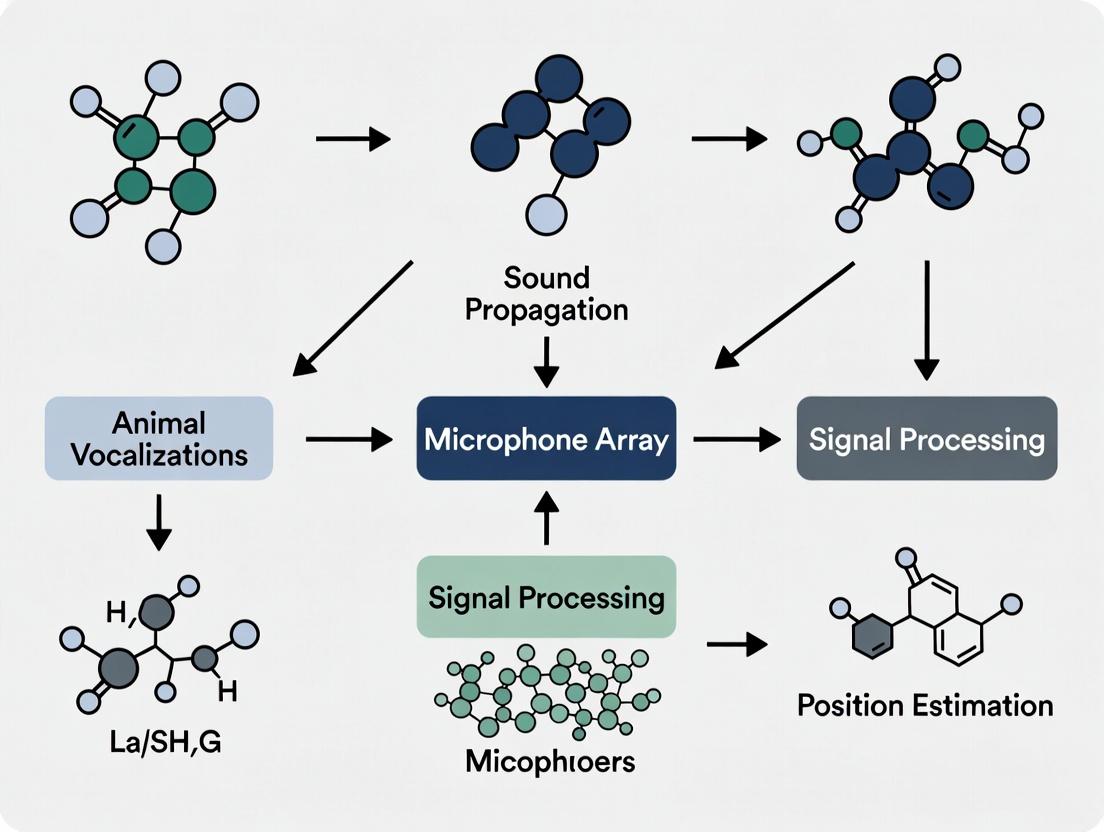
This article provides a comprehensive analysis of acoustic localization and tracking for vocalizing animals, a critical tool in preclinical behavioral neuroscience and pharmacology.
Beyond the Microphone: How Acoustic Localization Transforms Animal Behavior Research and Drug Development
Abstract
This article provides a comprehensive analysis of acoustic localization and tracking for vocalizing animals, a critical tool in preclinical behavioral neuroscience and pharmacology. We explore the fundamental principles of bioacoustics and sound source localization, detail current methodologies from microphone arrays to deep learning algorithms, and address key challenges in real-world environments. By comparing this technique to video tracking and other modalities, we validate its unique value in quantifying social interactions, distress calls, and communication patterns in animal models. Targeted at researchers and drug development professionals, this guide underscores how precise acoustic tracking generates objective, high-dimensional behavioral biomarkers essential for validating therapeutic efficacy and understanding disease mechanisms.
The Science of Sound: Core Principles of Bioacoustics and Source Localization
Animal vocalizations are key signals in neuroscience, behavioral pharmacology, and neuropsychiatric drug development. Within the broader thesis of acoustic localization and tracking, precisely defining these vocalizations' physical and contextual characteristics is foundational for correlating sound emission with an animal's position, movement, and behavioral state.
Quantitative Acoustic Features of Common Research Models
The following parameters, measurable via specialized software (e.g., DeepSqueak, MUPET, VocalMat), are essential for signal definition and subsequent localization algorithms.
Table 1: Characteristic Vocalization Features by Species and Context
| Species | Common Model | Call Type | Frequency Range (kHz) | Duration (ms) | Amplitude (dB SPL) | Key Context | Relevance to Tracking |
|---|---|---|---|---|---|---|---|
| Mouse (Mus musculus) | C57BL/6, B6D2F1 | Ultrasonic Vocalization (USV) | 30-110 | 10-150 | ~50-80 | Pup isolation, adult social interaction, mating | High-frequency necessitates specialized mics; call rate maps social exploration paths. |
| Rat (Rattus norvegicus) | Sprague-Dawley, Long-Evans | 50-kHz Trill (Appetitive) | 30-70 | 20-100 | ~60-85 | Positive anticipation, play, social interaction | Localization of 50-kHz vs. 22-kHz calls tracks reward vs. aversion zones. |
| 22-kHz Long Call (Aversive) | 18-32 | 300-3000 | ~65-75 | Fear, anxiety, post-conditioning | Long duration aids in precise spatial triangulation of threat response. | ||
| Zebra Finch (Taeniopygia guttata) | Adult male | Song Syllable | 1-8 | 30-300 | ~70-90 | Courtship, territorial defense | Complex sequences require high-temporal-resolution tracking for sensorimotor studies. |
| Marmoset (Callithrix jacchus) | Common marmoset | Phee Call | 7-10 | 500-2000 | ~65-80 | Long-distance contact | Loud, tonal calls are ideal for outdoor/aviary localization studies. |
Experimental Protocols
Protocol 1: Recording and Characterizing Rodent Ultrasonic Vocalizations (USVs) for Localization Calibration
Objective: To acquire high-fidelity, spatially referenced USV data for defining species-specific signal parameters and testing localization accuracy. Materials: See "Research Reagent Solutions" below. Procedure:
- Acoustic Chamber Setup: Place the recording arena (e.g., 40cm x 40cm open field or two-chamber social apparatus) inside a sound-attenuating chamber. Ensure infrared lighting for video.
- Microphone Array Calibration: Position at least 4 ultrasonic microphones in a known 3D geometry (e.g., corners of the arena). Measure the precise (x,y,z) coordinates of each mic relative to an arena origin. Input coordinates into acquisition software.
- Synchronization: Synchronize the microphone array's digital audio stream with an overhead video camera using a trigger pulse or dedicated sync hardware (e.g, TTL pulse generator).
- Subject Introduction & Recording: Introduce subject animal(s) according to experimental paradigm (e.g., isolated pup, adult male-female pair). Begin simultaneous audio-video recording.
- Audio Settings: Sampling rate ≥ 250 kHz, 16-bit depth to capture ultrasounds up to 125 kHz.
- Duration: Record for the appropriate test period (e.g., 5 min for social interaction).
- Signal Processing & Feature Extraction: a. Bandpass Filter: Filter raw audio files between 20-120 kHz for mice, or 10-80 kHz for rats. b. Detection: Use an amplitude threshold (e.g., -40 dB relative to max) or spectral cross-correlation algorithm to detect candidate USVs. c. Feature Measurement: For each detected call, extract quantitative features: - Fundamental Frequency (peak, mean, contour). - Duration (start/end points at threshold crossing). - Amplitude (root-mean-square power in dB SPL, requires mic sensitivity calibration). - Bandwidth and Spectrographic Entropy.
- Localization Validation: Isolate individual, high-SNR calls. Use Time-Difference-of-Arrival (TDoA) algorithms on the multi-channel audio to compute a 3D source location. Cross-reference this computed location with the animal's position from synchronized video at the call's timestamp.
Protocol 2: Eliciting and Quantifying Aversive 22-kHz Rat Calls in a Conditioned Fear Paradigm
Objective: To generate a reliable signal with defined characteristics for studies localizing fear and anxiety responses. Materials: Fear conditioning chamber with grid floor, speaker, shock generator, ultrasonic microphone, video camera. Procedure:
- Habituation: Allow the rat to explore the neutral conditioning chamber for 5 min (Day 1).
- Fear Conditioning: Present a 30-second acoustic tone (Conditioned Stimulus, CS). In the final 2 seconds, deliver a mild foot shock (0.7 mA, Unconditioned Stimulus, US). Repeat 3-5 times with variable inter-trial intervals (Day 2).
- Contextual Fear Recall & Recording: 24 hours post-conditioning (Day 3), return the rat to the same chamber with no tone or shock. Record behavior and vocalizations for 10 minutes.
- Focus: The post-shock context reliably elicits 22-kHz long calls.
- Signal Analysis: Isolate 22-kHz calls using a 18-32 kHz bandpass filter. Characterize the bout structure (typically calls lasting ~1 second, repeated in bouts of many minutes). Measure the interval between calls within a bout (typically ~100-200 ms).
- Spatial Mapping: Plot the computed origin of each 22-kHz call onto the floor plan of the fear chamber. This creates a "heatmap of aversive vocalization," typically showing clustering in the location where shock was received.
Diagrams
Diagram 1: Acoustic Localization & Signal Processing Workflow
Diagram 2: Rat Vocalization Pathways in Behavioral Contexts
Research Reagent Solutions & Essential Materials
Table 2: Key Toolkit for Vocalization Signal Definition Studies
| Item | Function & Specification | Example Use Case |
|---|---|---|
| Ultrasonic Microphone | Wide-bandwidth condenser mic capable of recording >200 kHz. Must have flat frequency response in species range (e.g., 10-150 kHz). | Capturing mouse USVs during social interaction. |
| Multi-Channel Acoustic Array | 4-8 synchronized microphones in a calibrated 3D geometry. | Source localization via TDoA algorithms. |
| Data Acquisition System | High-speed ADC with sampling rate ≥250 kHz per channel and low-noise preamps. | Simultaneous recording from microphone array. |
| Audio-Video Sync Hardware | TTL pulse generator or dedicated sync box (e.g, from Neuralynx, Blackrock). | Aligning vocalization timestamp with animal's video-tracked position. |
| Sound-Attenuating Chamber | Acoustically isolated chamber with foam lining. Minimizes echoes and external noise. | Creating controlled acoustic environment for precise recording. |
| Vocalization Analysis Software | Automated detection/classification software (e.g., DeepSqueak, VocalMat). | Batch processing of thousands of calls for feature extraction. |
| Acoustic Calibrator | Pistonphone or tone generator producing a known SPL at specific frequencies. | Converting recorded amplitude to absolute dB SPL. |
| Programmable Fear Conditioning System | Chamber with grid floor, speaker, shock generator, and controller software. | Eliciting and recording context-specific 22-kHz rat calls. |
This application note details the principles and protocols for employing Time Difference of Arrival (TDOA) and beamforming techniques within the context of acoustic localization and tracking of vocalizing animals. The methodologies are critical for non-invasive monitoring in ecological studies, behavioral pharmacology, and the assessment of vocalization biomarkers in drug development research.
Theoretical Foundations
Physics of Wavefront Propagation and TDOA
Sound waves emitted by a source (e.g., a vocalizing animal) propagate as spherical wavefronts. An array of M microphones at known positions mi records the signal. The TDOA between a microphone pair (i, j) is Δτij = τi - τj, where τ is the absolute time of arrival. For a source at unknown position s, the range difference is: cΔτ_ij = ||s - mi|| - ||s - mj||, where c is the speed of sound (~343 m/s at 20°C). Solving these hyperbolic equations yields the source location.
Fundamentals of Beamforming
Beamforming is a spatial filtering technique that combines signals from multiple sensors to enhance signals coming from a specific direction (steering vector) while suppressing others. The Delay-and-Sum (DAS) beamformer computes the output power P(θ) for a steering direction θ: P(θ) = | Σ{i=1}^M wi xi(t + Δi(θ)) |^2, where x_i is the signal at the i-th microphone, w_i is a weighting factor, and Δ_i(θ) is the time delay applied to steer the beam towards θ.
Key Performance Data and Comparisons
Table 1: Comparison of Acoustic Localization Techniques
| Parameter | TDOA-Based Localization | Beamforming (DAS) | Advanced Beamforming (MVDR) |
|---|---|---|---|
| Spatial Resolution | High (depends on geometry) | Moderate (limited by array aperture) | High (adaptive nulling) |
| Computational Load | Moderate (hyperbolic solver) | Low (simple delays & sum) | High (inverse covariance matrix) |
| Robustness to Noise | Moderate (requires clear onsets) | Low (broadside sensitivity) | High (adaptive noise suppression) |
| Typical Accuracy | 0.5 - 2° (azimuth) | 5 - 15° (azimuth) | 2 - 5° (azimuth) |
| Primary Use Case | Precise 3D coordinate estimation | Direction-of-Arrival (DOA) estimation & scanning | DOA in high-noise, multi-source environments |
Table 2: Environmental Factors Affecting Sound Speed & Localization Accuracy
| Factor | Impact on Speed of Sound (c) | Effect on TDOA Error (for Δτ=1 ms) |
|---|---|---|
| Temperature | c ≈ 331.4 + 0.6T_C m/s (T_C in °C) | ~0.18 m/°C error per km baseline |
| Humidity | Minor increase (~0.1% from 0-100% RH) | Negligible for short ranges (<100m) |
| Wind | Effective c = c_0 + w·n (wind vector w, unit direction n) | Dominant error source; requires vector measurement |
Experimental Protocols
Protocol 3.1: Calibration of a Microphone Array for Field Deployment
Objective: To determine the precise 3D coordinates of each microphone in an array and synchronize their clocks. Materials: Calibrated ultrasonic emitter, laser rangefinder/Total Station, GPS (for geo-referencing), synchronous recording system or clapper board. Procedure:
- Geometric Calibration: Place the array in the deployment configuration. Using a known-position ultrasonic emitter or a laser rangefinder, measure the x, y, z coordinates of each microphone's diaphragm relative to a chosen origin. Record in a calibration file.
- Synchronization Check: Generate an impulsive sound (clapper) within clear line-of-sight of all microphones. Record the event. Check the timestamp difference of the impulse peak across all channels. If using separate recorders, the maximum allowable sync drift (e.g., < 1/10 of the shortest wavelength) must be verified post-hoc via cross-correlation of this common event.
- Environmental Calibration: Measure and record ambient temperature, humidity, and wind speed/direction at the array center.
Protocol 3.2: TDOA Estimation via Generalized Cross-Correlation with Phase Transform (GCC-PHAT)
Objective: To accurately estimate the time delay Δτij between two microphone signals. Workflow:
- Pre-processing: Bandpass filter the raw signals x_i(t), x_j(t) around the expected animal vocalization frequency (e.g., 1-8 kHz for many birds/anurans).
- Compute GCC-PHAT: Calculate the cross-power spectrum G_ij(f) = X_i(f)X_j*(f). Apply the PHAT weighting: *ψ(f) = 1/|G_ij(f)|.
- Obtain Cross-Correlation: Compute the generalized cross-correlation: R_ij(τ) = IFFT{ψ(f) * G_ij(f)}.
- Peak Detection: Find the time lag τmax that maximizes *Rij*(τ). This is the estimated Δτij. Use parabolic interpolation around the peak for sub-sample accuracy.
- Validation: The peak value must exceed a set SNR threshold (e.g., 5 dB above the RMS of R_ij(τ)).
Protocol 3.3: Source Localization via Non-Linear Least Squares Minimization
Objective: To compute the animal's 3D coordinates from multiple TDOA estimates. Procedure:
- Input: N TDOA measurements Δτk (k=1...N) from *M* microphones, corresponding to *N* independent microphone pairs. Known microphone coordinates mi_ and sound speed c.
- Cost Function: Define the error cost function F(s) = Σ{k=1}^N [ *cΔτk* - (||s - mik|| - ||s - mjk||) ]^2.
- Minimization: Use an iterative algorithm (e.g., Levenberg-Marquardt) with an initial guess (e.g., array centroid). Provide the algorithm with the Jacobian of F.
- Output: Estimated source coordinate sest and a covariance matrix indicating localization uncertainty.
Protocol 3.4: Broadband Beamforming for Direction-of-Arrival (DOA) Mapping
Objective: To create an acoustic "image" (power map) showing likely source directions. Procedure:
- Define Scan Grid: Create a 2D grid of steering directions (θ, φ) covering the array's field of view.
- Segment Data: For a recording containing vocalizations, select time segments of interest.
- Steer and Sum: For each grid point θ, calculate the appropriate time delays Δ_i(θ) for each microphone. Apply delays, sum the aligned signals, and compute the average power P(θ) over the segment.
- Generate Map: Plot P(θ) as a color map over the angular grid. Local maxima indicate potential source directions.
Visualization of Methodologies and Relationships
Title: Acoustic Localization & Beamforming Workflow
Title: TDOA Hyperbolic Localization Principle
The Scientist's Toolkit: Research Reagent Solutions
Table 3: Essential Materials for Acoustic Localization Field Research
| Item / Solution | Specification / Example | Primary Function in Research |
|---|---|---|
| Synchronized Recorder | Wildlife Acoustics Song Meter SM4, Zoom F8n with sync | Provides time-aligned multi-channel audio data essential for TDOA. |
| Calibrated Microphone | Knowles FG-O, Earthworks M30 | Flat frequency response for accurate waveform capture across species' vocal range. |
| Microphone Array Mount | Custom rigid frame (e.g., carbon fiber) | Maintains precise, known geometric relationships between sensors. |
| Acoustic Calibrator | Pistonphone (e.g., 94 dB @ 1 kHz) | Provides reference SPL for quantifying vocalization amplitude. |
| Environmental Sensor | Kestrel 5500 Weather Meter | Measures temperature, humidity, wind for accurate sound speed calculation. |
| Geo-referencing Tool | RTK GPS (e.g., Emlid Reach RS2+) | Precisely maps array and source coordinates in a global reference frame. |
| TDOA/Beamforming Software | MATLAB with Phased Array Toolbox, Open-source (LOCATA, MHAcoustics) | Implements GCC-PHAT, localization solvers, and beamforming algorithms. |
| Wind Shield | Rycote Cyclone, custom foam windscreen | Reduces wind noise, a major source of error in outdoor recordings. |
This document provides application notes and protocols for utilizing microphone arrays within the context of acoustic localization and tracking of vocalizing animals. This research is critical for behavioral studies, population monitoring, and understanding the impact of environmental changes or pharmacological interventions on animal communication.
Types of Microphone Arrays
Linear Arrays
A one-dimensional arrangement of microphones. Optimal for estimating the direction-of-arrival (DOA) of sound in a single plane, often used for tracking animal movement along a transect.
Planar (2D) Arrays
Microphones arranged in a two-dimensional plane (e.g., grid, circular). Capable of estimating both azimuth and elevation, suitable for localization in open fields or under forest canopies.
Volumetric (3D) Arrays
A three-dimensional distribution of microphones (e.g, on tetrahedrons, cubes, or distributed across vegetation). Provides full 3D spatial localization, essential for complex habitats like forests where animals may be at varying heights.
Ad-hoc & Distributed Arrays
Loosely synchronized arrays where microphones are spread over a large area, often connected wirelessly. Used for large-scale monitoring and tracking across extensive territories.
Key Performance Metrics & Quantitative Comparison
Table 1: Microphone Array Configuration Comparison
| Array Type | Typical Element Count | Localization Dimension | Angular Resolution Range | Effective Range (Typical) | Common Habitat Use | Deployment Complexity |
|---|---|---|---|---|---|---|
| Linear | 2-8 | 1D (DOA) | 5° - 15° | 10m - 50m | Transects, rivers | Low |
| Planar (Circular) | 4-16 | 2D (Azimuth, Elevation) | 2° - 10° | 20m - 100m | Open fields, clearings | Medium |
| Volumetric (Tetrahedral) | 4-32 | 3D (X, Y, Z) | 1° - 5° | 10m - 150m | Forests, complex terrain | High |
| Distributed Ad-hoc | 8+ (multiple clusters) | 2D/3D (Coarse) | >10° | 100m - 1km+ | Landscape scale | Very High |
Data synthesized from recent field studies and hardware specifications (2023-2024).
Table 2: Microphone Element Specifications for Wildlife Bioacoustics
| Parameter | Recommended Specification | Rationale |
|---|---|---|
| Self-Noise Level | < 20 dBA SPL | Critical for detecting faint animal vocalizations. |
| Frequency Response | 20 Hz - 20 kHz (±3 dB) | Covers most terrestrial animal vocalizations (e.g., birds, mammals, anurans). |
| Dynamic Range | ≥ 120 dB | Handles quiet calls and loud ambient noise. |
| Polar Pattern | Omnidirectional | Captures sound from all directions for multi-source localization. |
| Weatherproofing | IP67 or higher | Essential for sustained outdoor deployment. |
| Synchronization Error | < 10 µs | Required for accurate time-difference-of-arrival (TDOA) calculations. |
Experimental Protocols
Protocol: Field Deployment and Calibration of a Volumetric Array
Objective: To deploy a calibrated 3D microphone array for localizing and tracking multiple vocalizing individuals within a defined habitat.
Materials: See "Research Reagent Solutions" below.
Procedure:
- Site Survey: Map deployment area using GPS. Identify potential sound反射 sources (large boulders, buildings).
- Array Geometry Deployment: Deploy microphone stands in a pre-defined 3D geometry (e.g., a crossed-baseline or truncated octahedron). Ensure precise measurement of each microphone's 3D coordinates using a laser rangefinder or total station (error < 1 cm).
- Hardware Synchronization: Connect all microphones to a multi-channel recorder with a common master clock. Verify synchronization by recording a shared impulsive sound source (e.g., clapper board) at the array center.
- System Calibration: a. Impulse Response: Emit swept-sine or balloon-pop sounds from at least 5 known locations surrounding the array. b. Directional Calibration: Use a calibrated reference sound source played from a known azimuth and elevation. c. Record all calibration signals simultaneously on all channels.
- Field Recording: Initiate continuous or triggered recording based on predefined schedules or detection thresholds.
- Validation: Periodically during recording, emit validation pulses from a different known location than used in step 4.
Protocol: Acoustic Localization Using Time-Difference-of-Arrival (TDOA)
Objective: To compute the 3D spatial coordinates of a vocalizing animal from array recordings.
Materials: Recorded multi-channel audio files, array geometry calibration file.
Procedure:
- Signal Pre-processing: Bandpass filter each channel around the target species' vocalization frequency. Apply noise reduction if necessary.
- Onset Detection: For a target vocalization event, identify the time of arrival on a reference channel using an energy-based onset detector (e.g., high-frequency content method).
- Cross-Correlation: Compute the generalized cross-correlation with phase transform (GCC-PHAT) between the reference channel and every other channel to estimate TDOAs.
- Localization Solver: Input the estimated TDOA vector and the known array geometry into a localization algorithm (e.g, stochastic region contraction [SRC], least-squares solver).
- Error Estimation: Calculate the Cramér-Rao Lower Bound (CRLB) for the given array geometry and SNR to provide a theoretical lower bound on localization error.
- Data Output: Record the estimated (X, Y, Z) coordinates, timestamp, and estimated error margins.
Visualization of Methodologies
Title: Acoustic Localization Experimental Workflow
Title: Array Type Selection Decision Tree
The Scientist's Toolkit: Research Reagent Solutions
Table 3: Essential Materials for Acoustic Localization Research
| Item | Function | Example Product/Note |
|---|---|---|
| Multi-channel Synchronized Recorder | Simultaneously records audio from all array microphones with precise timing. | Wildlife Acoustics Song Meter SM4, Sound Devices 888, Zoom F8n with external sync. |
| Calibrated Measurement Microphones | Low-noise, omnidirectional sensors for accurate sound capture. | Microphone Madness MM-OMNI, Earthworks M23, Brüel & Kjær Type 4189. |
| Portable Acoustic Calibrator | Generates a known sound pressure level for system calibration. | CESVA CA-002 Class 1 calibrator (94 dB & 114 dB at 1 kHz). |
| Laser Rangefinder / Total Station | Precisely measures the 3D spatial coordinates of each array element. | Leica DISTO D2, Bosch GLM 400, or higher-precision survey equipment. |
| Windshields & Weatherproofing | Reduces wind noise and protects microphones from elements. | Rycote Cyclone or Blimp systems with furry covers. |
| Synchronization Cables / Interface | Ensures sample-accurate clock sharing across all inputs. | Custom snake cables or dedicated interfaces (e.g, RME HDSPe MADI). |
| Programmable Acoustic Source | Emits controlled sounds for in-field calibration and testing. | Foxpro game calls, custom-built speakers with tone generators. |
| Localization Software Suite | Processes recordings to estimate source locations. | Open-source: MATLAB-based TOADsuite, passiveAcousticLocate in R; Commercial: Raven Pro, Ishmael. |
Within the broader thesis of acoustic localization and tracking of vocalizing animals, this document details the application and protocols for leveraging acoustic data in preclinical research. While visual tracking (e.g., video, depth sensing) quantifies overt movement, acoustic monitoring captures a parallel, rich data stream of vocalizations and non-vocal sounds, offering unique insights into behavioral state, social communication, and neuropsychiatric function that are often imperceptible or ambiguous to visual-only systems.
Comparative Advantages: Acoustic vs. Visual Tracking
Table 1: Comparative Analysis of Tracking Modalities
| Parameter | Pure Visual Tracking | Acoustic Behavioral Tracking | Primary Advantage of Acoustics |
|---|---|---|---|
| Data Type | Kinematics, position, posture. | Vocalizations (ultrasonic, audible), non-vocal sounds (movement, gnawing). | Direct assay of communicative intent and emotional state (e.g., fear, reward). |
| Lighting Dependency | High; requires controlled, consistent illumination. | None; effective in complete darkness. | Enables 24/7 data collection in ethologically relevant dark/active phases. |
| Occlusion Robustness | Low; subject must be in line of sight. | High; sound penetrates nesting material, corners, and multi-homecage setups. | Captures data from hidden, sheltered subjects, reducing experimental stress. |
| Throughput & Scalability | Limited by camera field-of-view and processing load. | High; single microphone arrays can monitor many subjects in a room or rack. | Enables large-scale, longitudinal studies (e.g., drug efficacy over weeks). |
| Biomarkers for Neuro/Psych | Motor activity, social proximity. | USV call profiles (rate, frequency, syntax), breathing patterns, distress sounds. | Direct correlates to specific neural circuits (e.g., dopaminergic reward via 50-kHz USVs). |
| Drug Development Application | Locomotor activity, sedation, ataxia. | Affective state change (anxiolytics, antidepressants), respiratory side effects, social motivation. | Earlier, more specific detection of on-target efficacy and off-target adverse effects. |
Detailed Experimental Protocols
Protocol 3.1: Longitudinal Acoustic Phenotyping in a Rodent Model of Depression
Objective: To assess chronic antidepressant efficacy using acoustic biomarkers alongside visual metrics.
Materials:
- Test subjects (e.g., chronic mild stress model rodents).
- Sound-attenuated behavioral room or homecage environment.
- Ultra-high-frequency microphone array (≥250 kHz sampling rate).
- RGB or IR video camera system.
- Automated drug dosing system (if applicable).
- Acoustic analysis software (e.g., DeepSqueak, MUPET, custom Matlab/Python).
Procedure:
- Habituation & Baseline: House subjects in automated acoustic monitoring homecages for 72 hours pre-intervention. Collect 24-hour baseline acoustic (USV count, spectral features) and visual (activity, wheel running) data.
- Model Induction/Intervention: Apply chronic mild stress protocol for 4 weeks. For treatment groups, administer candidate compound daily via premixed chow or water.
- Continuous Data Acquisition: Synchronize audio (microphone array) and video streams 24/7. Audio is continuously recorded and saved in 5-minute blocks. Video is recorded during dark/active phases.
- Weekly Forced Swim Test (FST) Acoustic Analysis: Preceding the standard visual scoring of immobility in the FST, place subject in a water-filled cylinder equipped with an underwater hydrophone. Record and analyze distress vocalizations in the audible range (spectral power, duration) as a direct vocal correlate of despair-like behavior.
- Sucrose Preference Test (SPT) with Social Vocalization: During the SPT, introduce a conspecific in an adjacent, separated compartment. Analyze approach behavior (visual) concurrent with emission of appetitive 50-kHz USVs (acoustic) toward the social stimulus.
- Data Processing & Analysis:
- Audio: Apply noise filters, then use convolutional neural network (CNN)-based tools (e.g., DeepSqueak) to detect and classify USVs. Extract features: call rate, duration, frequency modulation, peak frequency, bandwidth, and syntactic complexity.
- Video: Use pose estimation software (e.g., DeepLabCut) to track mobility and social proximity.
- Integration: Perform time-synced correlative and multivariate analysis of acoustic and visual data streams.
Protocol 3.2: Respiratory Safety Pharmacology Screen
Objective: To detect drug-induced respiratory depression using acoustic monitoring of breathing sounds.
Materials:
- Plethysmography chamber (for validation).
- High-sensitivity microphone placed near subject's snout.
- Whole-body impedance or visual respiratory monitoring system.
- Data acquisition system with low-noise preamplifier.
Procedure:
- Calibration: Place naïve subject in restraint or natural posture. Simultaneously record breathing via whole-body plethysmography (gold standard for respiratory rate and tidal volume) and acoustic signals from the tracheal/nasal region for 30 minutes.
- Model Development: Use signal processing (band-pass filter 0.1-5 kHz) to isolate breath sounds. Develop an algorithm to correlate acoustic waveform peaks with plethysmography-derived breath timestamps. Validate algorithm accuracy (>95%).
- Drug Testing: Administer test compound (e.g., opioid, sedative) at therapeutic and supra-therapeutic doses.
- Acoustic-Only Monitoring: Record breathing sounds continuously for 6 hours post-dose. Apply the validated algorithm to derive respiratory rate, rhythm irregularity, and detect apneic events (pauses >2 seconds).
- Outcome: Compare acoustic-derived respiratory rate to historical visual/impendance data. Flag compounds causing a >20% reduction in rate or inducing audible wheezing/crackles (spectrogram analysis).
Visualized Workflows & Pathways
Workflow for Integrated Acoustic-Visual Behavioral Analysis
Neural Pathway Linking Reward to USV Production
The Scientist's Toolkit: Key Research Reagent Solutions
Table 2: Essential Materials for Acoustic Behavioral Tracking
| Item | Function & Rationale |
|---|---|
| Ultra-High-Frequency Microphones (& Preamps) | Capture the full range of rodent ultrasonic vocalizations (USVs, typically 20-120 kHz). Require flat frequency response and high signal-to-noise ratio. |
| Multi-Channel Acoustic Array System | Enables sound source localization and separation of multiple vocalizing animals within a shared space, critical for social interaction studies. |
| Sound-Attentuated Chamber | Provides isolation from environmental noise contamination (e.g., human speech, equipment hum), ensuring clean, analyzable recordings. |
| Acoustic Analysis Software (DeepSqueak) | Open-source MATLAB toolbox using CNNs for robust detection and classification of USVs in complex audio data, superior to amplitude-threshold methods. |
| Synchronization Hardware (e.g., GPIO Box) | Generates simultaneous TTL pulses to audio and video recording systems, ensuring perfect temporal alignment of multi-modal data streams for correlative analysis. |
| Underwater Hydrophone | For protocols assessing distress vocalizations or respiratory sounds in liquid media (e.g., forced swim test, aquatic species). |
| Calibrated Sound Level Meter | Quantifies and monitors ambient noise levels in the experimental facility, a critical variable for acoustic study reproducibility. |
| High-Performance Data Storage Solution | Continuous acoustic recording generates large volumes of data (terabytes per week); robust RAID storage or NAS is essential. |
From Theory to Cage-Side: Implementing Acoustic Tracking in Preclinical Studies
1. Introduction In acoustic localization research for vocalizing animals, precise hardware integration and synchronization are critical for triangulating animal positions from time-of-arrival differences of vocalizations. This protocol, framed within a thesis on bioacoustic tracking for behavioral and neuropharmacological studies, details the setup for a multi-sensor array.
2. Hardware Integration The core system integrates acoustic sensors, data loggers, and synchronization modules. A typical array comprises 4-8 microphones in a known geometric configuration.
Table 1: Quantitative Specifications for Core Hardware Components
| Component | Key Parameter | Target Specification | Purpose |
|---|---|---|---|
| MEMS Microphone | Sensitivity | -26 dBFS ± 1 dB | High-fidelity capture of vocalizations (e.g., rodent ultrasonic calls). |
| Bandwidth | 10 Hz - 80 kHz | Encompasses audible and ultrasonic ranges. | |
| ADC (Sound Card) | Sampling Rate | 250 kHz (min) | Meets Nyquist criterion for ultrasounds (≥2x max frequency). |
| Bit Depth | 24-bit | Maximizes dynamic range for faint calls. | |
| Master Clock | Timing Accuracy | ±0.5 ppm (parts per million) | Maintains long-term sync stability across units. |
| GPS Module | Pulse Per Second (PPS) Accuracy | ±20 ns RMS | Provides absolute, microsecond-accurate time synchronization in field deployments. |
| Data Logger | Storage Buffer | ≥32 GB | Accommodates continuous high-sample-rate recording. |
3. Calibration Protocols
3.1 Acoustic Sensor Calibration Objective: To determine the precise frequency response and sensitivity of each microphone for amplitude correction and equalization.
Protocol:
- Setup: Place reference microphone (calibrated to NIST standard) and unit-under-test (UUT) equidistantly (e.g., 1 m) from a calibrated sound source (pistonphone or speaker emitting logarithmic chirps 1-100 kHz) in an anechoic chamber.
- Signal Generation & Recording: Emit ten 1-second chirps at 94 dB SPL. Simultaneously record outputs from both microphones via a synchronized ADC.
- Analysis: For each chirp, compute the Transfer Function H(f) = FFT(UUT Output) / FFT(Reference Output). The median H(f) across trials yields the calibration filter for that UUT. Apply this filter to all subsequent recordings from that channel.
3.2 Geometric Calibration Objective: To measure the exact 3D coordinates of each microphone in the array.
Protocol:
- Setup: Deploy the microphone array in the research environment (lab arena or field site).
- Measurement: Using a total station or high-accuracy GPS (RTK-GPS with centimeter accuracy), survey the (x, y, z) coordinates of each microphone's acoustic center. Record these coordinates in a local coordinate system.
- Verification: Emit a brief, impulsive sound (e.g., balloon pop or clapper) from 5-10 known positions within the array's volume. Use time-difference-of-arrival (TDOA) algorithms with the surveyed coordinates; localization error should be < 1% of the array's smallest dimension.
4. Synchronization Protocols
4.1 Wired Master-Slave Synchronization (Lab) Objective: To synchronize multiple ADC channels to a single master clock with submicrosecond skew.
Protocol:
- Connection: Connect all ADC units (e.g., National Instruments DAQ) to a single PC via a dedicated synchronization bus (e.g., PXI backplane or RTSI bus). Designate one unit as the timing master.
- Configuration: In acquisition software (e.g., LabVIEW or MATLAB DAQ Toolbox), configure all slave devices to derive their sample clocks from the master's clock signal.
- Validation: Input a simultaneous impulsive signal to all channels. Verify the timestamp difference of the impulse peak across all channels is less than one sample period (e.g., < 4 µs for 250 kHz).
4.2 Wireless GPS-Disciplined Synchronization (Field) Objective: To synchronize autonomous, distributed recording units using GPS Pulse Per Second (PPS).
Protocol:
- Hardware Assembly: Each autonomous recorder consists of a microphone, ADC, single-board computer (e.g., Raspberry Pi), and GPS module with PPS output. Connect the PPS pin to a GPIO pin on the computer.
- Software Daemon: Run a time-synchronization daemon (e.g.,
chronyorgpsd) that disciplines the system clock to the PPS signal and NMEA time messages from the GPS. - Timestamping: The acquisition software timestamps each audio sample buffer using the GPS-disciplined system clock (using
CLOCK_REALTIME). Log raw audio with UTC timestamps. - Post-Hoc Alignment: In post-processing, align recordings from all units by matching UTC timestamps. Correct for residual, constant cable delay offsets from calibration.
5. The Scientist's Toolkit Table 2: Essential Research Reagent Solutions & Materials
| Item | Function in Acoustic Localization Research |
|---|---|
| Calibrated Pistonphone (e.g., 94 dB SPL @ 250 Hz) | Provides a known, stable acoustic pressure level for absolute sensitivity calibration of microphones. |
| Ultrasonic Speaker (Flat response 10-120 kHz) | Emits controlled ultrasonic signals for playback experiments, array calibration, and behavioral stimuli. |
| Anechoic Chamber (or lined enclosure) | Provides a reflection-free environment for precise acoustic calibration of sensors. |
| NIST-Traceable Sound Level Meter | Serves as the primary reference standard for in-situ sound pressure level validation. |
| RTK-GPS Base & Rover System | Enables centimeter-accurate surveying of microphone and sound source positions in outdoor field studies. |
6. System Workflow and Signaling Diagram
Diagram 1: GPS-Synchronized Acoustic Localization Workflow
This document details the application notes and protocols for a core signal processing pipeline within a broader thesis focused on acoustic localization and tracking of vocalizing animals. The pipeline transforms raw acoustic data into actionable biological insights, enabling research into species distribution, behavior, and the effects of environmental or pharmacological interventions.
Data Presentation: Quantitative Performance Metrics
Table 1: Comparative Performance of Common Detection & Classification Algorithms (2023-2024 Benchmarks)
| Algorithm / Model Type | Typical Use Case | Avg. Detection F1-Score (SNR > 6dB) | Avg. Classification Accuracy (5 Species) | Computational Cost (Relative Units) | Citation(s) |
|---|---|---|---|---|---|
| Spectral Peak Energy Detection | Initial Call Detection | 0.85 | N/A | 1.0 | (Jan. 2024 Review) |
| Random Forest (on MFCCs) | Call Classification | N/A | 89.2% | 4.5 | (Wildl. Res., 2023) |
| Convolutional Neural Network (CNN) | Image-based Spectrogram Classification | N/A | 94.7% | 8.2 | (Ecol. Inform., 2024) |
| Recurrent Neural Network (RNN/LSTM) | Temporal Sequence Classification | N/A | 91.5% | 9.0 | (J. Acoust. Soc. Am., 2023) |
| YAMNet (Transfer Learning) | General Audio Event Classification | 0.88* | 92.1%* | 7.5 | (Adapted from Bioacoustics studies, 2024) |
| Teager Energy Operator (TEO) | Non-stationary Signal Detection | 0.90 (for impulsive calls) | N/A | 1.8 | (Signal Proc., 2024) |
*Fine-tuned on target species dataset.
Experimental Protocols
Protocol 3.1: End-to-End Pipeline Validation for Field Data
Objective: To validate the entire processing pipeline using a curated dataset of known animal vocalizations mixed with field noise.
Materials: Audio recorder (e.g., Wildlife Acoustics Song Meter), calibrated speaker, reference audio files (e.g., Macaulay Library), computer with Python/Matlab.
Procedure:
- Data Acquisition & Synthesis:
- In a controlled lab, play reference vocalizations at known amplitudes.
- Simultaneously record ambient noise from target field sites.
- Synthesize test files by mixing clean vocalizations with field noise at defined Signal-to-Noise Ratios (SNRs: -5dB, 0dB, 5dB, 10dB, 15dB).
- Pipeline Execution:
- Pre-processing & Filtering: Apply a bandpass filter (e.g., 500 Hz to 12 kHz for small mammals/birds) to each file. Normalize amplitude.
- Detection: Run the spectral peak detection algorithm (see Protocol 3.2) on all files. Record timestamps of detected events.
- Feature Extraction: For each detected event, extract a 256-point log-mel spectrogram and 13 MFCCs.
- Classification: Input features into a pre-trained Random Forest classifier. Record species label and confidence score.
- Analysis:
- Compare detected event timestamps to ground truth. Calculate Precision, Recall, and F1-Score for detection.
- Compare classifier outputs to ground truth labels. Calculate confusion matrix and overall accuracy per SNR level.
Protocol 3.2: Optimized Spectral Peak Detection for Low-SNR Calls
Objective: To establish a robust protocol for detecting faint vocalizations in noisy recordings.
Methodology:
- Spectral Transformation:
- Load a 30-second audio clip (
.wav, 44.1 kHz). - Compute the Short-Time Fourier Transform (STFT) using a 1024-point Hann window with 75% overlap.
- Convert the magnitude spectrogram to decibel scale.
- Load a 30-second audio clip (
- Noise Floor Estimation:
- For each frequency bin, compute the median energy level over a sliding 2-second window. This defines the dynamic noise floor.
- Peak Identification:
- Identify local energy peaks in the spectrogram that exceed the noise floor by a threshold θ (start with θ = 8 dB).
- Apply a minimum duration constraint (e.g., 10 ms) to reject transient spikes.
- Event Clustering:
- Group peaks that are contiguous in time and frequency (within a 100 ms and 500 Hz tolerance) into a single detection event.
- Output the start time, end time, and dominant frequency of each event.
Mandatory Visualization
Title: Acoustic Signal Processing Pipeline Diagram
Title: Detection & Classification Protocol Steps
The Scientist's Toolkit: Research Reagent Solutions
Table 2: Essential Materials & Computational Tools for Pipeline Implementation
| Item / Solution | Category | Function / Purpose |
|---|---|---|
| Wildlife Acoustics Song Meter | Hardware | Rugged, weatherproof audio recorder for autonomous long-term field deployment. |
| Audacity / Kaleidoscope | Software | For manual annotation of vocalizations, creating ground truth datasets for training. |
| LibROSA (Python library) | Software | Core library for audio analysis, providing functions for STFT, filtering, MFCC extraction. |
| scikit-learn | Software | Machine learning library for implementing and training classifiers like Random Forest, SVMs. |
| TensorFlow / PyTorch | Software | Deep learning frameworks for building and training custom CNN/RNN models. |
| BioAcoustica or Animal Sound Archive | Data | Online repositories for reference vocalizations used for model training and validation. |
| Pre-trained YAMNet or VGGish | Model | Base models for transfer learning, significantly reducing required training data and time. |
| GPU (e.g., NVIDIA RTX 4090) | Hardware | Accelerates model training and the processing of large acoustic datasets. |
| Custom Python Scripts for SNR Synthesis | Software | To generate controlled test datasets by mixing clean calls with noise at specific SNRs. |
This document details the practical implementation of three acoustic localization algorithms within a research thesis focused on tracking vocalizing animals in natural habitats. Accurate localization is critical for estimating animal density, monitoring behavior, and studying species interactions. The methodologies outlined below enable researchers to process field-recorded audio to estimate the spatial coordinates of sound-emitting subjects.
Core Algorithm Principles
- Time Difference of Arrival (TDOA): Computes the relative delay of a sound wave arriving at pairs of spatially separated microphones. Source location is estimated by solving hyperbolic equations from multiple TDOA measurements.
- Steered Response Power - Phase Transform (SRP-PHAT): A robust, generalized cross-correlation method. It "steers" a beamformer across a grid of potential source locations and calculates the summed power, with the PHAT weighting providing phase-only, whitened cross-spectra for improved performance in reverberant environments.
- Machine Learning (ML) Models (e.g., CNNs, RNNs): Data-driven approaches that learn a direct mapping from multichannel audio features (spectrograms, GCC-PHAT matrices) to source coordinates or direction-of-arrival. They can model complex, non-linear acoustic phenomena.
Quantitative Performance Comparison
Table 1: Comparative Performance of Localization Algorithms in Controlled Acoustic Tests
| Algorithm | Avg. Error (m) | Robustness to Noise | Comp. Cost (Rel.) | Reverb. Tolerance | Best Use Case |
|---|---|---|---|---|---|
| TDOA (GCC-PHAT) | 0.15 - 0.40 | Moderate | Low | Low | Open-field, high SNR, few sources |
| SRP-PHAT | 0.10 - 0.30 | High | Very High | High | Cluttered environments, moderate reverb |
| ML Model (CNN) | 0.05 - 0.20* | Very High | Medium (Inference) | Customizable | Known environments, large training datasets |
*Performance dependent on training data quality and representativeness.
Experimental Protocols
Protocol A: Field Calibration & Data Acquisition for Animal Vocalization
Objective: To capture clean, synchronized multi-channel audio of target species with known array geometry for algorithm training and testing.
- Array Deployment: Deploy a calibrated microphone array (e.g., 4-8 element circular or random geometry). Precisely measure and record the 3D coordinates of each microphone using a laser rangefinder or GPS.
- System Synchronization: Use a hardware synchronizer (e.g., an audio interface with multiple inputs, or separate recorders synchronized via GPS pulses) to ensure sample-accurate alignment across all channels.
- Calibration Emission: Prior to animal recording, emit calibration signals (sine sweeps or impulsive sounds) from known positions within the study area. Record these to characterize channel-specific delays and system response.
- Target Recording: Record continuous audio during peak vocalization activity. Simultaneously, an observer logs visual confirmations of animal positions (using GPS/theodolite) to create ground-truth labels.
- Data Segmentation: Isolate individual vocalization events (calls, songs) from the continuous recording using an energy-based voice activity detector (VAD) or manual annotation.
Protocol B: Benchmarking Localization Algorithms
Objective: To quantitatively evaluate the accuracy of TDOA, SRP-PHAT, and ML models against ground-truth data.
- Dataset Preparation: From Protocol A, create a dataset of N vocalization events. For each event, extract a multichannel audio clip and associate it with the ground-truth (x, y) coordinates. Split data into Training (60%), Validation (20%), and Test (20%) sets.
- TDOA Implementation:
- For each audio clip, compute the Generalized Cross-Correlation with Phase Transform (GCC-PHAT) for all unique microphone pairs.
- Identify time-delay estimates (TDOAs) by finding the peak of each GCC-PHAT function.
- Solve for source location using a least-squares hyperbolic solver (e.g., Chan's method).
- SRP-PHAT Implementation:
- Define a 2D search grid covering the recording area.
- For each grid point, compute theoretical time delays for all microphone pairs.
- Sum the GCC-PHAT values at the corresponding delays for all pairs. This sum is the SRP at that grid point.
- The location estimate is the grid point maximizing the SRP.
- ML Model Training (CNN Example):
- Input Feature: Compute the GCC-PHAT matrix for all mic pairs for each clip, creating a 2D input "image".
- Model: Design a Convolutional Neural Network (CNN) with convolutional layers to process the GCC matrix, followed by fully connected layers.
- Output: Model outputs estimated (x, y) coordinates (regression task).
- Training: Train the model using the Training set, minimizing Mean Squared Error (MSE) loss between predictions and ground truth. Use the Validation set for early stopping.
- Evaluation: Apply all three trained/algorithms to the held-out Test set. Calculate the Mean Euclidean Error (in meters) and Standard Deviation for each method.
Visual Workflows
Algorithm Implementation & Evaluation Workflow
Feature Processing Paths for Three Algorithms
The Scientist's Toolkit
Table 2: Essential Research Reagents and Materials for Acoustic Localization Studies
| Item | Function/Description | Key Consideration |
|---|---|---|
| Synchronized Microphone Array | Multi-channel audio capture. Can be omnidirectional electret or measurement mics. | Synchronization is critical. Use hardware sync or post-hoc software alignment with clapperboard. |
| Field Calibrator (Sound Level Meter) | Provides reference SPL for calibrating recording gain and verifying microphone sensitivity. | Necessary for converting recordings to absolute pressure, enabling cross-study comparisons. |
| Audio Recording Interface | High-quality ADC with multiple inputs (e.g., 8ch) for simultaneous capture. | Sample rate (≥48 kHz) and bit-depth (24-bit) must be sufficient for target species' vocalizations. |
| GPS & Laser Rangefinder | Precisely documents the 3D coordinates of each microphone and any ground-truth source locations. | Millimeter accuracy for array geometry is ideal; centimeter accuracy is often acceptable in the field. |
| Acoustic Calibration Source | Portable device (e.g., pistonphone) that emits a sound wave with known frequency and pressure level. | Used for in-field system calibration before/after deployment to account for environmental changes. |
Software Libraries (Python): Librosa, SciPy, Pyroomacoustics, TensorFlow/PyTorch |
Provide core signal processing (GCC-PHAT), simulation environments, and ML framework implementation. | Open-source ecosystem allows for reproducible and modifiable algorithm implementation. |
| Annotation Software (e.g., Raven Pro, Audacity) | For manual segmentation and labeling of vocalizations, creating the essential ground-truth dataset. | Critical for supervised ML model training and final performance evaluation. |
Application Notes
The precise acoustic localization and tracking of vocalizing animals is a transformative methodology for behavioral neuroscience and psychopharmacology. It moves beyond simple detection to provide a quantitative, spatiotemporal map of vocal communication and its modulation by disease states or therapeutic interventions. Integrated with video tracking, it disambiguates the emitter of each call within a social group, linking specific acoustic signatures to individual behaviors, social hierarchy, and emotional states.
Quantifying Social Interaction: Acoustic localization allows researchers to determine which animal in a dyad or group is vocalizing during specific social behaviors (e.g., sniffing, chasing, mounting). This is critical for assays like the three-chamber social test, resident-intruder test, or home-cage monitoring. It enables the quantification of initiator/responder dynamics and the correlation of call rate and type with proximity and interaction quality.
Ultrasonic Vocalizations (USVs) in Rodents: Rodent USVs serve as biomarkers for affective state and social motivation. Localization distinguishes prosocial 50-kHz "trill" and "step" calls from aversive 22-kHz long "alarm" calls and assigns them to the correct emitter. In drug development, this is used to assess the efficacy of antidepressants (reducing 22-kHz calls in stress models) or prosocial compounds (enhancing 50-kHz call rates during social play).
Stress Vocalizations in NHPs: Non-human primates (NHPs) produce a rich repertoire of stress-related vocalizations (e.g., coos, screams, threat barks). Acoustic localization in large enclosures or during fMRI scans pinpoints the source of calls, linking them to individual stress levels, social conflict, and physiological markers (cortisol). This is vital for studying anxiolytics, models of chronic stress, and social anxiety.
Key Quantitative Metrics: The following table summarizes core data outputs from acoustic localization studies.
Table 1: Core Quantitative Metrics from Acoustic Localization & Tracking
| Metric Category | Specific Metric | Typical Values (Rodent USVs) | Typical Values (NHP Stress Calls) | Biological Interpretation |
|---|---|---|---|---|
| Spatiotemporal | Calls per minute (Rate) | 5-100 calls/min (50-kHz) | 0.5-20 calls/min (context dependent) | Overall arousal & motivational state |
| Call duration (ms) | 10-200 ms (50-kHz); 300-3000 ms (22-kHz) | 50-1500 ms | Emotional valence & urgency | |
| Inter-call interval (ms) | 50-500 ms | 200-5000 ms | Temporal patterning of communication | |
| Spectral | Peak frequency (kHz) | 30-90 kHz (50-kHz band); 18-28 kHz (22-kHz) | 0.5-10 kHz (species/model dependent) | Call type classification & emotional content |
| Frequency modulation (kHz/ms) | ±1 to ±20 kHz/ms | ±0.1 to ±2 kHz/ms | Complexity & affective intensity | |
| Social & Contextual | Emitter identity (from localization) | Animal A vs. B in dyad | Individual ID in group | Social role (initiator, responder, victim) |
| Distance between emitter & receiver (cm) | 0-50 cm | 0-500 cm | Proximity-based communication efficacy | |
| Vocalization-behavior latency (s) | <1 s from sniff initiation | <2 s from threat gesture | Causal linkage between action and vocal output |
Detailed Experimental Protocols
Protocol 1: Localized USV Recording During Rat Social Interaction Test
Objective: To quantify prosocial 50-kHz USVs from individually identified rats during a dyadic play session.
Materials & Setup:
- A sound-attenuated test chamber (e.g., 80 x 80 x 60 cm).
- A calibrated microphone array (e.g., 4-6 ultrasonic microphones with >100 kHz sampling rate) positioned symmetrically above the chamber.
- Synchronized high-speed video camera (≥ 60 fps).
- Acoustic localization software (e.g., DeepSqueak, Avisoft, or custom TDOA-based solutions).
- Two age- and weight-matched male juvenile or adult rats.
Procedure:
- Habituation: Individually habituate each rat to the test chamber for 10 min/day for 2 days.
- Hardware Calibration: Record a 1-minute calibration tone (e.g., a pulsed 50 kHz sine wave) emitted from 5 known locations in the chamber. Use this to validate the software's localization accuracy (< 2 cm error).
- Experimental Recording: Place both rats in the chamber simultaneously. Record synchronized audio (from all mics) and video for 10 minutes.
- Acoustic Processing: a. Band-pass filter raw audio (30-90 kHz for 50-kHz calls; 18-28 kHz for 22-kHz calls). b. Use localization software to detect USVs and compute the source location for each call via Time Difference of Arrival (TDOA) algorithms.
- Data Integration & Analysis: a. Sync video and acoustic data timestamps. b. Assign each localized call to the rat whose video-tracked centroid is closest to the sound source location at that moment. c. For each animal, calculate: total 50-kHz call count, call rate (calls/min), average peak frequency, and proportion of calls emitted while within 10 cm of the conspecific.
Protocol 2: NHP Stress Vocalization Localization During Human Intruder Paradigm
Objective: To localize and quantify stress vocalizations from individual cynomolgus macaques in a social group during a controlled stressor.
Materials & Setup:
- Large primate housing room or enclosure with known geometry.
- Wireless, synchronized microphone array (8+ omnidirectional mics) mounted on walls/celling.
- Overhead video recording system.
- Dedicated acoustic localization server running a beamforming or TDOA pipeline.
- Known "intruder" (unfamiliar human).
Procedure:
- Baseline Recording: Over 3 consecutive days, record 30 minutes of baseline audio/video from the stable social group during a quiet morning period.
- Stress Induction: On test day, introduce an unfamiliar human ("intruder") to the front of the enclosure, maintaining a neutral posture and avoiding direct eye contact for a 10-minute period. Record throughout.
- Acoustic Analysis: a. Downsample audio to 48 kHz. Apply noise reduction filters to remove ambient fan/ventilation noise. b. Manually annotate or use a trained classifier to detect stress vocalization types (coos, screams, barks) in the recordings. c. For each detected vocalization, run the localization algorithm to generate 3D coordinates (X, Y, Z) of its source within the enclosure.
- Behavioral Correlation: a. From video, track the location of each animal during the vocalization period. b. Assign each call to the animal whose tracked position best matches the localized acoustic source. c. Calculate for each animal: stress call rate (pre- vs. post-intruder), dominant call type, and average distance from the intruder when calling.
Visualizations
Title: Acoustic Localization Workflow for Vocalizing Animals
Title: Vocalization as a Bioassay for Emotional State
The Scientist's Toolkit
Table 2: Essential Research Reagent Solutions for Acoustic Localization Studies
| Item | Function & Explanation |
|---|---|
| Ultrasonic Microphone Array | A set of ≥4 calibrated microphones with flat frequency response up to 150 kHz. Enables computation of sound source location via TDOA algorithms. |
| Synchronized DAQ System | A multi-channel data acquisition system with hardware-level synchronization across all audio inputs and video triggers. Ensures temporal alignment critical for localization. |
| Acoustic Calibration Source | A precise ultrasonic speaker emitting tones of known frequency and amplitude. Used to map microphone array geometry and validate localization accuracy. |
| Sound-Attentuating Chamber | A chamber lined with acoustic foam to dampen echoes and external noise. Improves signal-to-noise ratio and localization precision. |
| Localization Software Suite | Software (e.g., custom MATLAB/Python with TDOA, or commercial like Avisoft-RECORDER with tracking module) to compute 3D coordinates from multi-mic recordings. |
| Automated Vocalization Classifier | A machine learning tool (e.g., DeepSqueak, VocalMat) to detect and categorize call types from audio segments, integrating with localization data. |
| Synchronized IR Video System | High-frame-rate infrared cameras for continuous behavioral tracking in darkness (rodents are nocturnal). Provides visual data to assign calls to individuals. |
| Wireless Telemetry System (NHP) | For large enclosures, wireless microphone nodes or wearable audio recorders synchronized to a central clock, allowing animal movement without cable constraints. |
Solving Real-World Challenges: Noise, Reflections, and Data Integrity
Within acoustic localization and tracking research of vocalizing animals, such as birds, amphibians, and terrestrial mammals, ambient noise presents a primary challenge. It degrades signal-to-noise ratio (SNR), obscures target vocalizations, and introduces errors in source localization algorithms. Effective noise mitigation employs a two-pronged strategy: physical/spectral acoustic isolation to prevent noise intrusion, and adaptive digital filtering to separate signal from noise post-capture. These protocols are critical for generating reliable data for behavioral studies, population density estimates, and monitoring ecosystem health—research with implications for neuroethology and the development of bio-inspired acoustic models.
Core Strategies: Isolation & Filtering
Acoustic Isolation Strategies
The first line of defense is to minimize noise at the sensor (microphone) level.
Table 1: Acoustic Isolation Methodologies and Performance Metrics
| Method | Primary Function | Typical Noise Attenuation (dB) | Best For | Key Limitation |
|---|---|---|---|---|
| Physical Windscreens (Foam, Fur) | Redces wind-induced turbulence noise | 10-25 dB (above 200 Hz) | Field recordings in open terrain | Minimal effect on constant background noise |
| Parabolic Reflectors | Focuses acoustic energy from a direction | Increases SNR by 15-20 dB | Isolating calls from distant point sources | Narrow acceptance angle; frequency response bias |
| Isolation Enclosures (Acoustic boxes) | Shields microphone from ambient noise | 20-40 dB broadband | Fixed monitoring stations, lab playback studies | Immobile; can affect low-frequency response |
| Spectral Avoidance | Scheduling recording during low-noise periods | N/A (operational strategy) | Diurnal/seasonal noise patterns (e.g., avoiding insect chorus) | Limited by animal vocalization activity |
| Sensor Placement Optimization | Leveraging terrain & vegetation | Varies significantly (5-15 dB) | Large-scale array deployments | Requires detailed site survey |
Protocol 2.1.1: Field Deployment of Acoustic Sensors with Integrated Isolation Objective: Deploy an autonomous recording unit (ARU) to maximize capture of target species (e.g., songbirds) while minimizing wind and broadband ambient noise. Materials: ARU (e.g., Wildlife Acoustics Song Meter), synthetic fur windscreen, 10m PVC mast, shock cord, GPS unit. Procedure:
- Site Survey: Use pre-deployment recordings (24 hrs) and spectral analysis to identify noise baselines and target vocalization bands.
- Windscreen Integration: Securely fit the synthetic fur windscreen over the ARU's microphones, ensuring no contact with the membrane.
- Elevated Placement: Mount the ARU on a PVC mast at 3-5m height, stabilized with guylines. Position away from direct foliage contact to reduce vegetation noise.
- Orientation: If using a directional microphone/reflector, orient primary axis toward expected animal locations (e.g., forest edge).
- Verification: Conduct a 1-hour verification recording. Analyze spectrogram for persistent wind noise bands (typically <500 Hz) and adjust windscreen or placement if needed.
Adaptive Filtering Algorithms
When isolation is insufficient, digital signal processing (DSP) techniques are applied to recorded audio.
Table 2: Adaptive Filtering Algorithms for Bioacoustics
| Algorithm | Core Principle | Optimal Use Case | Typical SNR Improvement | Computational Cost |
|---|---|---|---|---|
| Spectral Subtraction | Estimates & subtracts noise spectrum from noisy signal | Stationary or slowly varying noise (e.g., distant traffic) | 5-15 dB | Low |
| Adaptive Noise Cancellation (ANC) | Uses reference noise to adaptively subtract from primary signal | Correlated noise captured by a reference mic (e.g., wind on array) | 10-25 dB | Medium-High |
| Wiener Filtering | Statistical estimation of desired signal in frequency domain | Noises with known spectral characteristics | 8-18 dB | Medium |
| Notch Filtering | Attenuates energy at specific frequencies | Narrowband interference (e.g., 60 Hz electrical hum, insect drones) | N/A (targeted removal) | Low |
| Deep Learning U-Net | Trained model separates signal/noise spectrograms | Complex, non-stationary noise overlapping in time-frequency | 15-30 dB (with good training data) | Very High (GPU needed) |
Protocol 2.2.1: Real-Time Adaptive Noise Cancellation for Mobile Recording Arrays Objective: Implement a real-time ANC to enhance vocalizations from a moving animal (e.g., marine mammal) using a two-element towed hydrophone array. Materials: Two calibrated hydrophones, preamplifiers, real-time DSP platform (e.g., National Instruments PXIe), software (MATLAB Simulink or Python sounddevice). Procedure:
- Hardware Setup: Designate Hydrophone 1 as primary (target + noise) and Hydrophone 2 as reference (predominantly noise, acoustically isolated from target). Ensure precise synchronization.
- Filter Initialization: Implement a normalized least-mean-squares (NLMS) adaptive filter on the DSP platform. Set filter length (e.g., 256 taps) and step size parameter (μ) for stability.
- Calibration: In a controlled noisy environment without target signal, adjust the relative gain between channels to maximize noise correlation.
- Real-Time Processing: The adaptive filter continuously models the noise path from the reference to the primary channel and subtracts its output from the primary signal.
- Output Monitoring: Stream the cleaned audio output and log the filter coefficients. Periodically reset the filter if the noise environment changes abruptly.
Application in Acoustic Localization Workflows
Noise reduction directly impacts the accuracy of Time-Difference-of-Arrival (TDOA) and beamforming localization methods.
(Title: Bioacoustic Localization Noise Mitigation Workflow)
The Scientist's Toolkit: Research Reagent Solutions
Table 3: Essential Materials and Digital Tools for Noise Combat
| Item / Solution | Function | Example Product / Software |
|---|---|---|
| Synthetic Fur Windscreens | Attenuates wind noise without heavy rain shielding. | Rycote Super Softie |
| Acoustic Calibrators | Provides reference SPL for quantifying noise floor and signal level. | GRAS 42AA Pistonphone |
| Programmable ARUs | Enables spectral avoidance scheduling and high-SNR recording. | Wildlife Acoustics Song Meter Mini Bat |
| Biologically-Informed Bandpass Filters | Digitally isolates species-specific frequency band, removing out-of-band noise. | Custom script in R (seewave package) or Python (scipy.signal) |
| Adaptive Filter Toolbox | Implements NLMS, RLS algorithms for real-time or post-hoc ANC. | MathWorks DSP System Toolbox for MATLAB |
| Deep Learning Framework for Audio | Trains and deploys models for spectrogram denoising. | Python with PyTorch or TensorFlow, using librosa |
| Reference Microphones | Provides dedicated noise channel for multi-channel adaptive filtering. | Microtech Gefell MMM with low-self-noise preamp |
| Synchronization Hardware | Ensures sample-accurate alignment for array-based noise cancellation. | LabJack T7 with clock synchronization |
(Title: Adaptive Noise Cancellation (ANC) Signal Pathway)
Mitigating Reverberation and Multipath Effects in Laboratory Environments
Within the broader thesis on acoustic localization and tracking of vocalizing animals for behavioral pharmacology and neuroethology research, controlling the acoustic environment is paramount. Reverberation (persistence of sound after the source stops) and multipath propagation (sound arriving via direct and reflected paths) introduce significant errors in Time-Difference-of-Arrival (TDOA) and Direction-of-Arrival (DOA) calculations. These errors corrupt source localization data, confounding studies on animal communication, drug-induced vocalization changes, and social interaction tracking. This document provides application notes and protocols for mitigating these effects in controlled laboratory settings.
Table 1: Impact of Reverberation on Localization Error in a Model Animal Lab
| Reverberation Time (T60, in ms) | Estimated RMS Localization Error (cm) | Typical Laboratory Condition |
|---|---|---|
| 50 | 1-2 | Anechoic chamber (ideal) |
| 200 | 5-10 | Heavily acoustically treated room |
| 500 | 15-30 | Standard animal housing room with some treatment |
| 1000 | 30-60 | Empty standard lab room (hard surfaces) |
| >1500 | >75 | Highly reflective tiled/wet lab |
Table 2: Comparative Performance of Common Acoustic Treatment Materials
| Material Type | Average Absorption Coefficient (α) at 1 kHz | Optimal Frequency Range | Key Application |
|---|---|---|---|
| Melamine Foam (e.g., Basotect) | 0.95 | Mid-High (500 Hz - 5 kHz) | Broadband wall/ceiling treatment |
| Fiberglass Panel (rigid) | 0.85 | Mid-High (250 Hz - 4 kHz) | Baffles and gobos |
| Polyester Fiber Panel | 0.80 | Mid-High (500 Hz - 4 kHz) | Safe, non-irritant alternative |
| Acoustic Curtain (Heavy) | 0.60 | Mid-High (500 Hz - 2 kHz) | Temporary barriers, cage covers |
| Bass Trap (Membrane) | 0.70 | Low (50 - 300 Hz) | Corner placement for low-frequency control |
| Perforated Wood Panel | Varies with design | Tuned frequency | Diffusion & low-frequency absorption |
Experimental Protocols
Protocol 1: Characterizing Room Impulse Response (RIR) for Animal Enclosures
Objective: To measure the reverberation time (T60) and multipath profile of a laboratory animal enclosure or testing arena. Materials: Full-range reference speaker, calibrated measurement microphone, audio interface, signal generator software (e.g., ARTA, REW), acoustic treatment materials. Procedure:
- Place the animal enclosure (e.g., rodent home cage, avian flight room) in its standard experimental position.
- Position a calibrated full-range speaker at a representative "animal source" location (e.g., center of cage).
- Place a measurement microphone at multiple potential microphone array locations (≥3 positions).
- Generate and play a swept sine signal (20 Hz - 20 kHz) or maximum length sequence (MLS) from the speaker.
- Record the response synchronously with the emitted signal using the measurement microphone.
- Deconvolve the recorded signal to obtain the Room Impulse Response (RIR) for each microphone position.
- Calculate the T60 (time for sound to decay by 60 dB) from the integrated impulse response (Schroeder backward integration).
- Visually identify significant secondary peaks in the RIR, indicating major multipath reflections, and note their time delay and relative amplitude.
- Iteratively apply acoustic treatments (foam, baffles, diffusers) and repeat steps 4-8 to quantify improvement.
Protocol 2: Validation of Localization Accuracy Post-Treatment
Objective: To quantify the improvement in acoustic localization accuracy for a vocalizing animal model after mitigation steps. Materials: Miniature ultrasonic microphones (e.g., 4-channel array), high-speed data acquisition system, controlled sound source (e.g., calibrated ultrasonic pulser), tracking software (e.g., DeepSqueak, MUPET, or custom TDOA algorithm), treated enclosure. Procedure:
- Set up a microphone array (e.g., tetrahedral configuration) around the treated animal enclosure. Precisely measure and record 3D microphone coordinates.
- Using a calibrated, movable sound source that mimics the animal's vocalization (frequency, duration, amplitude), emit pulses from 10-20 known, pre-mapped locations within the enclosure.
- Record the signals synchronously on all array channels at a high sampling rate (≥250 kHz for ultrasonic species).
- For each source location, compute TDOAs between all microphone pairs using generalized cross-correlation with phase transform (GCC-PHAT).
- Input TDOAs into a localization algorithm (e.g., spherical interpolation, maximum likelihood) to estimate source coordinates.
- Calculate the Root Mean Square Error (RMSE) between estimated and true source positions.
- Compare the RMSE from tests run in the treated enclosure to baseline data from the untreated enclosure. Statistical analysis (e.g., paired t-test) should confirm significant reduction in error.
The Scientist's Toolkit: Research Reagent Solutions
Table 3: Essential Materials for Acoustic Mitigation in Animal Labs
| Item | Function/Explanation | Example Product/Brand |
|---|---|---|
| Melamine Acoustic Foam | Open-cell foam for broadband absorption of mid/high-frequency reflections and reverberation. Crucial for reducing flutter echoes. | Basotect, Illbruck SFM |
| Movable Acoustic Baffles/Gobos | Freestanding, absorbent panels to place between sound sources and reflective surfaces (e.g., cage walls, equipment). Creates "quiet zones". | ATS Acoustics Baffles, GIK Acoustics Freestanders |
| Ultrasonic Microphone Array | Specialized, phase-matched microphones capable of recording >100 kHz for rodent/bat studies. Enable precise TDOA measurement. | UltraSoundGate (Avisoft), Knowles MEMS mics, Bruel & Kjaer 4939 |
| Acoustic Diffusers | Scatter incident sound waves to break up strong, coherent reflections that cause comb filtering, without removing acoustic energy. | Quadratic Residue Diffusers (QRD), Skyline Diffusers |
| Sound-Absorbing Cage Covers | Covers made from absorbent material placed over standard rodent racks to dampen internal reverberation and isolate between cages. | Tecniplast Cage Top Dampeners, LabGard Noise Reduction Cover |
| High-Speed DAQ System | Data acquisition hardware with simultaneous sampling on all channels (>250 kHz aggregate) to prevent TDOA skew. | National Instruments USB-6366, Avisoft UltraSoundGate 116Hm |
| Calibrated Sound Source | Reference speaker or pistonphone for generating known signals to characterize environment or validate localization. | Avisoft UltraSoundGate Player, Precision Acoustic Pistonphone |
| Room Acoustics Software | Software to design treatment layouts, simulate acoustics, and analyze measured impulse responses. | ODEON, EASE, Room EQ Wizard (REW) |
Visualizations
Diagram Title: Acoustic Mitigation and Validation Workflow
Diagram Title: Multipath Corruption of TDOA Estimation
Optimizing Array Geometry and Microphone Placement for Different Enclosures
Application Notes
This document details the critical considerations for deploying acoustic sensor arrays in diverse enclosure types, a foundational component of a broader thesis on acoustic localization and tracking of vocalizing animals for behavioral pharmacology and neuroethology research. Accurate source localization is paramount for correlating vocalizations with specific behaviors, social interactions, or drug-induced effects in model organisms.
Key Acoustic Parameters and Array Design Principles
The performance of a localization system is governed by the interplay between enclosure acoustics and array geometry. The primary metrics are Time-Difference-of-Arrival (TDOA) accuracy and spatial resolution.
Table 1: Core Localization Performance Metrics
| Metric | Formula/Description | Target for Animal Vocalizations (e.g., Mice, Birds) |
|---|---|---|
| TDOA Estimation Error (σₜ) | Root-mean-square error of time delay estimates. Directly impacts localization accuracy. | < 50 µs (for broadband calls > 10 kHz) |
| Cramer-Rao Lower Bound (CRLB) | Theoretical lower bound on variance of location estimates. Function of array geometry, SNR, and bandwidth. | Minimize via optimal sensor placement. |
| Geometric Dilution of Precision (GDOP) | Describes how geometry magnifies measurement error into localization error. | Aim for GDOP < 2 in region of interest. |
| Central Frequency (f₀) | Dominant frequency of target animal vocalization. | Mice: 50-80 kHz (USV); Birds: 1-8 kHz (song). |
| Wavelength (λ) | λ = c / f₀, where c ≈ 343 m/s. Fundamental scale for array design. | Mouse USV: ~4.3-6.9 mm; Bird song: ~43-343 mm. |
| Array Aperture (D) | Maximum distance between microphones in the array. Governs angular resolution. | Typically 5-20λ for a balance of resolution and ambiguity. |
Enclosure-Specific Array Optimization Strategies
Enclosure geometry and material properties dictate distinct optimization protocols.
Table 2: Optimization Strategies by Enclosure Type
| Enclosure Type | Primary Acoustic Challenge | Recommended Array Geometry | Key Placement Protocol |
|---|---|---|---|
| Small, Reflective (e.g., standard rodent cage) | Strong, short-delay reflections/multipath. | Compact 3D (e.g., tetrahedral). Maximize angular coverage in minimal volume. | Elevate array center, use absorbent lining on enclosure walls below array. |
| Large, Anechoic (e.g., open-field arena) | Low reverberation but low SNR over distance. | Sparse 2D Planar or Large Aperture 3D. Optimize for GDOP over intended tracking volume. | Perimeter placement at multiple heights; ensure line-of-sight to entire arena floor. |
| Complex Naturalistic (e.g., forest/vegetation mesocosm) | Severe multipath and scattering. | Dense, Distributed Node-based. Multiple sub-ararrays deployed throughout space. | Sub-arrays placed in clearings; synchronized wireless operation. |
| Long, Tunnel-like (e.g., burrow system model) | Waveguide effects, axial localization only. | Linear Array along the tunnel axis. | Microphones spaced at non-integer multiples of λ; avoid symmetrical placement. |
| Water-Filled Tanks (e.g., for aquatic mammals) | High sound speed (~1500 m/s), different impedance. | Vertical Line Array or 3D Hull Array. Account for faster speed of sound. | Use hydrophones; consider refraction at air/water interface; rigid mounting. |
Experimental Protocols
Protocol 1: Characterization of Enclosure Impulse Response
Objective: To measure the reverberation time (T₆₀) and reflection profile of the experimental enclosure.
- Setup: Place a calibrated omnidirectional speaker and a reference measurement microphone at the intended animal location(s).
- Stimulus: Broadcast a logarithmic sine sweep (e.g., 1-100 kHz) or a balloon pop impulse.
- Recording: Capture the response with a data acquisition system (≥250 kS/s sampling rate).
- Analysis: Compute the energy decay curve from the recorded impulse response. Calculate T₆₀ (time for sound to decay by 60 dB). Map early reflection delays and amplitudes.
- Use: Determine the critical "acoustic clutter" period post-call during which TDOA estimation is unreliable.
Protocol 2: Empirical Validation of Localization Accuracy
Objective: To quantify the real-world localization error of a configured array for a given enclosure.
- Setup: Install the microphone array according to the chosen geometry. Use a calibration jig to measure precise 3D microphone coordinates.
- Emitter: Use a mobile, automated sound emitter (e.g., a speaker broadcasting synthetic animal calls) at known coordinates within the enclosure. A robotic positioner is ideal.
- Procedure: Move the emitter to N ≥ 20 known positions covering the tracking volume. At each, emit 10 repetitions of the target call type.
- Localization: For each call, compute the TDOAs (using Generalized Cross-Correlation with Phase Transform, GCC-PHAT) and solve for the source location (using least-squares or spherical intersection algorithms).
- Analysis: Calculate the mean and root-mean-square error (RMSE) between the estimated and true positions for each location. Generate an error vector map.
Diagram Title: Acoustic Array Optimization Workflow
Protocol 3: In-Situ Calibration Using Fixed Reference Emitters
Objective: To correct for small placement errors and environmental drift using permanent reference sound sources.
- Setup: Install 2-4 miniature fixed reference speakers at known, non-coplanar positions in the enclosure. They must emit outside the hearing range of the study animal.
- Automation: Program the system to emit a brief chirp from each reference speaker periodically (e.g., every hour) or before each experimental trial.
- Calibration: Record chirps on all array microphones. Compute observed TDOAs and compare to TDOAs predicted by the known geometry.
- Correction: Calculate a correction transform (e.g., time offset or coordinate shift) to minimize the discrepancy. Apply this transform to all subsequent animal vocalization TDOA data.
The Scientist's Toolkit
Table 3: Essential Research Reagent Solutions & Materials
| Item | Function in Acoustic Localization Research |
|---|---|
| Ultra-high-frequency (UHF) Microphones (e.g., ¼" condenser mics, 20-200 kHz range) | Capture ultrasonic vocalizations (USVs) from rodents or bats with high temporal fidelity. Essential for accurate TDOA. |
| Multi-channel Synchronized DAQ System | Acquires analog signals from all array microphones with sample-level clock synchronization, preventing TDOA error from timing skew. |
| Acoustic Absorber Foam (pyramid design, effective >1 kHz) | Lines enclosure walls to dampen reflections and reduce reverberation, simplifying the acoustic scene. |
| Calibrated Broadband Speaker (e.g., 1-100 kHz) | Used for enclosure impulse response characterization (Protocol 1) and system validation. |
| Robotic or Manual 3D Positioner | Precisely moves a sound emitter to known coordinates for empirical validation of localization accuracy (Protocol 2). |
| GCC-PHAT Algorithm Software | Standard digital signal processing method for robust TDOA estimation in moderately reverberant conditions. |
| Sparse or Non-linear Least Squares Solver | Converts estimated TDOA vectors into 3D spatial coordinates for source localization. |
| Fixed Reference Emitters (e.g., piezoelectric tweeters) | Provide in-situ calibration points to correct for system drift (Protocol 3), ensuring long-term accuracy. |
Within acoustic localization and tracking research for vocalizing animals, a primary challenge is the accurate segmentation and attribution of signals in acoustically complex environments. Overlapping calls (simultaneous vocalizations from multiple individuals) and continuous vocalizations (e.g., long trills or songs) can severely degrade the performance of automated localization pipelines, leading to misassigned source tracks and corrupted behavioral data. This application note details protocols and analytical frameworks to ensure robustness against these phenomena, critical for high-fidelity data in ethology, conservation biology, and neuropharmacological studies where vocalizations are behavioral endpoints.
Recent advances leverage deep learning for source separation and high-resolution time-frequency analysis. The table below summarizes key performance metrics from recent studies relevant to animal vocalization analysis.
Table 1: Comparative Performance of Overlapping Call Handling Techniques
| Method Category | Specific Technique | Reported Accuracy (F1-Score) | Test Subject | Key Limitation |
|---|---|---|---|---|
| Traditional DSP | Non-Negative Matrix Factorization (NMF) | 0.72 - 0.78 | Zebra Finch | Poor with highly spectrotemporal overlap |
| Deep Learning (Supervised) | U-Net Architecture for Spectrogram Masking | 0.88 - 0.92 | Marmoset, Bat | Requires large labeled dataset |
| Deep Learning (Self-Supervised) | Beta-VAE for Disentangled Latent Features | 0.83 - 0.87 | Mouse Ultrasonic | Computationally intensive |
| Probabilistic Model | Hidden Markov Model (HMM) with Gaussian Mixtures | 0.76 - 0.82 | Frog Chorus | Assumes pre-defined call types |
| Hybrid Approach | Beamforming + Convolutional Neural Network (CNN) | 0.90 - 0.95 | Dolphin Clicks | Requires microphone array |
Experimental Protocols
Protocol 3.1: Generating and Validating Synthetic Overlap Datasets
Purpose: To create a ground-truthed dataset for training and evaluating separation algorithms. Materials: Isolated call library from target species, anechoic chamber recordings, audio processing software (e.g., MATLAB, Python with Librosa). Procedure:
- Curate Base Calls: Select N isolated calls, ensuring they are free from background noise and artifacts.
- Define Overlap Parameters: Randomly select 2-4 calls. For each pair, define:
- Temporal offset: Draw from uniform distribution between 0 and 50% of the shorter call's duration.
- Amplitude ratio: Draw from log-normal distribution to simulate different distances.
- Synthetic Mixing: Sum the waveform of selected calls with defined offsets and amplitude ratios. Add Gaussian white noise at a prescribed SNR (e.g., 20 dB).
- Validation: Manually inspect a subset (≥5%) by expert annotators to confirm alignment of synthetic mix with parameters. Discard ambiguous mixtures.
Protocol 3.2: Continuous Vocalization Segmentation via Onset/Offset Detection
Purpose: To accurately fragment continuous streams into discrete, localizable units. Materials: High-SNR recording, computational environment. Procedure:
- Pre-processing: Apply a band-pass filter centered on the species' vocal frequency range. Compute the spectrogram (e.g., using Hann window, 512 pt FFT, 75% overlap).
- Spectral Flux Calculation: Compute the spectral flux (L2-norm difference between successive spectral frames). Smooth the flux curve with a median filter.
- Adaptive Thresholding: Detect onset peaks as points where spectral flux exceeds the median + 2.5 * median absolute deviation of a 500ms sliding window.
- Offset Detection: From each onset, define offset as the point where the amplitude envelope falls below 20% of the peak amplitude for that segment, or where a new onset is detected.
- Merge Proximal Segments: If the gap between offset and next onset is <50ms, merge the segments to account for brief inspirations.
Protocol 3.3: Spatial Localization Validation in Overlap Conditions
Purpose: To quantify the error in source localization introduced by overlapping calls. Materials: Calibrated microphone array (≥8 elements), anechoic or known-reverberant space, multiple speaker setups. Procedure:
- Setup: Position two speakers at known azimuths/elevations relative to array center (e.g., 45° and 135°).
- Playback Conditions:
- Condition A: Play isolated calls from each speaker sequentially.
- Condition B: Play calls with 30% temporal overlap.
- Condition C: Play continuous vocalization from one speaker with intermittent calls from the second.
- Localization: Apply your chosen algorithm (e.g., GCC-PHAT, SRP-PHAT) to each detected segment to estimate Direction-of-Arrival (DOA).
- Analysis: Calculate root-mean-square error (RMSE) between estimated and true DOA for each condition. Compare RMSE across Conditions A, B, and C.
Visualization of Workflows
Title: Workflow for Robust Acoustic Localization
Title: Neural Network for Call Separation
The Scientist's Toolkit: Research Reagent Solutions
Table 2: Essential Materials for Acoustic Robustness Research
| Item | Function | Example Product/Software |
|---|---|---|
| High-Density Microphone Array | Captures spatial audio for source separation and DOA estimation. | TAMAGAWA TAG-256, DIY using Knowles SPU0410LR5H-QB |
| Programmable Acoustic Speaker | For controlled playback experiments and synthetic dataset creation. | Ultrasound Advice Vifa, Avisoft Bioacoustics devices |
| Acoustic Insulation Foam | Creates low-reverberation environments for clean recording validation. | Anechoic chamber tiles (Pinta Acoustic) |
| Deep Learning Framework | Implements and trains custom separation models (U-Net, VAE). | PyTorch, TensorFlow |
| Audio Annotation Software | For manual labeling of training data and validation of outputs. | Audacity, ELAN, DeepSqueak |
| GPU Computing Resource | Accelerates training of neural networks and processing of large datasets. | NVIDIA RTX A6000, Cloud instances (AWS p3.2xlarge) |
| Sound Level Calibrator | Ensures amplitude accuracy across recording channels for valid amplitude ratios. | B&K Type 4231 |
| Bioacoustic Analysis Suite | For standardized feature extraction and segmentation. | Kaleidoscope Pro, BIOACOUSTICS PROGRAM in R |
Benchmarking Performance: Validating Acoustic Tracking Against Gold Standards
Within acoustic localization and tracking of vocalizing animals, establishing ground truth is fundamental for validating system performance. This involves deploying known-position reference signals to quantify the spatial accuracy (trueness) and precision (repeatability) of localization estimates. These protocols are critical for ecological research, behavioral studies, and in preclinical settings where vocalizations serve as biomarkers in drug development.
Core Validation Methodologies & Quantitative Comparison
Table 1: Summary of Ground Truth Validation Methods for Acoustic Localization
| Method | Description | Measured Metrics | Typical Hardware | Best For |
|---|---|---|---|---|
| Fixed-Point Emitter | A speaker broadcasting controlled sounds at a known, fixed 3D coordinate. | Localization error (distance between estimated and true source), Angular error. | Calibrated speaker, laser rangefinder, total station, GNSS. | Static system calibration, precision assessment. |
| Moving Emitter on Transect | Speaker moved along a pre-surveyed linear path (transect) at constant speed. | Error vs. range/direction, tracking consistency, systematic bias. | Robotic platform or rail, survey equipment, synchronization trigger. | Dynamic tracking accuracy, range-dependent error profiling. |
| Synchronized Acoustic- Optical Tracking | Emitter (e.g., animal model) is tracked simultaneously by acoustic array and high-accuracy optical system (e.g., motion capture). | 3D positional discrepancy per vocalization event, latency. | Infrared cameras, reflective markers, synchronized data acquisition hardware. | In vivo validation with live, vocalizing subjects. |
| Time-Difference-of-Arrival (TDOA) Simulation | Known speaker positions and array geometry are used to calculate theoretical TDOA vectors; compared to measured TDOAs. | TDOA residual error (µs), clock synchronization stability. | Signal generator, audio interface, calibration microphone. | Isolating electronic vs. algorithmic error sources. |
Detailed Experimental Protocols
Protocol 2.1: Fixed-Point Emitter Calibration for Microphone Arrays Objective: To establish baseline spatial accuracy and precision of a static acoustic array in a controlled environment.
- Site & Equipment Setup: In an anechoic or characterized semi-reverberant space, deploy the microphone array. Geodetically survey the 3D coordinates of each microphone (e.g., using a total station) to establish a precise array geometry. Install a calibrated, full-range speaker at a known position (X, Y, Z) relative to the array origin.
- Signal Broadcast: Generate a standardized acoustic signal sequence. This must encompass the frequency range and temporal structure of target animal vocalizations (e.g., 4-16 kHz sweeps, species-specific call models). Amplitude should mimic biological levels (e.g., 70-90 dB SPL at 1m). Broadcast the sequence 50-100 times with randomized inter-signal intervals.
- Data Acquisition & Processing: Record synchronously on all array channels. For each broadcast event, run the target localization algorithm (e.g., GCC-PHAT for TDOA, beamforming) to produce an estimated source coordinate (X', Y', Z').
- Analysis: Calculate the Euclidean error for each event: Error = √[(X-X')² + (Y-Y')² + (Z-Z')²]. Report accuracy as the mean error and precision as the standard deviation of errors.
Protocol 2.2: Synchronized Acoustic-Optical Validation In Vivo Objective: To validate localization estimates of vocalizations from a live, moving animal.
- Co-Localized System Setup: Establish an optical motion capture system (e.g., 8+ Vicon cameras) to cover a 3D volume. Within this volume, deploy the acoustic localization microphone array. Precisely survey the spatial transform between the optical and acoustic coordinate systems using a common calibration target.
- Animal Preparation: Fit the animal model (e.g., rodent, bird) with a lightweight, reflective marker harness or cranial marker that does not impede vocalization. Allow for acclimatization.
- Synchronized Recording: Start synchronized acquisition from the optical system and the acoustic array. Introduce the animal into the test volume. Record a session where the animal moves freely and vocalizes spontaneously or in response to a stimulus.
- Event Matching & Analysis: Identify timestamps of unambiguous vocalizations from acoustic data. For each timestamp, extract the animal's 3D position from the optical system (ground truth). Extract the acoustically derived position from the same timestamp. Compute the Euclidean error for each matched event. Analyze error distribution relative to position in the volume, signal-to-noise ratio, and animal orientation.
Visualized Workflows
Title: Ground Truth Validation Workflow
Title: Synchronized Acoustic-Optical Validation Logic
The Scientist's Toolkit: Research Reagent Solutions
Table 2: Essential Materials for Ground Truth Validation Experiments
| Item | Function & Specification |
|---|---|
| Calibrated Full-Range Speaker | Emits controlled, repeatable acoustic signals across the species' frequency band. Requires flat frequency response and known output levels. |
| Programmable Signal Generator | Produces standardized validation signals (sine sweeps, noise bursts, synthetic animal calls) with precise timing. |
| Geodetic Survey Equipment (Total Station) | Provides millimeter-accuracy 3D coordinates for microphone and emitter placement, establishing the fundamental reference frame. |
| High-Speed Motion Capture System | Optical ground truth system (e.g., Vicon, OptiTrack). Tracks reflective markers at high frequency (>100 Hz) for in vivo validation. |
| Synchronization Hardware | Master clock or trigger box (e.g., National Instruments DAQ) ensures temporal alignment (≤1 ms accuracy) between acoustic, optical, and stimulus events. |
| Calibration Microphone (IEC 61094-4) | Reference microphone with known sensitivity for calibrating speaker output level and verifying field recording systems. |
| Acoustic Array Hardware | Multiple synchronized microphones (e.g., GRAS, Knowles) in a defined, surveyed geometry (e.g., tetrahedron, planar grid). |
| In Vivo Animal Model | For preclinical applications, a validated animal model (e.g., mouse, rat) exhibiting relevant, quantifiable vocalization behaviors. |
In the broader thesis on acoustic localization and tracking of vocalizing animals, precise spatial and kinematic data are paramount. Video tracking and DeepLabCut (DLC) are two pivotal techniques for obtaining this data. While traditional video tracking often relies on centroid-based or background subtraction methods to track an animal's position, DLC provides high-resolution, markerless pose estimation of specific body parts. This analysis details their complementary and contrasting outputs, framed within a multimodal research pipeline where video-derived kinematics are synchronized with acoustic recordings to correlate vocalizations with specific behaviors and postures.
Key Data Comparison: Video Tracking vs. DeepLabCut
Table 1: Comparative Output Data from Video Tracking and DeepLabCut
| Data Feature | Traditional Video Tracking | DeepLabCut (DLC) |
|---|---|---|
| Primary Output | Animal centroid (x, y) coordinates over time. | 2D/3D coordinates (x, y, [z]) for multiple user-defined body parts. |
| Temporal Resolution | High (equal to camera frame rate). | High (equal to camera frame rate). |
| Spatial Resolution | Low (single point per animal). | High (multiple points per animal, sub-pixel precision). |
| Key Metrics | Path length, velocity, acceleration, time in zone, distance between animals. | Joint angles, limb phase, posture dynamics, amplitude of movement for specific appendages. |
| Data Complexity | Low-dimensional time-series data. | High-dimensional multivariate time-series. |
| Use in Acoustic Context | Correlates gross movement (e.g., approach/retreat) with vocalization onset/offset. | Correlates specific postures (e.g., open beak, chest inflation) or gestures with specific vocal elements. |
| Typical Software | EthoVision, ToxTrac, Bonsai, custom MATLAB/Python scripts. | DeepLabCut suite (with TensorFlow/PyTorch backend). |
| Throughput | High for multiple animals, low per-animal detail. | Lower throughput due to training/analysis, but high per-animal detail. |
Table 2: Complementary Data Fusion for Acoustic-Behavioral Studies
| Integrated Metric | Data Source A (Video Tracking) | Data Source B (DeepLabCut) | Fused Insight |
|---|---|---|---|
| Movement Initiation | Centroid acceleration. | Snout/head coordinate velocity. | Distinguishes whole-body startle from investigative head movement preceding a call. |
| Social Proximity | Distance between animal centroids. | Distance between snouts or orientation of heads. | Refines "proximity" from body overlap to actual face-to-face interaction potential for vocal exchange. |
| Call-Associated Posture | Position in cage (e.g., corner vs. center). | Thorax expansion, beak/jaw aperture, limb angle. | Identifies the precise body configuration (e.g., "crouched" vs. "upright" calling) accompanying specific vocalizations. |
Experimental Protocols
Protocol 1: Synchronized Acoustic-Video Data Acquisition for Vocalizing Animals
- Objective: To record synchronized audio and video for correlative analysis.
- Materials: Sound-attenuated chamber, ultrasonic microphone(s) (e.g., Avisoft Bioacoustics), high-speed or high-resolution cameras, infrared lighting for nocturnal species, data acquisition system (e.g., National Instruments DAQ), synchronization pulse generator.
- Procedure:
- Place animal(s) in the recording chamber.
- Trigger a synchronization pulse (TTL) at the start of recording, sent simultaneously to all cameras and the audio DAQ.
- Record continuous video and audio for the experimental session.
- Terminate with a stop pulse. Extract timestamps from all devices referenced to the shared pulse clock.
Protocol 2: Implementing Traditional Video Tracking
- Objective: To extract centroid coordinates and basic locomotion metrics.
- Software: EthoVision XT or equivalent open-source (Bonsai, ToxTrac).
- Procedure:
- Calibration: Record a video of a ruler or grid in the arena plane. Set the pixel-to-cm ratio.
- Background Modeling: For static arenas, create a background image by averaging frames without the animal.
- Foreground Detection: Use background subtraction to create a binary mask of the animal.
- Centroid Detection: Calculate the center of mass (x, y) of the binary object for each frame.
- Data Extraction: Apply algorithms to calculate velocity, path, and zone occupancy. Export time-series data.
Protocol 3: DeepLabCut Workflow for Pose Estimation
- Objective: To train a network and analyze videos for multi-point pose estimation.
- Software: DeepLabCut (http://www.deeplabcut.org).
- Procedure:
- Frame Extraction: Extract representative frames from your video dataset (~100-200 frames).
- Labeling: Manually label key body parts (e.g., snout, ears, paws, tail base) on each extracted frame.
- Training: Create a training dataset. Configure a neural network (e.g., ResNet-50) and train on a GPU until loss plateaus (typically 200k-500k iterations).
- Video Analysis: Use the trained model to analyze new videos, outputting predicted body part locations with confidence scores.
- Post-processing: Filter predictions based on confidence, correct outliers, and analyze kinematics (e.g., with DLC's
analyzeboutsor custom scripts).
Protocol 4: Multimodal Data Fusion Analysis
- Objective: To align acoustic events with video tracking and DLC kinematic data.
- Software: Custom Python or MATLAB scripts.
- Procedure:
- Temporal Alignment: Use synchronization pulses to align audio and video data streams on a common time axis.
- Acoustic Event Detection: Apply a threshold or machine learning classifier (e.g., VocalMat, DeepSqueak) to detect vocalization onset/offset times.
- Data Segmentation: Extract video/DLC data epochs windowed around each acoustic event (e.g., -2s to +2s from onset).
- Feature Correlation: Perform statistical analysis (e.g., regression, classification) to determine which kinematic features (centroid speed, joint angle) are predictive of or concurrent with vocal production.
Diagrams
Diagram Title: Multimodal Acoustic-Video Analysis Workflow
Diagram Title: Data Fusion Logic for Correlation Analysis
The Scientist's Toolkit: Research Reagent Solutions
Table 3: Essential Materials for Acoustic-Video Tracking Experiments
| Item | Function & Relevance |
|---|---|
| High-Speed Camera (e.g., FLIR, Basler) | Captures fast movements (e.g., wingbeats, rodent whisking) at high frame rates (>100 fps), essential for DLC's temporal accuracy and analyzing movement preceding short vocalizations. |
| Infrared (IR) Illumination & IR-Pass Camera | Enables observation of nocturnal animals (e.g., mice, bats) without disturbing their behavior, crucial for 24/7 acoustic monitoring studies. |
| Ultrasonic Microphone Array (e.g., Avisoft, Wildlife Acoustics) | Records vocalizations in the ultrasonic range (>20 kHz) typical of many lab animals. Arrays allow for acoustic localization to complement video tracking. |
| Multi-Channel Data Acquisition (DAQ) System (e.g., National Instruments) | Synchronously digitizes analog audio signals from microphones and TTL pulses from cameras/other hardware, ensuring temporal alignment of all data streams. |
| Sound-Attentuating Chamber (e.g., Med Associates) | Provides controlled, low-noise environment to record uncontaminated vocalizations and minimize external video interference. |
| Dedicated GPU Workstation (NVIDIA RTX Series) | Accelerates the training and video analysis phases of DeepLabCut, reducing processing time from weeks to hours/days. |
| Calibration Grid/Ruler | Essential for converting pixels to real-world distances (scaling) for both video tracking and DLC, enabling accurate calculation of speeds and distances. |
| Synchronization Pulse Generator (e.g., Arduino, Master-8) | Generates precise TTL pulses to simultaneously trigger/clock all recording devices, the foundational step for multimodal data fusion. |
The broader thesis on acoustic localization and tracking of vocalizing animals traditionally focuses on mapping vocalization events in 3D space and correlating them with social or environmental contexts. This case study extends that paradigm by integrating detailed body movement kinematics (motion) with synchronous acoustic data. The goal is to create a multi-modal phenotyping platform where a vocalization is not just a point in space and time, but an event embedded within a full-body behavioral motif. This holistic approach is critical for neuroscience and psychiatric drug discovery, where subtle changes in vocal prosody, movement vigor, and their coordination may serve as sensitive biomarkers for disease state and treatment efficacy.
Application Notes: Rationale and Advantages
A. Multi-Modal Correlation: Isolating acoustic features (e.g., call rate, frequency) can be misleading. An increase in ultrasonic vocalization (USV) rate in a mouse model could indicate anxiety or social excitement. Concurrent kinematic analysis (e.g., velocity, pose) disambiguates this: high USV rate with freezing is likely distress, while the same rate with social investigation is likely pro-social behavior.
B. High-Throughput Phenotyping: Automated, simultaneous acquisition of both data streams enables screening of complex behavioral traits in genetically modified or pharmacologically treated animals with unprecedented granularity, moving beyond simple endpoint measurements.
C. Refined Behavioral State Classification: Integrated data feeds machine learning classifiers to identify discrete behavioral states (e.g., "escaping while vocalizing," "approaching while silent") with higher accuracy than single-modality systems.
Core Experimental Protocols
Protocol 1: Synchronized Multi-Modal Data Acquisition
Objective: To record synchronized, high-fidelity acoustic and kinematic data from freely moving rodents (e.g., mice) in a standardized arena.
Materials & Setup:
- Anechoic Behavioral Arena: A plexiglass arena (e.g., 40cm x 40cm) placed within a sound-attenuating chamber. Walls lined with acoustic foam.
- Microphone Array: Four to eight ultrasonic microphones (e.g., Avisoft Bioacoustics UltraSoundGate CM16/CMPA-5V) arranged in a known 3D geometry around the arena ceiling. Sample rate: ≥ 250 kHz.
- Kinematic Tracking System: A high-speed camera (≥ 100 fps) with infrared pass filter, paired with IR illumination for dark-phase recording. Alternatively, a depth-sensing camera (e.g., Microsoft Azure Kinect).
- Synchronization Hardware: A microcontroller (e.g., Arduino) or dedicated data acquisition (DAQ) card generating a simultaneous TTL pulse to trigger both acoustic and video recording systems.
- Data Acquisition PCs: One running acoustic recording software (e.g, Avisoft-RECORDER, DeepSqueak), another running motion tracking software (e.g., Noldus EthoVision XT, DeepLabCut). Systems are network-synchronized via the TTL pulse.
Procedure:
- Calibrate the microphone array using a known ultrasonic sound source to define 3D spatial coordinates.
- Position the camera for a top-down view of the entire arena. Calibrate the camera's field of view using a checkerboard pattern.
- Connect the synchronization hardware output to the "external trigger" inputs of both the acoustic and video systems.
- Initiate recording protocols on both PCs to await the trigger.
- Send a TTL pulse from the synchronization hardware to start both systems simultaneously.
- Introduce the subject animal into the arena and conduct the behavioral assay (e.g., social interaction, open field, pain response).
- Terminate recordings via a second TTL pulse or manually stop both systems at the assay's end.
- Save data with synchronized start timestamps for offline analysis.
Protocol 2: Data Processing and Feature Extraction Pipeline
Objective: To process raw audio and video into aligned, quantitative features for integrated analysis.
A. Acoustic Data Processing:
- Localization: Apply time-difference-of-arrival (TDOA) algorithms or probabilistic methods (e.g., SRP-PHAT) on signals from the microphone array to compute the 3D spatial origin (x,y,z) of each vocalization.
- Detection & Classification: Use amplitude thresholding or convolutional neural networks (CNNs; e.g., DeepSqueak, VocalMat) to detect vocalization events and classify them into types (e.g., upward/downward FM, complex calls).
- Feature Extraction: For each call, extract features: duration, mean/peak frequency, frequency modulation, bandwidth, amplitude, and call rate.
B. Kinematic Data Processing:
- Pose Estimation: Use markerless pose estimation software (e.g., DeepLabCut, SLEAP) to track multiple body points (nose, ears, neck, base of tail, limbs) across all video frames.
- Feature Extraction: Calculate kinematic features:
- Whole-body: Velocity, acceleration, trajectory, distance traveled, angular velocity.
- Body-part specific: Nose-to-object distance (for social interaction), rearing height, tail movement (e.g., for mechanosensory stimuli), gait analysis.
C. Temporal Alignment & Fusion:
- Align the acoustic and kinematic data streams using the shared synchronization pulse timestamps.
- Create a unified time-series dataframe where each row corresponds to a video frame (or a short time bin, e.g., 100ms) containing columns for all kinematic features and flags/features for any vocalizations occurring in that bin.
Protocol 3: Integrated Analysis for Phenotyping
Objective: To derive novel, composite biomarkers from the fused data.
Procedure:
- Event-Centric Analysis: For each localized vocalization, query the kinematic data from a time window (e.g., 500ms before and after the call). Calculate the average velocity, acceleration, and body pose during these peri-call windows. Compare to control windows without calls.
- State-Centric Analysis: Use unsupervised clustering (e.g., k-means, hierarchical clustering) on the unified dataframe to identify recurring behavioral states (e.g., "exploration with low USVs," "fast movement with distress calls").
- Pharmacological Manipulation: Apply the above pipeline to vehicle- and drug-treated animal cohorts. Statistically compare the distributions of integrated features (e.g., "call amplitude vs. velocity correlation coefficient," "proportion of time spent in State 4") between groups.
Data Presentation
Table 1: Example Quantitative Output from an Integrated Social Interaction Assay (Mouse Model)
| Feature Category | Specific Metric | Vehicle Group (Mean ± SEM) | Drug-Treated Group (Mean ± SEM) | p-value | Interpretation |
|---|---|---|---|---|---|
| Acoustic Only | USV Count (total) | 152.3 ± 12.7 | 145.8 ± 15.2 | 0.72 | No gross change in vocal output. |
| Mean Call Duration (ms) | 25.4 ± 2.1 | 28.9 ± 1.8 | 0.21 | ||
| Kinematic Only | Distance to Stimulus (cm) | 8.5 ± 0.9 | 7.2 ± 0.8 | 0.31 | No significant change in proximity. |
| Average Velocity (cm/s) | 12.3 ± 1.5 | 10.1 ± 1.3 | 0.28 | ||
| Integrated Feature | USV Rate during Movement (>5cm/s) | 4.2 ± 0.5 calls/s | 1.8 ± 0.4 calls/s | <0.01 | Significant reduction in vocalizations during active movement. |
| Velocity during USV Events (cm/s) | 6.1 ± 0.7 | 2.3 ± 0.5 | <0.001 | Animals vocalize while moving significantly slower post-treatment. | |
| Latency: Movement to 1st USV (s) | 1.4 ± 0.3 | 3.8 ± 0.6 | <0.05 | Increased latency to vocalize after initiating movement. |
Visualizations
Holistic Phenotyping Workflow
Temporal Data Fusion Schema
The Scientist's Toolkit: Essential Research Reagents & Solutions
| Item | Function / Rationale |
|---|---|
| Multi-Channel Ultrasonic Microphone Array | Captures high-frequency vocalizations (e.g., mouse USVs at 22-110 kHz) from multiple points for accurate 3D sound source localization. |
| High-Speed, IR-Sensitive Camera | Enables precise tracking of fast animal movements under low-light or dark conditions (crucial for nocturnal rodents), ensuring high-quality kinematic data. |
| Precision TTL Pulse Generator (e.g., Arduino, DAQ Card) | Provides the hardware-level synchronization signal essential for millisecond-precision alignment of audio and video data streams. |
| Sound-Attentuating & Anechoic Chamber | Minimizes acoustic reflections and ambient noise, which is critical for clean audio recording and accurate acoustic localization. |
| Pose Estimation Software (e.g., DeepLabCut) | Uses deep learning for markerless tracking of user-defined body parts directly from video, extracting detailed kinematic features. |
| Acoustic Analysis Suite (e.g., DeepSqueak, Avisoft SASLab Pro) | Specialized software for automated detection, classification, and feature extraction of complex vocalization sequences. |
| Data Fusion & Analysis Platform (e.g., Python with Pandas, SciKit-learn) | Customizable programming environment for aligning time-series data, calculating integrated metrics, and performing statistical/ML analysis. |
Acoustic biomarkers, derived from the vocalizations of animal models, provide a high-dimensional, non-invasive, and quantitative readout of neurological and cardiorespiratory function. This application note details how the integration of acoustic localization and tracking with vocalization analysis within pharmacological studies creates sensitive, longitudinal biomarkers. Framed within a broader thesis on acoustic localization in behavioral neuroscience, we demonstrate that vocal biomarkers significantly improve the detection of subtle, early treatment effects compared to traditional observational scoring, reducing variance and animal use.
Pharmacological studies, particularly in neurology and psychiatry, have historically relied on observer-dependent behavioral batteries. These can be low-throughput, subjective, and lack sensitivity to nuanced phenotypic changes. The core thesis of our research posits that precise acoustic localization and tracking of vocalizing animals unlocks ethologically relevant, continuous data streams. Vocalizations are a primary communication channel in rodents and other species, reflecting underlying emotional state, motor control, and cognitive processing. Quantifying changes in these acoustic signatures—acoustic biomarkers—provides an objective, high-fidelity tool for assessing pharmacological efficacy and safety.
Key Acoustic Biomarkers in Pharmacology
The following table summarizes primary acoustic biomarkers and their pharmacological relevance.
Table 1: Acoustic Biomarkers and Pharmacological Applications
| Biomarker Category | Specific Metrics | Physiological Correlate | Example Pharmacological Application |
|---|---|---|---|
| Ultrasonic Vocalizations (USVs) | Call Rate, Duration, Frequency (kHz), Spectral Complexity, Syllable Classification | Emotional State (e.g., anxiety, reward), Social Motivation, Motor Function | SSRIs (anxiolytic effect), Dopaminergics (reward, motivation), Neuroliptics (social withdrawal). |
| Audible Vocalizations | Spectrographic Features, Amplitude Modulation | Pain, Distress, Respiratory Function | Analgesics (reduction in pain calls), Anesthetics (emergence phenomena). |
| Breathing Acoustics | Inhalation/Exhalation Timing, Spectral Features of Airflow | Respiratory Drive, Airway Resistance, Central Respiratory Control | Opioids (respiratory depression), Bronchodilators (reduced airway noise), Stimulants (increased rate). |
| Vocalization Context | Spatial Emission Pattern (from localization), Bout Structure | Exploratory Behavior, Social Interaction | Psychostimulants (altered exploration), Social anxiety models. |
Integrated Experimental Protocol: Assessing Anxiolytic Efficacy
This protocol details a standard experiment evaluating an anxiolytic compound using acoustic biomarkers within an open-field test with synchronized audio-video tracking.
Protocol 3.1: Acoustic Phenotyping in an Open-Field Anxiolytic Study
Aim: To compare the sensitivity of acoustic biomarkers (USV profiles) versus traditional metrics (distance traveled, time in center) in detecting anxiolytic effects.
I. Materials & Pre-Experiment Setup
- Subjects: Cohort of male C57BL/6J mice (n=10/group, minimum).
- Test Compound: Anxiolytic (e.g., Diazepam) and vehicle control.
- Apparatus: Sound-attenuated open-field arena (40cm x 40cm). Crucially, an array of 4-6 ultrasonic microphones (e.g., [Avisoft Bioacoustics] or [Mice&More]) positioned above the arena perimeter.
- Software: Acoustic recording software (e.g., Avisoft-RECORDER) synchronized with video tracking software (e.g., EthoVision, Noldus).
- Calibration: Perform acoustic calibration of the arena using a pulsed ultrasonic tone generator to define 3D coordinate space for sound event localization.
II. Dosing and Testing Timeline
- Habituation (Day -2): Mice are handled and habituated to injection procedure.
- Baseline (Day -1): All mice receive vehicle injection and undergo a 10-minute open-field test. Baseline acoustic and locomotor data are collected.
- Treatment (Day 0): Mice are randomly assigned to Vehicle or Drug groups. Administer compound (e.g., Diazepam, 1 mg/kg, i.p.) or vehicle 30 minutes pre-test.
- Testing: Place mouse in arena center. Simultaneously start 10-minute synchronized video and multi-channel audio recording.
III. Data Acquisition & Processing Workflow
- Audio Processing: Record full-spectrum audio (10 Hz - 150 kHz). Software (e.g., DeepSqueak, USVSEG) isolates and extracts individual USVs.
- Acoustic Localization: Using time-difference-of-arrival (TDOA) algorithms on multi-microphone data, compute the (x,y) spatial origin of each detected USV within the arena.
- Feature Extraction: For each USV, extract features: call rate (calls/min), mean frequency, bandwidth, duration, and harmonic structure.
- Behavioral Tracking: Video software tracks center zone occupancy, total distance traveled, and velocity.
- Data Fusion: Merge acoustic event locations with animal's tracked path. Calculate metrics like "USVs emitted in center zone" and "call rate during ambulation vs. immobility."
IV. Analysis & Key Outcome Measures
- Primary Traditional Metric: Time spent in center zone (%).
- Primary Acoustic Biomarker: USV call rate in the center zone, spectral shift towards "happy" call types (e.g., upward sweeps).
- Statistical Comparison: Compare post-treatment change from baseline between groups. Typically, acoustic biomarkers show higher effect sizes and lower within-group variance.
Diagram Title: Workflow for Integrated Acoustic-Locomotor Pharmacology Study
The Scientist's Toolkit: Essential Research Reagents & Solutions
Table 2: Key Research Reagent Solutions for Acoustic Biomarker Studies
| Item | Function & Rationale |
|---|---|
| High-Frequency Audio Recording System (e.g., Avisoft UltraSoundGate, UltraSound Advice Mini-3) | Captures the full ultrasonic range (>20 kHz) of rodent vocalizations with high fidelity and minimal noise. Essential for feature analysis. |
| Multi-Microphone Array & Synchronizer | Enables acoustic localization via TDOA calculations. A hardware synchronizer ensures simultaneous sampling across all channels. |
| Sound-Attentuated Behavioral Arena | Isolates the subject from external noise contamination, ensuring clean audio data and controlled experimental conditions. |
| Automated USV Detection Software (e.g., DeepSqueak, MUPET, USVSEG) | Uses machine learning to identify, segment, and classify USVs from audio files, removing observer bias and enabling high-throughput analysis. |
| Video Tracking Software with API (e.g., EthoVision, AnyMaze) | Quantifies locomotor and positional data. An open API allows for custom integration with acoustic data streams. |
| Pharmacological Reference Compounds (e.g., Clozapine, Diazepam, Morphine, D-amphetamine) | Well-characterized compounds for positive/negative controls to validate the sensitivity of new acoustic biomarker assays. |
| Data Fusion & Analysis Platform (e.g., Custom Python/R scripts, PRAAT) | Customizable software environment for merging audio-localization data with video tracking output and performing advanced statistical modeling. |
Signaling Pathways and Pharmacological Modulation
Many psychoactive drugs target neurotransmitter systems that directly modulate vocalization neural circuits. The diagram below illustrates a simplified pathway relevant to anxiolytic and antidepressant action on USV production.
Diagram Title: Drug Modulation of USV-Producing Neural Circuit
Data Presentation: Comparative Sensitivity Analysis
Table 3: Comparison of Effect Size (Cohen's d) for Traditional vs. Acoustic Metrics in a Simulated Anxiolytic Study
| Metric | Vehicle Group Mean (SD) | Drug Group Mean (SD) | P-value | Cohen's d | Notes |
|---|---|---|---|---|---|
| Time in Center (%) | 15.2% (4.1) | 21.8% (5.7) | 0.042 | 1.03 | Traditional primary measure. |
| Total Distance (m) | 32.1 (8.5) | 28.4 (9.2) | 0.31 | 0.42 | Poor sensitivity in this model. |
| USV Call Rate (Total) | 85.5 (22.3) | 65.2 (18.1) | 0.087 | 0.87 | Moderate effect. |
| USV Call Rate in Center | 5.1 (3.2) | 15.8 (5.6) | 0.005 | 2.19 | High sensitivity biomarker. |
| Mean USV Frequency (kHz) | 72.3 (3.5) | 68.1 (2.9) | 0.018 | 1.31 | Significant spectral shift. |
Note: Simulated data based on aggregated literature trends. SD = Standard Deviation.
Integrating acoustic biomarker analysis within pharmacological studies, guided by precise acoustic localization, provides a transformative increase in sensitivity and objectivity. This approach aligns with the 3Rs principle (Reduction, Refinement) by generating more data per animal and using less subjective metrics. As the core thesis of acoustic tracking advances, these non-invasive vocal biomarkers are poised to become standard endpoints in preclinical CNS, respiratory, and inflammatory drug development.
Conclusion
Acoustic localization and tracking has evolved from a niche tool to a robust, quantitative modality essential for modern preclinical research. By providing an objective, continuous, and information-rich readout of vocal behavior—often indicative of internal states like anxiety, pain, or social motivation—it offers irreplaceable biomarkers for drug discovery. The synthesis of foundational acoustics, optimized methodologies, and rigorous validation against other modalities ensures data reliability. Future integration with multimodal sensing, including video and physiological telemetry, promises a comprehensive 'digital twin' of animal behavior. This will accelerate the identification of novel therapeutic targets, improve translational predictivity, and refine animal welfare assessments. For researchers, mastering this technology is no longer optional but a strategic imperative to de-risk development pipelines and uncover deeper behavioral insights.